Learn how syllable stress shifts between history and historical. Use our humming trick to master natural English rhythm in this helpful intermediate ESL guide.
Have you ever seen the phrase "an historical event" in a book and felt confused?
You probably learned a clear rule in your English classes: use "a" before consonant sounds (like a dog or a house) and "an" before vowel sounds (like an apple or an hour).
Since "historical" starts with an "H" sound, it should be "a historical," right? Yes! In modern English, that is the correct choice. So why do some writers use "an"?
The answer lies in an important part of speaking natural English: syllable stress.
What is Syllable Stress?
English words are made of parts called syllables. In English, we do not say every syllable the same way. We make one syllable louder, longer, and clearer than the others. This is called the stressed syllable.
When you change a word, the stress can move to a different place. Let's look at our example:
History: The stress is on the first syllable (his-tree or his-tuh-ree). The "H" sound is very strong and clear.
Historical: The stress moves to the second syllable (hi-stawr-i-kuhl). The first syllable becomes weak.
Why the "H" Disappears
In English, when a syllable is weak (unstressed), we usually make the vowel sound very soft or replace it with the the schwa sound.
In the past, when people said "historical," the first syllable was so weak that they completely dropped the "H" sound. They pronounced it like is-TOR-i-cal.
Because they did not say the "H," the word started with a vowel sound. That is why they wrote "an historical." You will still see this in older books or very formal writing today. However, for everyday speaking and writing, you should use "a historical."
A Fun Trick: Try Humming!
Word stress can be very difficult for students to hear. When you look at the letters, your brain tries to pronounce every vowel clearly.
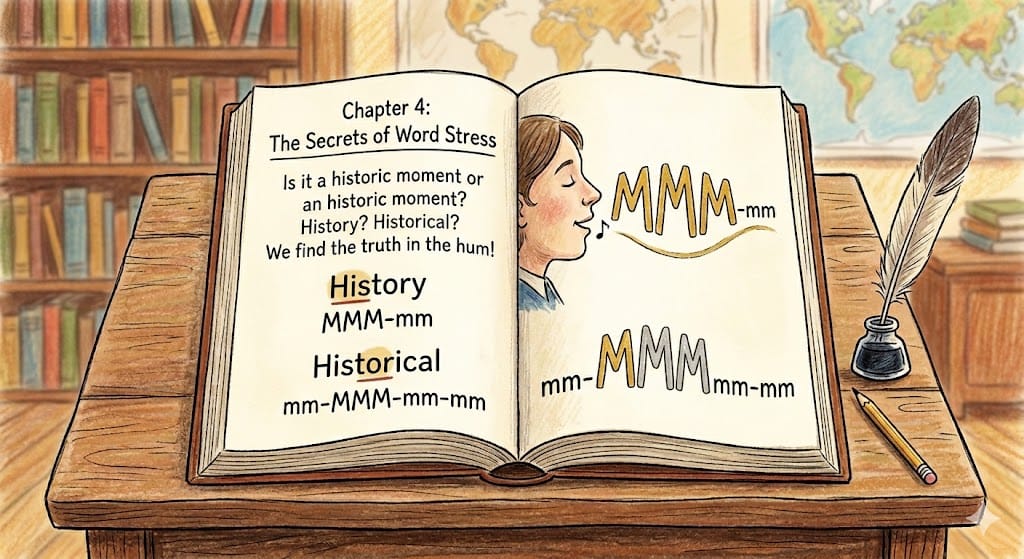
If you are having trouble finding the stressed syllable, try this trick: Hum the word!
Instead of speaking the word, close your mouth and make a humming sound ("Mmm").
Hum the word history: MMM-mm .
Hum the word historical: mm-MMM-mm-mm.
When you take away the letters and just hum the "music" of the word, it is much easier to hear which part is the longest and loudest.
English rhythm takes time to learn, but once you start listening for the "music" of the words, your pronunciation will sound much more natural!
[
{
"title": "Syllable Stress Speed Run: Phonetic Edition",
"questions": [
{
"category": "3-Syllable Words",
"question": "Where is the stress in the word 'tomorrow'?",
"options": ["[TUH-mahr-oh]", "[tuh-MAHR-oh]", "[tuh-mahr-OH]", "[TOO-mahr-oh]"],
"answer": "[tuh-MAHR-oh]",
"explanation": "The stress is on the second syllable: [tuh-MAHR-oh]."
},
{
"category": "3-Syllable Words",
"question": "Where is the stress in the word 'computer'?",
"options": ["[KUHM-pyoo-ter]", "[kuhm-PYOO-ter]", "[kuhm-pyoo-TER]", "[KOM-pyoo-ter]"],
"answer": "[kuhm-PYOO-ter]",
"explanation": "The stress is on the second syllable: [kuhm-PYOO-ter]."
},
{
"category": "3-Syllable Words",
"question": "Where is the stress in the word 'expensive'?",
"options": ["[IK-spen-siv]", "[ik-SPEN-siv]", "[ik-spen-SIV]", "[EK-spen-siv]"],
"answer": "[ik-SPEN-siv]",
"explanation": "The stress is on the second syllable: [ik-SPEN-siv]."
},
{
"category": "3-Syllable Words",
"question": "Where is the stress in the word 'beautiful'?",
"options": ["[BYOO-tuh-fuhl]", "[byoo-TUH-fuhl]", "[byoo-tuh-FUHL]", "[BEE-yoo-tuh-fuhl]"],
"answer": "[BYOO-tuh-fuhl]",
"explanation": "The stress is on the first syllable: [BYOO-tuh-fuhl]."
},
{
"category": "4-Syllable Words",
"question": "Where is the stress in the word 'interesting'?",
"options": ["[IN-ter-uh-sting]", "[in-TER-uh-sting]", "[in-ter-UH-sting]", "[in-ter-uh-STING]"],
"answer": "[IN-ter-uh-sting]",
"explanation": "The stress is on the first syllable: [IN-ter-uh-sting]."
},
{
"category": "3-Syllable Words",
"question": "Where is the stress in the word 'banana'?",
"options": ["[BUH-nan-uh]", "[buh-NAN-uh]", "[buh-nan-UH]", "[BAH-nan-uh]"],
"answer": "[buh-NAN-uh]",
"explanation": "The stress is on the second syllable: [buh-NAN-uh]."
},
{
"category": "3-Syllable Words",
"question": "Where is the stress in the word 'understand'?",
"options": ["[UHN-der-stand]", "[uhn-DER-stand]", "[uhn-der-STAND]", "[OON-der-stand]"],
"answer": "[uhn-der-STAND]",
"explanation": "The stress is on the final syllable: [uhn-der-STAND]."
},
{
"category": "4-Syllable Words",
"question": "Where is the stress in the word 'information'?",
"options": ["[IN-fer-mey-shuhn]", "[in-FER-mey-shuhn]", "[in-fer-MEY-shuhn]", "[in-fer-mey-SHUHN]"],
"answer": "[in-fer-MEY-shuhn]",
"explanation": "Words ending in -tion usually have stress on the syllable right before it: [in-fer-MEY-shuhn]."
},
{
"category": "2-Syllable Words",
"question": "Where is the stress in the word 'hotel'?",
"options": ["[HOH-tel]", "[hoh-TEL]", "[HAW-tel]", "[haw-TEL]"],
"answer": "[hoh-TEL]",
"explanation": "The stress is on the second syllable: [hoh-TEL]."
},
{
"category": "2-Syllable Words",
"question": "Where is the stress in the word 'police'?",
"options": ["[PUH-lees]", "[puh-LEES]", "[POH-lees]", "[poh-LEES]"],
"answer": "[puh-LEES]",
"explanation": "The stress is on the second syllable: [puh-LEES]."
},
{
"category": "2-Syllable Words",
"question": "Where is the stress in the word 'happen'?",
"options": ["[HAP-uhn]", "[hap-UHN]", "[HEY-puhn]", "[hey-PUHN]"],
"answer": "[HAP-uhn]",
"explanation": "The stress is on the first syllable: [HAP-uhn]."
},
{
"category": "2-Syllable Words",
"question": "Where is the stress in the word 'begin'?",
"options": ["[BIH-gin]", "[bih-GIN]", "[BEE-gin]", "[bee-GIN]"],
"answer": "[bih-GIN]",
"explanation": "The stress is on the second syllable: [bih-GIN]."
},
{
"category": "2-Syllable Words",
"question": "Where is the stress in the word 'decide'?",
"options": ["[DIH-sahyd]", "[dih-SAHYD]", "[DEE-sahyd]", "[dee-SAHYD]"],
"answer": "[dih-SAHYD]",
"explanation": "The stress is on the second syllable: [dih-SAHYD]."
},
{
"category": "3-Syllable Words",
"question": "Where is the stress in the word 'photograph'?",
"options": ["[FOH-tuh-graf]", "[foh-TUH-graf]", "[foh-tuh-GRAF]", "[FOU-toh-graf]"],
"answer": "[FOH-tuh-graf]",
"explanation": "The stress is on the first syllable: [FOH-tuh-graf]."
},
{
"category": "4-Syllable Words",
"question": "Where is the stress in the word 'photographer'?",
"options": ["[FUH-tog-ruh-fer]", "[fuh-TOG-ruh-fer]", "[fuh-tog-RUH-fer]", "[fuh-tog-ruh-FER]"],
"answer": "[fuh-TOG-ruh-fer]",
"explanation": "The stress shifts to the second syllable in 'photographer': [fuh-TOG-ruh-fer]."
},
{
"category": "3-Syllable Words",
"question": "Where is the stress in the word 'vegetable'?",
"options": ["[VEJ-tuh-buhl]", "[vej-TUH-buhl]", "[vej-tuh-BUHL]", "[VEJ-eh-tuh-buhl]"],
"answer": "[VEJ-tuh-buhl]",
"explanation": "The stress is on the first syllable: [VEJ-tuh-buhl]."
},
{
"category": "4-Syllable Words",
"question": "Where is the stress in the word 'comfortable'?",
"options": ["[KUHM-fer-tuh-buhl]", "[kuhm-FER-tuh-buhl]", "[kuhm-fer-TUH-buhl]", "[kuhm-fer-tuh-BUHL]"],
"answer": "[KUHM-fer-tuh-buhl]",
"explanation": "The stress is heavily placed on the first syllable: [KUHM-fer-tuh-buhl]."
},
{
"category": "3-Syllable Words",
"question": "Where is the stress in the word 'yesterday'?",
"options": ["[YES-ter-dey]", "[yes-TER-dey]", "[yes-ter-DEY]", "[YES-tuh-dey]"],
"answer": "[YES-ter-dey]",
"explanation": "The stress is on the first syllable: [YES-ter-dey]."
},
{
"category": "3-Syllable Words",
"question": "Where is the stress in the word 'volunteer'?",
"options": ["[VOL-uhn-teer]", "[vol-UHN-teer]", "[vol-uhn-TEER]", "[VOH-luhn-teer]"],
"answer": "[vol-uhn-TEER]",
"explanation": "Words ending in -eer typically carry the stress on the final syllable: [vol-uhn-TEER]."
},
{
"category": "3-Syllable Words",
"question": "Where is the stress in the word 'Japanese'?",
"options": ["[JAP-uh-neez]", "[jap-UH-neez]", "[jap-uh-NEEZ]", "[JAH-puh-neez]"],
"answer": "[jap-uh-NEEZ]",
"explanation": "Words ending in -ese usually have the stress on the final syllable: [jap-uh-NEEZ]."
},
{
"category": "3-Syllable Words",
"question": "Where is the stress in the word 'delicious'?",
"options": ["[DIH-lish-uhs]", "[dih-LISH-uhs]", "[dih-lish-UHS]", "[DEE-lish-uhs]"],
"answer": "[dih-LISH-uhs]",
"explanation": "The stress is on the second syllable: [dih-LISH-uhs]."
},
{
"category": "3-Syllable Words",
"question": "Where is the stress in the word 'imagine'?",
"options": ["[IH-maj-in]", "[ih-MAJ-in]", "[ih-maj-IN]", "[EE-maj-in]"],
"answer": "[ih-MAJ-in]",
"explanation": "The stress is on the second syllable: [ih-MAJ-in]."
},
{
"category": "4-Syllable Words",
"question": "Where is the stress in the word 'dictionary'?",
"options": ["[DIK-shuh-ner-ee]", "[dik-SHUH-ner-ee]", "[dik-shuh-NER-ee]", "[dik-shuh-ner-EE]"],
"answer": "[DIK-shuh-ner-ee]",
"explanation": "The primary stress is on the first syllable: [DIK-shuh-ner-ee]."
},
{
"category": "3-Syllable Words",
"question": "Where is the stress in the word 'important'?",
"options": ["[IM-pawr-tuhnt]", "[im-PAWR-tuhnt]", "[im-pawr-TUHNT]", "[IM-por-tuhnt]"],
"answer": "[im-PAWR-tuhnt]",
"explanation": "The stress is on the second syllable: [im-PAWR-tuhnt]."
},
{
"category": "3-Syllable Words",
"question": "Where is the stress in the word 'family'?",
"options": ["[FAM-uh-lee]", "[fam-UH-lee]", "[fam-uh-LEE]", "[FAH-mih-lee]"],
"answer": "[FAM-uh-lee]",
"explanation": "The stress is on the first syllable: [FAM-uh-lee]."
},
{
"category": "3-Syllable Words",
"question": "Where is the stress in the word 'develop'?",
"options": ["[DIH-vel-uhp]", "[dih-VEL-uhp]", "[dih-vel-UHP]", "[DEE-vel-uhp]"],
"answer": "[dih-VEL-uhp]",
"explanation": "The stress is on the second syllable: [dih-VEL-uhp]."
},
{
"category": "3-Syllable Words",
"question": "Where is the stress in the word 'hospital'?",
"options": ["[HOS-pi-tuhl]", "[hos-PI-tuhl]", "[hos-pi-TUHL]", "[HOHS-pi-tuhl]"],
"answer": "[HOS-pi-tuhl]",
"explanation": "The stress is on the first syllable: [HOS-pi-tuhl]."
},
{
"category": "3-Syllable Words",
"question": "Where is the stress in the word 'engineer'?",
"options": ["[EN-juh-neer]", "[en-JUH-neer]", "[en-juh-NEER]", "[IN-juh-neer]"],
"answer": "[en-juh-NEER]",
"explanation": "Words ending in -eer typically carry the stress on the final syllable: [en-juh-NEER]."
},
{
"category": "3-Syllable Words",
"question": "Where is the stress in the word 'idea'?",
"options": ["[AHY-dee-uh]", "[ahy-DEE-uh]", "[ahy-dee-UH]", "[AHY-dyuh]"],
"answer": "[ahy-DEE-uh]",
"explanation": "The stress is on the second syllable: [ahy-DEE-uh]."
},
{
"category": "3-Syllable Words",
"question": "Where is the stress in the word 'umbrella'?",
"options": ["[UHM-brel-uh]", "[uhm-BREL-uh]", "[uhm-brel-UH]", "[UHM-bruh-luh]"],
"answer": "[uhm-BREL-uh]",
"explanation": "The stress is on the second syllable: [uhm-BREL-uh]."
}
]
}
]