Learn how to talk about temple practices in English.
{
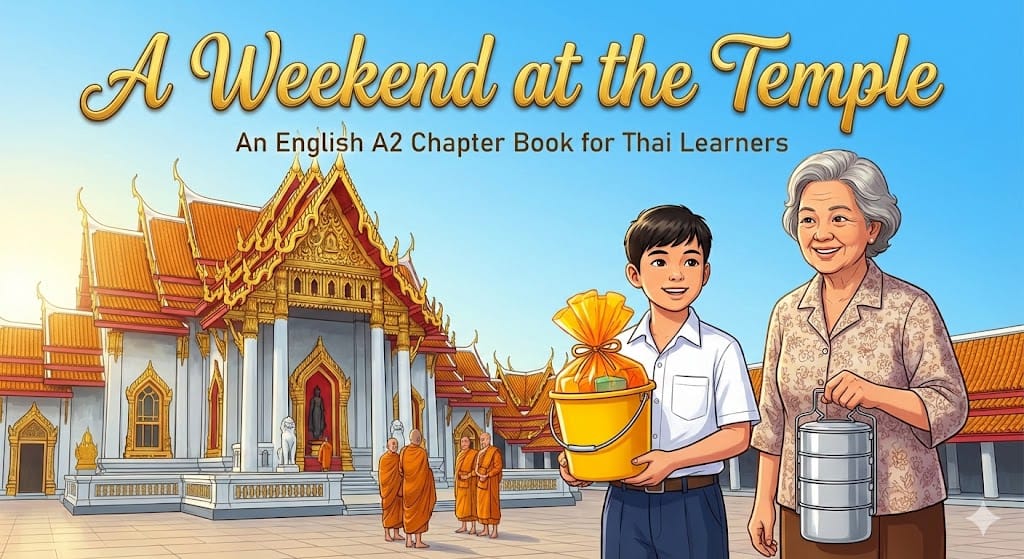
"title": "A Weekend at the Temple",
"language": "en",
"subtitle": "An English A2 Chapter Book for Thai Learners",
"chapters": [
{
"id": "chapter-1",
"title": "Chapter 1: The Early Morning Kitchen",
"content": [
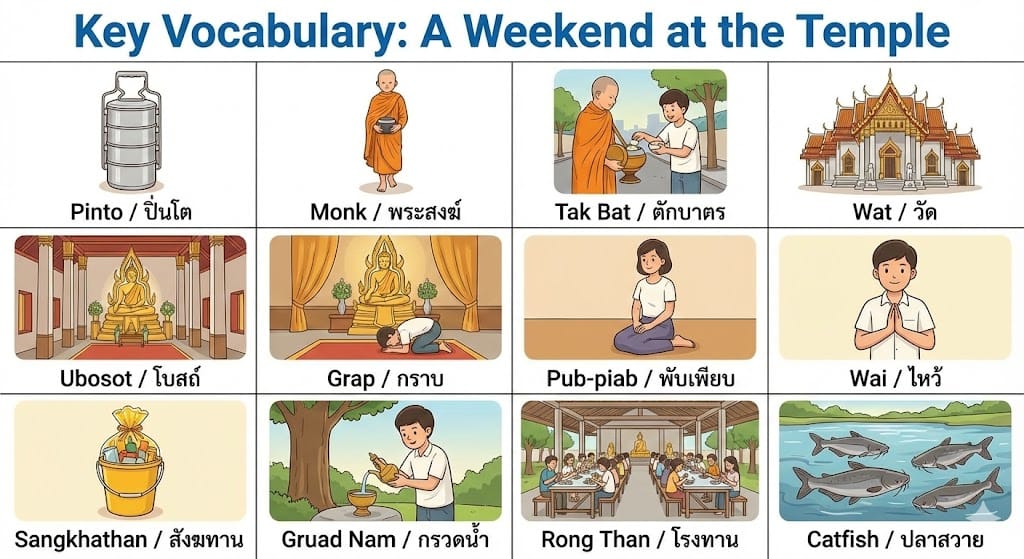
"Kla woke up at 5:00 AM. It was very dark outside. In the kitchen, his grandma was already cooking. The smell of jasmine rice and spicy green curry filled the air. Kla helped his grandma put the food into a \"Pinto.\" A Pinto is a traditional stacked lunch box made of metal.",
"\"We must hurry, Kla,\" Grandma said. \"The monks will walk past our house soon.\" Kla was sleepy, but he was happy. He wanted to make merit today. He put on a clean white shirt. It is important to look neat and polite."
],
"translation": "กล้าตื่นนอนตอนตี 5 ข้างนอกยังมืดสนิท ในห้องครัว คุณย่าของเขากำลังทำอาหารอยู่ กลิ่นหอมของข้าวหอมมะลิและแกงเขียวหวานรสเผ็ดอบอวลไปทั่ว กล้าช่วยคุณย่าตักอาหารใส่ \"ปิ่นโต\" ปิ่นโตคือกล่องใส่อาหารแบบซ้อนกันทำจากโลหะ \"เราต้องรีบแล้วนะกล้า\" ย่าพูด \"พระสงฆ์กำลังจะเดินผ่านหน้าบ้านเราเร็วๆ นี้\" กล้ารู้สึกง่วงนอนแต่เขาก็มีความสุข เขาอยากจะทำบุญในวันนี้ เขาใส่เสื้อเชิ้ตสีขาวสะอาด มันสำคัญมากที่จะต้องดูเรียบร้อยและสุภาพ",
"quiz": [
{
"question": "1. What time did Kla wake up?",
"options": [
{ "text": "a) 7:00 AM", "value": "wrong" },
{ "text": "b) 5:00 AM", "value": "correct" },
{ "text": "c) 9:00 AM", "value": "wrong" }
]
},
{
"question": "2. What is a \"Pinto\"?",
"options": [
{ "text": "a) A type of spicy curry", "value": "wrong" },
{ "text": "b) A stacked lunch box", "value": "correct" },
{ "text": "c) A monk's robe", "value": "wrong" }
]
},
{
"question": "3. True or False: Kla put on a dirty shirt.",
"options": [
{ "text": "a) True", "value": "wrong" },
{ "text": "b) False", "value": "correct" }
]
}
]
},
{
"id": "chapter-2",
"title": "Chapter 2: Waiting for the Monks",
"content": [
"Kla and Grandma stood in front of their house. They took off their shoes and waited on the pavement. Soon, a line of monks walked down the street. The monks wore saffron (orange) robes. They walked very quietly without shoes. This tradition is called \"Tak Bat\" or alms-giving.",
"Kla felt a little nervous. He put rice and curry into the monks' bowls carefully. He did not touch the monks. The monks did not say \"thank you.\" Instead, they gave a blessing in the Pali language. Kla bowed his head to show respect."
],
"translation": "กล้าและย่ายืนอยู่ที่หน้าบ้าน พวกเขาถอดรองเท้าและรออยู่บนทางเท้า ไม่นานนัก แถวของพระสงฆ์ก็เดินมาตามถนน พระสงฆ์ห่มจีวรสีส้ม (สีเหลืองทอง) พวกท่านเดินอย่างเงียบสงบโดยไม่สวมรองเท้า ประเพณีนี้เรียกว่า \"ตักบาตร\" หรือการให้ทาน กล้ารู้สึกประหม่านิดหน่อย เขาตักข้าวและแกงใส่ลงในบาตรพระอย่างระมัดระวัง เขาไม่ได้ถูกตัวพระสงฆ์ พระสงฆ์ไม่ได้พูดว่า \"ขอบคุณ\" แต่ท่านให้พรเป็นภาษาบาลีแทน กล้าก้มศีรษะลงเพื่อแสดงความเคารพ",
"quiz": [
{
"question": "1. What color robes do the monks wear?",
"options": [
{ "text": "a) Blue", "value": "wrong" },
{ "text": "b) White", "value": "wrong" },
{ "text": "c) Orange (Saffron)", "value": "correct" }
]
},
{
"question": "2. What is the tradition called?",
"options": [
{ "text": "a) Tak Bat", "value": "correct" },
{ "text": "b) Songkran", "value": "wrong" },
{ "text": "c) Loy Krathong", "value": "wrong" }
]
},
{
"question": "3. True or False: The monks walked with shoes on.",
"options": [
{ "text": "a) True", "value": "wrong" },
{ "text": "b) False", "value": "correct" }
]
}
]
},
{
"id": "chapter-3",
"title": "Chapter 3: At the Temple Gate",
"content": [
"After breakfast, the family drove to the local temple. The temple is called a \"Wat\" in Thai. Before they entered, Kla checked his clothes. \"Are you wearing shorts?\" Grandma asked. Kla shook his head. \"No, I am wearing long trousers.\"",
"In Thai culture, you must dress politely at the temple. Men should wear long pants. Women must cover their shoulders and knees. It is rude to show too much skin in a holy place. They walked through the beautifully decorated gate. There were statues of giant guardians protecting the entrance."
],
"translation": "หลังจากมื้อเช้า ครอบครัวก็ขับรถไปที่วัดในท้องถิ่น ศาสนสถานนี้เรียกว่า \"Wat\" ในภาษาไทย ก่อนที่จะเข้าไปข้างใน กล้าสำรวจเสื้อผ้าของเขา \"หลานใส่กางเกงขาสั้นหรือเปล่า?\" ย่าถาม กล้าส่ายหน้า \"ไม่ครับ ผมใส่กางเกงขายาว\" ในวัฒนธรรมไทย คุณต้องแต่งกายอย่างสุภาพที่วัด ผู้ชายควรใส่กางเกงขายาว ผู้หญิงต้องปกปิดไหล่และหัวเข่า ถือเป็นเรื่องหยาบคายหากโชว์ผิวหนังมากเกินไปในสถานที่ศักดิ์สิทธิ์ พวกเขาเดินผ่านประตูที่ตกแต่งอย่างสวยงาม มีรูปปั้นยักษ์คอยปกป้องทางเข้าอยู่",
"quiz": [
{
"question": "1. What is a temple called in Thai?",
"options": [
{ "text": "a) Ban", "value": "wrong" },
{ "text": "b) Wat", "value": "correct" },
{ "text": "c) Rong Rian", "value": "wrong" }
]
},
{
"question": "2. Why did Kla wear long trousers?",
"options": [
{ "text": "a) Because it was cold", "value": "wrong" },
{ "text": "b) To be polite", "value": "correct" },
{ "text": "c) Because he likes fashion", "value": "wrong" }
]
},
{
"question": "3. True or False: Women should cover their shoulders.",
"options": [
{ "text": "a) True", "value": "correct" },
{ "text": "b) False", "value": "wrong" }
]
}
]
},
{
"id": "chapter-4",
"title": "Chapter 4: The Golden Buddha",
"content": [
"They walked to the main hall, called the \"Ubosot.\" Kla took off his shoes and left them on the steps. Inside, the room was very beautiful. There was a huge, golden Buddha statue sitting in the center.",
"The statue looked peaceful. The floor was covered with a soft red carpet. Kla walked on his knees to move forward. He did not stand up tall, because he wanted to be lower than the Buddha. He sat down and prostrated three times. This is called \"Grap.\" He touched his forehead to the floor to show his highest respect."
],
"translation": "พวกเขาเดินไปที่พระอุโบสถ ซึ่งเรียกว่า \"โบสถ์\" กล้าถอดรองเท้าและวางไว้ที่บันได ภายในห้องสวยงามมาก มีพระพุทธรูปองค์ใหญ่สีทองประดิษฐานอยู่ตรงกลาง องค์พระดูสงบ พื้นปูด้วยพรมสีแดงนุ่มๆ กล้าเดินเข่าเพื่อขยับไปข้างหน้า เขาไม่ยืนค้ำหัว เพราะเขาต้องการอยู่ต่ำกว่าพระพุทธรูป เขานั่งลงและกราบสามครั้ง สิ่งนี้เรียกว่า \"กราบ\" เขาจรดหน้าผากลงกับพื้นเพื่อแสดงความเคารพสูงสุด",
"quiz": [
{
"question": "1. Where did Kla leave his shoes?",
"options": [
{ "text": "a) In the car", "value": "wrong" },
{ "text": "b) On the steps", "value": "correct" },
{ "text": "c) He kept them on", "value": "wrong" }
]
},
{
"question": "2. How many times did Kla bow (prostrate)?",
"options": [
{ "text": "a) One time", "value": "wrong" },
{ "text": "b) Two times", "value": "wrong" },
{ "text": "c) Three times", "value": "correct" }
]
},
{
"question": "3. True or False: The Buddha statue was made of wood.",
"options": [
{ "text": "a) True", "value": "wrong" },
{ "text": "b) False", "value": "correct" }
]
}
]
},
{
"id": "chapter-5",
"title": "Chapter 5: Listening to the Chants",
"content": [
"Many people sat on the floor together. The monks sat on a raised platform. They began to chant. The sound was low and rhythmic. They were speaking Pali, an ancient language from India. Kla did not understand the words, but the sound made him feel calm.",
"He sat in a polite position called \"Pub-piab.\" His legs were folded to one side, like a mermaid. He put his hands together in a prayer position near his chest. This hand position is called a \"Wai.\" Everyone was quiet and listened to the monks sharing the Buddha's teachings."
],
"translation": "ผู้คนมากมายนั่งบนพื้นด้วยกัน พระสงฆ์นั่งบนอาสนะที่ยกสูงขึ้น ท่านเริ่มสวดมนต์ เสียงนั้นทุ้มและเป็นจังหวะ ท่านกำลังพูดภาษาบาลี ซึ่งเป็นภาษาโบราณจากอินเดีย กล้าไม่เข้าใจความหมายของคำ แต่เสียงนั้นทำให้เขารู้สึกสงบ เขานั่งในท่าสุภาพที่เรียกว่า \"พับเพียบ\" ขาของเขาพับไปด้านหนึ่ง เหมือนนางเงือก เขาพนมมือไว้ที่หน้าอก ท่ามือแบบนี้เรียกว่า \"ไหว้\" ทุกคนเงียบและฟังพระสงฆ์ถ่ายทอดคำสอนของพระพุทธเจ้า",
"quiz": [
{
"question": "1. What language do the monks chant in?",
"options": [
{ "text": "a) Thai", "value": "wrong" },
{ "text": "b) English", "value": "wrong" },
{ "text": "c) Pali", "value": "correct" }
]
},
{
"question": "2. What is the sitting position called?",
"options": [
{ "text": "a) Cross-legged", "value": "wrong" },
{ "text": "b) Pub-piab", "value": "correct" },
{ "text": "c) Standing", "value": "wrong" }
]
},
{
"question": "3. True or False: Kla understood every word of the chant.",
"options": [
{ "text": "a) True", "value": "wrong" },
{ "text": "b) False", "value": "correct" }
]
}
]
},
{
"id": "chapter-6",
"title": "Chapter 6: The Yellow Bucket",
"content": [
"After the chanting, it was time to give offerings. Kla picked up a bright yellow bucket. It was wrapped in orange cellophane. This is called \"Sangkhathan.\" Inside the bucket, there were useful things for the monks. Kla saw toothpaste, soap, candles, washing powder, and a torch.",
"\"Monks cannot go shopping like us,\" Grandma explained. \"So we give them things they need for daily life.\" Kla walked on his knees to the monk. He offered the yellow bucket with both hands. The monk accepted it and gave Kla a small blessing."
],
"translation": "หลังจากการสวดมนต์ ก็ถึงเวลาถวายของ กล้าหยิบถังสีเหลืองสดใสที่ห่อด้วยพลาสติกใสสีส้ม สิ่งนี้เรียกว่า \"สังฆทาน\" ภายในถังมีของใช้ที่เป็นประโยชน์สำหรับพระสงฆ์ กล้าเห็นยาสีฟัน สบู่ เทียน ผงซักฟอก และไฟฉาย \"พระสงฆ์ไม่สามารถไปเดินซื้อของเหมือนเราได้\" ย่าอธิบาย \"ดังนั้นเราจึงถวายสิ่งของที่ท่านจำเป็นต้องใช้ในชีวิตประจำวัน\" กล้าเดินเข่าเข้าไปหาพระสงฆ์ เขาถวายถังสีเหลืองด้วยสองมือ พระสงฆ์รับประเคนและให้พรเล็กๆ แก่กล้า",
"quiz": [
{
"question": "1. What is the yellow bucket offering called?",
"options": [
{ "text": "a) Sangkhathan", "value": "correct" },
{ "text": "b) Pinto", "value": "wrong" },
{ "text": "c) Tuk-tuk", "value": "wrong" }
]
},
{
"question": "2. Why do people give these buckets?",
"options": [
{ "text": "a) To decorate the temple", "value": "wrong" },
{ "text": "b) Because monks cannot go shopping", "value": "correct" },
{ "text": "c) To pay for entrance", "value": "wrong" }
]
},
{
"question": "3. True or False: The bucket contained toys and candy.",
"options": [
{ "text": "a) True", "value": "wrong" },
{ "text": "b) False", "value": "correct" }
]
}
]
},
{
"id": "chapter-7",
"title": "Chapter 7: Pouring the Water",
"content": [
"While the monks chanted a final blessing, Grandma handed Kla a small brass bottle and a bowl. \"Now we do the Gruad Nam,\" she whispered. As the monks chanted, Kla slowly poured water from the bottle into the bowl.",
"He focused his mind. He thought about his ancestors and family members who had passed away. \"I share this merit with you,\" he thought. He did not drink the water. After the ceremony, he went outside to a large tree. He poured the water onto the earth, giving it to the spirits of the land."
],
"translation": "ขณะที่พระสงฆ์สวดให้พรจบ ย่าส่งขวดน้ำทองเหลืองเล็กๆ และขันใบหนึ่งให้กล้า \"ตอนนี้เราจะกรวดน้ำกัน\" เธอกระซิบ ขณะที่พระสวด กล้าค่อยๆ รินน้ำจากขวดลงในขัน เขาตั้งสมาธิ เขานึกถึงบรรพบุรุษและสมาชิกในครอบครัวที่ล่วงลับไปแล้ว \"ผมขอแบ่งบุญนี้ให้แก่ท่าน\" เขาคิด เขาไม่ได้ดื่มน้ำนั้น หลังจากเสร็จพิธี เขาออกไปข้างนอกที่ต้นไม้ใหญ่ เทน้ำลงสู่พื้นดิน เพื่ออุทิศให้แก่แม่พระธรณี",
"quiz": [
{
"question": "1. What is the ceremony called?",
"options": [
{ "text": "a) Wai Phra", "value": "wrong" },
{ "text": "b) Gruad Nam", "value": "correct" },
{ "text": "c) Len Nam", "value": "wrong" }
]
},
{
"question": "2. Who did Kla think about?",
"options": [
{ "text": "a) His friends at school", "value": "wrong" },
{ "text": "b) His ancestors", "value": "correct" },
{ "text": "c) His dinner", "value": "wrong" }
]
},
{
"question": "3. True or False: Kla drank the water after pouring it.",
"options": [
{ "text": "a) True", "value": "wrong" },
{ "text": "b) False", "value": "correct" }
]
}
]
},
{
"id": "chapter-8",
"title": "Chapter 8: Temple Food",
"content": [
"It was now almost noon. The monks had finished eating their one meal of the day. Now, the visitors could eat the leftover food. There was a large open hall with many tables. This is called the \"Rong Than\" or alms house.",
"The food was free for everyone. Kla ate some stir-fried vegetables and rice noodles. It was delicious but very spicy! People sat together like a big family. Rich people and poor people ate the same food. After eating, Kla washed his own plate and spoon. Everyone helps to keep the temple clean."
],
"translation": "ตอนนี้เกือบเที่ยงแล้ว พระสงฆ์ฉันภัตตาหารมื้อเดียวของวันเสร็จเรียบร้อย ตอนนี้ผู้มาเยือนสามารถทานอาหารที่เหลือได้ มีศาลาโล่งขนาดใหญ่ที่มีโต๊ะมากมาย สิ่งนี้เรียกว่า \"โรงทาน\" อาหารที่นี่ฟรีสำหรับทุกคน กล้าทานผัดผักและก๋วยเตี๋ยวเส้นเล็ก มันอร่อยมากแต่เผ็ดสุดๆ! ผู้คนนั่งด้วยกันเหมือนครอบครัวใหญ่ คนรวยและคนจนทานอาหารแบบเดียวกัน หลังจากทานเสร็จ กล้าล้างจานและช้อนของตัวเอง ทุกคนช่วยกันรักษาความสะอาดวัด",
"quiz": [
{
"question": "1. What is the eating area called?",
"options": [
{ "text": "a) Rong Than", "value": "correct" },
{ "text": "b) Restaurant", "value": "wrong" },
{ "text": "c) Supermarket", "value": "wrong" }
]
},
{
"question": "2. How much did the food cost?",
"options": [
{ "text": "a) 100 Baht", "value": "wrong" },
{ "text": "b) It was free", "value": "correct" },
{ "text": "c) 50 Baht", "value": "wrong" }
]
},
{
"question": "3. True or False: Kla left his dirty plate on the table.",
"options": [
{ "text": "a) True", "value": "wrong" },
{ "text": "b) False", "value": "correct" }
]
}
]
},
{
"id": "chapter-9",
"title": "Chapter 9: Feeding the Fish",
"content": [
"Behind the temple, there was a wide river. Many people were standing on the pier. \"Let's make more merit,\" Grandma said. She bought a bag of fish food pellets and a loaf of bread. Kla threw the bread into the water.",
"Suddenly, the water splashed! Hundreds of fish came to the surface. They were huge catfish. In Thailand, temples near rivers are safe zones for fish. No one catches them here. Kla felt happy watching the fish eat. He learned that being kind to animals is a good way to make merit and clean the heart."
],
"translation": "ด้านหลังวัดมีแม่น้ำกว้างใหญ่ ผู้คนมากมายยืนอยู่บนท่าน้ำ \"ไปทำบุญเพิ่มกันเถอะ\" ย่าชวน เธอซื้อถุงอาหารปลาและขนมปังแถวหนึ่ง กล้าโยนขนมปังลงไปในน้ำ ทันใดนั้นน้ำก็แตกกระจาย! ปลาเป็นร้อยๆ ตัวโผล่ขึ้นมาบนผิวน้ำ พวกมันคือปลาสวายตัวใหญ่ ในประเทศไทย วัดที่อยู่ติดแม่น้ำคือเขตอภัยทานสำหรับปลา ไม่มีใครจับปลาที่นี่ กล้ารู้สึกมีความสุขที่ได้มองดูปลากินอาหาร เขาเรียนรู้ว่าการเมตตาต่อสัตว์เป็นวิธีที่ดีในการทำบุญและชำระล้างจิตใจ",
"quiz": [
{
"question": "1. Where did they go after lunch?",
"options": [
{ "text": "a) To the cinema", "value": "wrong" },
{ "text": "b) To the river behind the temple", "value": "correct" },
{ "text": "c) To the market", "value": "wrong" }
]
},
{
"question": "2. What kind of fish did Kla see?",
"options": [
{ "text": "a) Goldfish", "value": "wrong" },
{ "text": "b) Catfish", "value": "correct" },
{ "text": "c) Sharks", "value": "wrong" }
]
},
{
"question": "3. True or False: People catch and eat the fish at the temple.",
"options": [
{ "text": "a) True", "value": "wrong" },
{ "text": "b) False", "value": "correct" }
]
}
]
},
{
"id": "chapter-10",
"title": "Chapter 10: A Peaceful Heart",
"content": [
"It was time to go home. Kla sat in the car feeling very relaxed. \"How do you feel?\" Grandma asked. \"I feel 'Sabai Jai',\" Kla answered. In English, this means he has a comfortable and happy heart. He had woken up early, given food to monks, listened to wisdom, and fed the fish.",
"He took out his phone to text his foreign friend, Tom. He wanted to tell Tom all about his weekend. \"Making merit is not just about giving things,\" Kla wrote. \"It is about making your own mind happy and peaceful.\""
],
"translation": "ได้เวลากลับบ้านแล้ว กล้านั่งในรถด้วยความรู้สึกผ่อนคลายมาก \"หลานรู้สึกยังไงบ้าง?\" ย่าถาม \"ผมรู้สึก 'สบายใจ' ครับ\" กล้าตอบ ในภาษาอังกฤษ คำนี้หมายถึงเขามีจิตใจที่สุขสบายและมีความสุข เขาตื่นแต่เช้า ใส่บาตรพระ ฟังธรรม และให้อาหารปลา เขาหยิบโทรศัพท์ขึ้นมาเพื่อส่งข้อความหา ทอม เพื่อนชาวต่างชาติของเขา เขาอยากเล่าเรื่องวันหยุดสุดสัปดาห์ให้ทอมฟัง \"การทำบุญไม่ใช่แค่การให้สิ่งของนะ\" กล้าเขียน \"แต่มันคือการทำให้จิตใจของเราเองมีความสุขและสงบ\"",
"quiz": [
{
"question": "1. What Thai phrase describes Kla's feeling?",
"options": [
{ "text": "a) Sabai Jai", "value": "correct" },
{ "text": "b) Mai Pen Rai", "value": "wrong" },
{ "text": "c) Sawasdee", "value": "wrong" }
]
},
{
"question": "2. Who did Kla text?",
"options": [
{ "text": "a) His teacher", "value": "wrong" },
{ "text": "b) His friend Tom", "value": "correct" },
{ "text": "c) His brother", "value": "wrong" }
]
},
{
"question": "3. True or False: Kla learned that merit is only about giving money.",
"options": [
{ "text": "a) True", "value": "wrong" },
{ "text": "b) False", "value": "correct" }
]
}
]
}
]
}