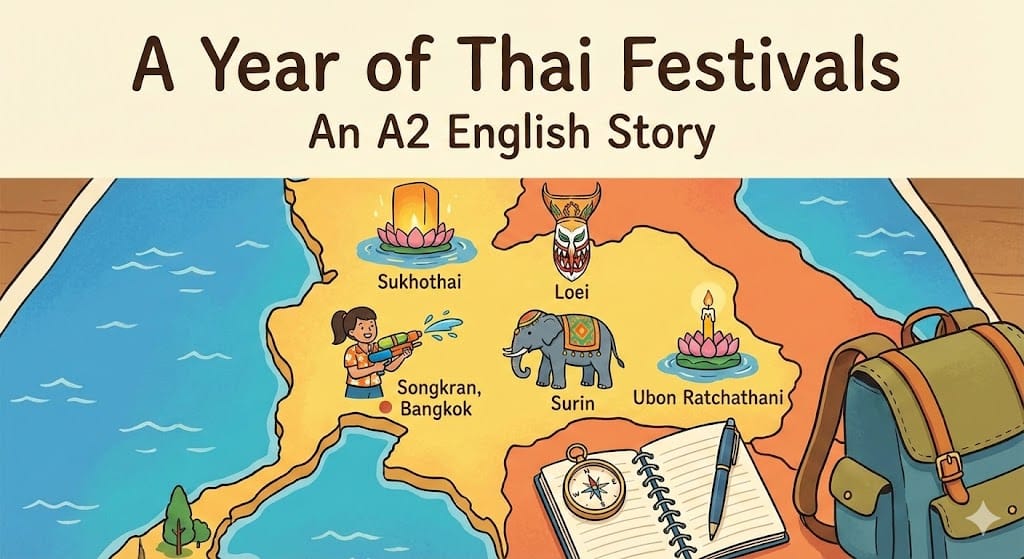
Immerse yourself in Thailand’s rich culture with this beginner-friendly English story! Follow a traveler’s diary through 12 vibrant provinces and festivals, complete with Thai translations and comprehension quizzes.
{
"title": "A Year of Thai Festivals",
"language": "en",
"subtitle": "An English A2 Chapter Book",
"chapters": [
{
"id": "chapter-1",
"title": "Chapter 1: Nakhon Sawan (January)",
"content": [
"Dear Diary, my journey begins in January! I am in Nakhon Sawan for the Chinese New Year festival. The streets are decorated with red lanterns. I watched a long, colourful dragon dance through the city.",
"People wear red clothes for good luck. I ate tasty steamed buns and sweet cakes. The sound of drums and firecrackers is very loud. It is a very happy and busy start to my year in Thailand!"
],
"translation": "ไดอารี่ที่รัก การเดินทางของฉันเริ่มต้นในเดือนมกราคม! ฉันอยู่ที่นครสวรรค์สำหรับเทศกาลตรุษจีน ถนนประดับด้วยโคมไฟสีแดง ฉันดูการเชิดมังกรที่มีสีสันยาวเหยียดไปทั่วเมือง ผู้คนสวมเสื้อผ้าสีแดงเพื่อความโชคดี ฉันกินซาลาเปาและขนมหวานแสนอร่อย เสียงกลองและประทัดดังมาก มันเป็นการเริ่มต้นปีในประเทศไทยที่มีความสุขและวุ่นวายมาก!",
"quiz": [
{
"question": "1. Where is the writer in January?",
"options": [
{ "text": "a) Nakhon Sawan", "value": "correct" },
{ "text": "b) Bangkok", "value": "wrong" },
{ "text": "c) Phuket", "value": "wrong" }
]
},
{
"question": "2. True or False: People wear green for good luck.",
"options": [
{ "text": "True", "value": "wrong" },
{ "text": "False", "value": "correct" }
]
},
{
"question": "3. What animal dance did the writer see?",
"options": [
{ "text": "a) Lion", "value": "wrong" },
{ "text": "b) Dragon", "value": "correct" },
{ "text": "c) Elephant", "value": "wrong" }
]
}
]
},
{
"id": "chapter-2",
"title": "Chapter 2: Chiang Mai (February)",
"content": [
"Dear Diary, it is February, and the weather is cool. I am in Chiang Mai for the beautiful Flower Festival. The streets are full of bright colours. I see giant floats made entirely of fresh flowers!",
"There are yellow orchids, red roses, and white lotuses. Many people are wearing traditional northern Thai clothes. I listened to soft music and ate a delicious local sausage. I took so many photos to remember this wonderful day."
],
"translation": "ไดอารี่ที่รัก ตอนนี้เป็นเดือนกุมภาพันธ์และอากาศเย็นสบาย ฉันอยู่ที่เชียงใหม่เพื่อชมเทศกาลไม้ดอกไม้ประดับที่สวยงาม ท้องถนนเต็มไปด้วยสีสันสดใส ฉันเห็นขบวนรถบุปผชาติขนาดยักษ์ที่ทำจากดอกไม้สดทั้งหมด! มีกล้วยไม้สีเหลือง กุหลาบสีแดง และดอกบัวสีขาว ผู้คนมากมายสวมชุดพื้นเมืองภาคเหนือ ฉันฟังเพลงที่นุ่มนวลและกินไส้กรอกท้องถิ่นที่อร่อยมาก ฉันถ่ายรูปไว้เยอะมากเพื่อเตือนความจำถึงวันที่ยอดเยี่ยมนี้",
"quiz": [
{
"question": "1. Which month does the writer visit Chiang Mai?",
"options": [
{ "text": "a) March", "value": "wrong" },
{ "text": "b) February", "value": "correct" },
{ "text": "c) April", "value": "wrong" }
]
},
{
"question": "2. True or False: The floats are made of fresh flowers.",
"options": [
{ "text": "True", "value": "correct" },
{ "text": "False", "value": "wrong" }
]
},
{
"question": "3. What did the writer eat?",
"options": [
{ "text": "a) A local sausage", "value": "correct" },
{ "text": "b) Pad Thai", "value": "wrong" },
{ "text": "c) Spicy soup", "value": "wrong" }
]
}
]
},
{
"id": "chapter-3",
"title": "Chapter 3: Ayutthaya (March)",
"content": [
"Dear Diary, it is March. I am in the ancient city of Ayutthaya. Today, I went to the Wai Kru Muay Thai Festival. It is a special event to honor martial arts teachers.",
"Hundreds of boxers from all over the world are gathered at the old temple ruins. I watched them perform the traditional dance before fighting. The fighters wear special headbands. Thai boxing is not just a sport; it is an important part of Thai culture."
],
"translation": "ไดอารี่ที่รัก ตอนนี้เดือนมีนาคม ฉันอยู่ในเมืองโบราณอยุธยา วันนี้ฉันไปงานเทศกาลไหว้ครูมวยไทย มันเป็นงานพิเศษเพื่อยกย่องครูสอนศิลปะการต่อสู้ นักมวยหลายร้อยคนจากทั่วโลกมารวมตัวกันที่ซากวัดเก่า ฉันดูพวกเขาแสดงการร่ายรำแบบดั้งเดิมก่อนการต่อสู้ นักมวยสวมมงคลบนศีรษะ มวยไทยไม่ใช่แค่กีฬา แต่เป็นส่วนสำคัญของวัฒนธรรมไทย",
"quiz": [
{
"question": "1. Which city is the writer visiting?",
"options": [
{ "text": "a) Bangkok", "value": "wrong" },
{ "text": "b) Ayutthaya", "value": "correct" },
{ "text": "c) Surin", "value": "wrong" }
]
},
{
"question": "2. True or False: The festival honors martial arts teachers.",
"options": [
{ "text": "True", "value": "correct" },
{ "text": "False", "value": "wrong" }
]
},
{
"question": "3. What do the fighters wear on their heads?",
"options": [
{ "text": "a) Hats", "value": "wrong" },
{ "text": "b) Helmets", "value": "wrong" },
{ "text": "c) Special headbands", "value": "correct" }
]
}
]
},
{
"id": "chapter-4",
"title": "Chapter 4: Bangkok (April)",
"content": [
"Dear Diary, April is the hottest month in Thailand! I am in Bangkok for Songkran, the Thai New Year. It is a giant water fight! I bought a big water gun and wore a colourful shirt.",
"Everyone on the street is throwing water at each other. People smile, laugh, and shout 'Happy New Year!' I also went to a temple to gently pour water on a Buddha statue. This means washing away bad luck. I am completely soaked!"
],
"translation": "ไดอารี่ที่รัก เมษายนเป็นเดือนที่ร้อนที่สุดในประเทศไทย! ฉันอยู่ในกรุงเทพฯ เพื่อฉลองสงกรานต์ ปีใหม่ไทย มันคือสงครามน้ำขนาดยักษ์! ฉันซื้อปืนฉีดน้ำกระบอกใหญ่และใส่เสื้อสีสันสดใส ทุกคนบนถนนสาดน้ำใส่กัน ผู้คนยิ้ม หัวเราะ และตะโกนว่า 'สวัสดีปีใหม่!' ฉันยังไปวัดเพื่อรดน้ำพระพุทธรูปอย่างเบามือ นี่หมายถึงการชะล้างโชคร้าย ฉันเปียกโชกไปทั้งตัว!",
"quiz": [
{
"question": "1. What is Songkran?",
"options": [
{ "text": "a) A food festival", "value": "wrong" },
{ "text": "b) The Thai New Year", "value": "correct" },
{ "text": "c) A ghost festival", "value": "wrong" }
]
},
{
"question": "2. True or False: People throw snow at each other during Songkran.",
"options": [
{ "text": "True", "value": "wrong" },
{ "text": "False", "value": "correct" }
]
},
{
"question": "3. Why do people pour water on a Buddha statue?",
"options": [
{ "text": "a) To wash away bad luck", "value": "correct" },
{ "text": "b) To make it look shiny", "value": "wrong" },
{ "text": "c) To cool it down", "value": "wrong" }
]
}
]
},
{
"id": "chapter-5",
"title": "Chapter 5: Yasothon (May)",
"content": [
"Dear Diary, it is May. I traveled to Yasothon in the northeast of Thailand. I am here for the Bun Bang Fai, or the Rocket Festival. Farmers make giant rockets out of bamboo and plastic.",
"They fire them high into the sky to ask the rain gods for a good rainy season. The rockets are very loud and leave a long trail of smoke. Before the launch, there is a big parade with dancing. I hope the rain comes soon!"
],
"translation": "ไดอารี่ที่รัก ตอนนี้เดือนพฤษภาคม ฉันเดินทางไปยโสธรในภาคอีสานของประเทศไทย ฉันมาที่นี่เพื่องานบุญบั้งไฟ หรือเทศกาลจรวด ชาวนาทำบั้งไฟยักษ์จากไม้ไผ่และพลาสติก พวกเขาจุดมันขึ้นสู่ท้องฟ้าเพื่อขอฝนจากเทพเจ้าแห่งฝนสำหรับฤดูฝนที่ดี บั้งไฟเสียงดังมากและทิ้งรอยควันยาว ก่อนการปล่อย มีขบวนแห่ใหญ่พร้อมการเต้นรำ ฉันหวังว่าฝนจะตกเร็วๆ นี้!",
"quiz": [
{
"question": "1. Why do farmers fire rockets into the sky?",
"options": [
{ "text": "a) To ask for rain", "value": "correct" },
{ "text": "b) To scare away birds", "value": "wrong" },
{ "text": "c) To celebrate the moon", "value": "wrong" }
]
},
{
"question": "2. True or False: The rockets are quiet.",
"options": [
{ "text": "True", "value": "wrong" },
{ "text": "False", "value": "correct" }
]
},
{
"question": "3. In which part of Thailand is Yasothon?",
"options": [
{ "text": "a) The south", "value": "wrong" },
{ "text": "b) The north", "value": "wrong" },
{ "text": "c) The northeast", "value": "correct" }
]
}
]
},
{
"id": "chapter-6",
"title": "Chapter 6: Loei (June)",
"content": [
"Dear Diary, it is June, and I am in a small town in Loei province. I am attending the Phi Ta Khon Festival, also known as the Ghost Festival.",
"Local men wear large, colourful masks made of carved coconut tree trunks and sticky rice steamers. The masks look a little scary but also funny. The 'ghosts' dance in the street and wear loud bells around their waists. They make noise to wake up the protecting spirits."
],
"translation": "ไดอารี่ที่รัก ตอนนี้เดือนมิถุนายน และฉันอยู่ในเมืองเล็กๆ ในจังหวัดเลย ฉันเข้าร่วมงานเทศกาลผีตาโขน หรือที่รู้จักกันในชื่อเทศกาลผี ผู้ชายในท้องถิ่นสวมหน้ากากขนาดใหญ่สีสันสดใสที่ทำจากโคนต้นมะพร้าวแกะสลักและหวดนึ่งข้าวเหนียว หน้ากากดูน่ากลัวนิดหน่อยแต่ก็ตลกด้วย 'ผี' เต้นรำบนถนนและสวมกระดิ่งเสียงดังรอบเอว พวกเขาทำเสียงดังเพื่อปลุกวิญญาณคุ้มครอง",
"quiz": [
{
"question": "1. What is another name for the Phi Ta Khon Festival?",
"options": [
{ "text": "a) The Water Festival", "value": "wrong" },
{ "text": "b) The Ghost Festival", "value": "correct" },
{ "text": "c) The Light Festival", "value": "wrong" }
]
},
{
"question": "2. True or False: The masks are small and black.",
"options": [
{ "text": "True", "value": "wrong" },
{ "text": "False", "value": "correct" }
]
},
{
"question": "3. What do the 'ghosts' wear around their waists?",
"options": [
{ "text": "a) Flowers", "value": "wrong" },
{ "text": "b) Bells", "value": "correct" },
{ "text": "c) Ropes", "value": "wrong" }
]
}
]
},
{
"id": "chapter-7",
"title": "Chapter 7: Ubon Ratchathani (July)",
"content": [
"Dear Diary, it is July, the beginning of Buddhist Lent. I am visiting Ubon Ratchathani. This city is famous for its beautiful Candle Festival. Artists carve giant wax sculptures.",
"Some of the sculptures are as big as a house! The carvings show stories from the life of the Buddha. They are very detailed and bright yellow. In the evening, there is a grand parade. The large wax sculptures are pulled on trucks decorated with lights."
],
"translation": "ไดอารี่ที่รัก ตอนนี้เดือนกรกฎาคม เป็นช่วงต้นของวันเข้าพรรษา ฉันมาเที่ยวอุบลราชธานี เมืองนี้มีชื่อเสียงเรื่องเทศกาลแห่เทียนพรรษาที่สวยงาม ศิลปินแกะสลักประติมากรรมขี้ผึ้งขนาดยักษ์ ประติมากรรมบางชิ้นใหญ่เท่าบ้าน! รอยแกะสลักบอกเล่าเรื่องราวจากพุทธประวัติ มีรายละเอียดมากและเป็นสีเหลืองสว่าง ในตอนเย็นมีขบวนแห่ยิ่งใหญ่ ประติมากรรมขี้ผึ้งขนาดใหญ่ถูกลากบนรถบรรทุกที่ประดับด้วยแสงไฟ",
"quiz": [
{
"question": "1. What material are the giant sculptures made of?",
"options": [
{ "text": "a) Wax", "value": "correct" },
{ "text": "b) Ice", "value": "wrong" },
{ "text": "c) Stone", "value": "wrong" }
]
},
{
"question": "2. True or False: The sculptures tell stories about the Buddha.",
"options": [
{ "text": "True", "value": "correct" },
{ "text": "False", "value": "wrong" }
]
},
{
"question": "3. What time of day is the grand parade?",
"options": [
{ "text": "a) Morning", "value": "wrong" },
{ "text": "b) Afternoon", "value": "wrong" },
{ "text": "c) Evening", "value": "correct" }
]
}
]
},
{
"id": "chapter-8",
"title": "Chapter 8: Phichit (August)",
"content": [
"Dear Diary, it is August. It is the rainy season, so the rivers are full of water. I am in Phichit to watch the Long Boat Racing Festival. The wooden boats are very long and painted in bright colours.",
"Each boat has a team of many rowers. They row very fast while the crowd cheers loudly. It is exciting to watch them race on the river. The teamwork is amazing!"
],
"translation": "ไดอารี่ที่รัก ตอนนี้เดือนสิงหาคม เป็นฤดูฝน ดังนั้นแม่น้ำจึงเต็มไปด้วยน้ำ ฉันอยู่ที่พิจิตรเพื่อดูเทศกาลแข่งขันเรือยาว เรือไม้มีความยาวมากและทาสีด้วยสีสันสดใส เรือแต่ละลำมีทีมฝีพายหลายคน พวกเขาพายเร็วมากในขณะที่ฝูงชนเชียร์เสียงดัง น่าตื่นเต้นมากที่ได้ดูพวกเขาแข่งกันในแม่น้ำ การทำงานเป็นทีมนั้นน่าทึ่งมาก!",
"quiz": [
{
"question": "1. What month is the boat racing?",
"options": [
{ "text": "a) August", "value": "correct" },
{ "text": "b) July", "value": "wrong" },
{ "text": "c) September", "value": "wrong" }
]
},
{
"question": "2. True or False: The boats are made of plastic.",
"options": [
{ "text": "True", "value": "wrong" },
{ "text": "False", "value": "correct" }
]
},
{
"question": "3. What does the writer think is amazing?",
"options": [
{ "text": "a) The food", "value": "wrong" },
{ "text": "b) The teamwork", "value": "correct" },
{ "text": "c) The music", "value": "wrong" }
]
}
]
},
{
"id": "chapter-9",
"title": "Chapter 9: Phetchabun (September)",
"content": [
"Dear Diary, it is September. I am visiting Phetchabun for a unique festival called Um Phra Lam Nam. This means 'diving with the Buddha'.",
"The townspeople take a special Buddha statue to the river. The governor dives into the water with the statue! People believe this will bring good rain and healthy crops for the farmers. I stood on the riverbank and watched this beautiful tradition."
],
"translation": "ไดอารี่ที่รัก ตอนนี้เดือนกันยายน ฉันมาเที่ยวเพชรบูรณ์สำหรับเทศกาลที่เป็นเอกลักษณ์เรียกว่า อุ้มพระดำน้ำ นี่หมายถึง 'การดำน้ำกับพระพุทธรูป' ชาวเมืองนำพระพุทธรูปพิเศษไปที่แม่น้ำ ผู้ว่าราชการจังหวัดดำดิ่งลงไปในน้ำพร้อมกับพระพุทธรูป! ผู้คนเชื่อว่าสิ่งนี้จะนำฝนที่ดีและพืชผลที่สมบูรณ์มาสู่เกษตรกร ฉันยืนอยู่ริมฝั่งแม่น้ำและชมประเพณีที่สวยงามนี้",
"quiz": [
{
"question": "1. What province is the writer in?",
"options": [
{ "text": "a) Phetchabun", "value": "correct" },
{ "text": "b) Loei", "value": "wrong" },
{ "text": "c) Yasothon", "value": "wrong" }
]
},
{
"question": "2. True or False: The governor dives into the river with a statue.",
"options": [
{ "text": "True", "value": "correct" },
{ "text": "False", "value": "wrong" }
]
},
{
"question": "3. What do people hope the festival will bring?",
"options": [
{ "text": "a) Money", "value": "wrong" },
{ "text": "b) Good rain and healthy crops", "value": "correct" },
{ "text": "c) Snow", "value": "wrong" }
]
}
]
},
{
"id": "chapter-10",
"title": "Chapter 10: Phuket (October)",
"content": [
"Dear Diary, it is October, and I am in the south, in Phuket. The island is celebrating the Vegetarian Festival. For nine days, people do not eat meat to clean their bodies and minds.",
"The streets are full of yellow flags and delicious vegan food stalls. I ate amazing noodles and fried tofu. There are also street parades with loud firecrackers. The community spirit here is very strong."
],
"translation": "ไดอารี่ที่รัก ตอนนี้เดือนตุลาคม และฉันอยู่ทางใต้ที่ภูเก็ต เกาะนี้กำลังฉลองเทศกาลกินเจ เป็นเวลาเก้าวันที่ผู้คนไม่กินเนื้อสัตว์เพื่อชำระล้างร่างกายและจิตใจ ถนนเต็มไปด้วยธงสีเหลืองและแผงลอยขายอาหารเจแสนอร่อย ฉันกินบะหมี่และเต้าหู้ทอดที่ยอดเยี่ยมมาก นอกจากนี้ยังมีขบวนแห่ตามท้องถนนพร้อมประทัดเสียงดัง จิตวิญญาณของชุมชนที่นี่แข็งแกร่งมาก",
"quiz": [
{
"question": "1. How many days does the Vegetarian Festival last?",
"options": [
{ "text": "a) Five days", "value": "wrong" },
{ "text": "b) Nine days", "value": "correct" },
{ "text": "c) Twelve days", "value": "wrong" }
]
},
{
"question": "2. True or False: People eat a lot of meat during this festival.",
"options": [
{ "text": "True", "value": "wrong" },
{ "text": "False", "value": "correct" }
]
},
{
"question": "3. What color are the flags on the street?",
"options": [
{ "text": "a) Red", "value": "wrong" },
{ "text": "b) Blue", "value": "wrong" },
{ "text": "c) Yellow", "value": "correct" }
]
}
]
},
{
"id": "chapter-11",
"title": "Chapter 11: Sukhothai (November)",
"content": [
"Dear Diary, it is November. Tonight is the full moon. I am in the historical park of Sukhothai for Loy Krathong. This is the festival of lights.",
"I bought a small boat called a 'krathong'. It is made of banana leaves, flowers, and candles. I lit the candle and pushed my krathong onto the lake. It is a way to say thank you to the water goddess. The water is full of twinkling lights."
],
"translation": "ไดอารี่ที่รัก ตอนนี้เดือนพฤศจิกายน คืนนี้เป็นคืนพระจันทร์เต็มดวง ฉันอยู่ในอุทยานประวัติศาสตร์สุโขทัยสำหรับงานลอยกระทง นี่คือเทศกาลแห่งแสงไฟ ฉันซื้อเรือลำเล็กๆ ที่เรียกว่า 'กระทง' มันทำจากใบตอง ดอกไม้ และเทียน ฉันจุดเทียนและดันกระทงของฉันลงไปในทะเลสาบ มันเป็นวิธีกล่าวขอบคุณพระแม่คงคา ผืนน้ำเต็มไปด้วยแสงไฟระยิบระยับ",
"quiz": [
{
"question": "1. What is Loy Krathong known as?",
"options": [
{ "text": "a) The festival of lights", "value": "correct" },
{ "text": "b) The festival of flowers", "value": "wrong" },
{ "text": "c) The festival of ghosts", "value": "wrong" }
]
},
{
"question": "2. True or False: A krathong is typically made of plastic.",
"options": [
{ "text": "True", "value": "wrong" },
{ "text": "False", "value": "correct" }
]
},
{
"question": "3. Who are the people thanking during this festival?",
"options": [
{ "text": "a) The sun god", "value": "wrong" },
{ "text": "b) The water goddess", "value": "correct" },
{ "text": "c) The fire spirits", "value": "wrong" }
]
}
]
},
{
"id": "chapter-12",
"title": "Chapter 12: Sakon Nakhon (December)",
"content": [
"Dear Diary, my journey ends in December. I am in Sakon Nakhon to see the Christmas Star Parade. To celebrate Christmas, local people make beautiful stars out of colored paper and bamboo.",
"They put glowing lights inside the stars. At night, there is a large parade. Hundreds of bright stars move through the dark streets. Children sing joyful songs. It is a magical way to end my year of traveling through Thailand."
],
"translation": "ไดอารี่ที่รัก การเดินทางของฉันสิ้นสุดในเดือนธันวาคม ฉันอยู่ที่สกลนครเพื่อดูขบวนแห่ดาวคริสต์มาส เพื่อฉลองคริสต์มาส ชาวบ้านทำดาวสวยงามจากกระดาษสีและไม้ไผ่ พวกเขาใส่ไฟสว่างไว้ข้างในดาว ในตอนกลางคืนมีขบวนแห่ใหญ่ ดาวสว่างไสวหลายร้อยดวงเคลื่อนผ่านถนนที่มืดมิด เด็กๆ ร้องเพลงอย่างมีความสุข มันเป็นวิธีที่วิเศษมากในการจบปีแห่งการเดินทางทั่วประเทศไทยของฉัน",
"quiz": [
{
"question": "1. Which holiday is being celebrated in Sakon Nakhon?",
"options": [
{ "text": "a) New Year's Eve", "value": "wrong" },
{ "text": "b) Christmas", "value": "correct" },
{ "text": "c) Halloween", "value": "wrong" }
]
},
{
"question": "2. True or False: The stars are made of colored paper and bamboo.",
"options": [
{ "text": "True", "value": "correct" },
{ "text": "False", "value": "wrong" }
]
},
{
"question": "3. What is inside the stars?",
"options": [
{ "text": "a) Candy", "value": "wrong" },
{ "text": "b) Glowing lights", "value": "correct" },
{ "text": "c) Small bells", "value": "wrong" }
]
}
]
}
]
}