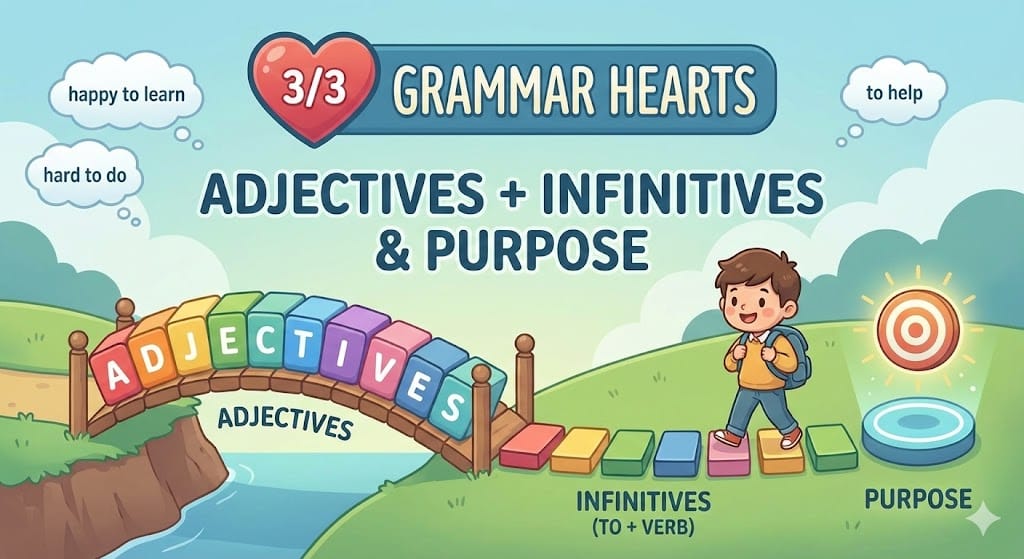
This activity helps students practice connecting adjectives with infinitives, using the "It's..." structure, and expressing purpose. Learners will identify correct forms, complete sentences, and arrange words to master these structures.
[
{
"title": "Adjectives + Infinitives & Purpose",
"hint": {
"summary": "Using Infinitives with Adjectives and for Purpose",
"content": "* **Adjective + to-infinitive:** Use *to + verb* after an adjective (e.g., *happy to help*).\n* **It's...:** We often use *It's + adjective + to-infinitive* (e.g., *It's important to learn*).\n* **Purpose:** Use the *to-infinitive* to explain *why* someone does something (e.g., *workshops to encourage people*).\n* **Negative:** Use **not + to-infinitive** (e.g., *It's hard not to think*)."
},
"questions": [
{
"type": "multiple-choice",
"question": "I was very ___ to see my old friend again.",
"options": ["happy", "happily", "happiness"],
"correctIndex": 0,
"explanation": "We use the **to-infinitive** when a verb follows an adjective (happy to see)."
},
{
"type": "multiple-choice",
"question": "It is dangerous ___ on that icy road.",
"options": ["drive", "to drive", "not to drive"],
"correctIndex": 1,
"explanation": "We use a sentence starting with **It's...** followed by an adjective + **to-infinitive**."
},
{
"type": "multiple-choice",
"question": "She went to the library ___ for her exam.",
"options": ["study", "to study", "for study"],
"correctIndex": 1,
"explanation": "We use the **to-infinitive** (infinitive of purpose) to give the reason for doing something."
},
{
"type": "multiple-choice",
"question": "It is important ___ late for class.",
"options": ["not to be", "to not be", "to be"],
"correctIndex": 0,
"explanation": "We make negative infinitives with **not + to-infinitive**."
},
{
"type": "multiple-choice",
"question": "He gives workshops ___ people to improve their skills.",
"options": ["encourage", "to encourage", "not to encourage"],
"correctIndex": 1,
"explanation": "This is the **infinitive of purpose**. It explains why he gives workshops."
},
{
"type": "multiple-choice",
"question": "We are ___ to announce the winner of the competition.",
"options": ["pleased", "pleasing", "please"],
"correctIndex": 0,
"explanation": "We use an adjective (pleased) before the **to-infinitive**."
},
{
"type": "multiple-choice",
"question": "It's hard ___ about the stressful news.",
"options": ["not think", "not to think", "to don't think"],
"correctIndex": 1,
"explanation": "The correct negative form is **not + to-infinitive** (not to think)."
},
{
"type": "multiple-choice",
"question": "Is it easy ___ this software?",
"options": ["use", "using", "to use"],
"correctIndex": 2,
"explanation": "After **It is + adjective** (easy), we use the **to-infinitive**."
},
{
"type": "multiple-choice",
"question": "They exercise every day ___ healthy.",
"options": ["to stay", "stay", "for stay"],
"correctIndex": 0,
"explanation": "Use the **infinitive of purpose** (to stay) to show the reason for exercising."
},
{
"type": "multiple-choice",
"question": "I am sorry ___ that you are feeling sick.",
"options": ["hear", "hearing", "to hear"],
"correctIndex": 2,
"explanation": "Adjective (sorry) + **to-infinitive** (to hear)."
},
{
"type": "fill-in-the-blank",
"instruction": "Complete the sentence with the correct form (to + verb):",
"question": "It is difficult ___ (learn) a new language quickly.",
"answer": ["to learn"],
"explanation": "Use **It's + adjective + to-infinitive**."
},
{
"type": "fill-in-the-blank",
"instruction": "Complete the sentence with the correct form:",
"question": "I called my mother ___ (ask) for a recipe.",
"answer": ["to ask"],
"explanation": "Use the **infinitive of purpose** to give the reason for calling."
},
{
"type": "fill-in-the-blank",
"instruction": "Complete the sentence with the correct form:",
"question": "We were _________ (surprise) to find the shop closed.",
"answer": ["surprised"],
"explanation": "Adjective (surprised) + **to-infinitive**."
},
{
"type": "fill-in-the-blank",
"instruction": "Complete the sentence:",
"question": "It is rude ___ (stare) at people.",
"answer": ["to stare"],
"explanation": "Adjective (rude) + **to-infinitive**."
},
{
"type": "fill-in-the-blank",
"instruction": "Complete the sentence with the negative form:",
"question": "It is hard ___ (worry) about the future. (-)",
"answer": ["not to worry"],
"explanation": "Negative infinitives are formed with **not + to-infinitive**."
},
{
"type": "fill-in-the-blank",
"instruction": "Complete the sentence with the correct form:",
"question": "Are you ready ___ (go) now?",
"answer": ["to go"],
"explanation": "Adjective (ready) + **to-infinitive**."
},
{
"type": "fill-in-the-blank",
"instruction": "Complete the sentence with the correct form:",
"question": "He creates art ___ (express) his feelings.",
"answer": ["to express"],
"explanation": "This is the **infinitive of purpose** (reason for creating art)."
},
{
"type": "fill-in-the-blank",
"instruction": "Complete the sentence with the correct form:",
"question": "It's impossible ___ (finish) this work in one hour.",
"answer": ["to finish"],
"explanation": "Use **It's + adjective + to-infinitive**."
},
{
"type": "fill-in-the-blank",
"instruction": "Complete the sentence with the correct form:",
"question": "She was lucky ___ (win) the prize.",
"answer": ["to win"],
"explanation": "Adjective (lucky) + **to-infinitive**."
},
{
"type": "fill-in-the-blank",
"instruction": "Complete the sentence with the correct form:",
"question": "I saved money ___ (buy) a new computer.",
"answer": ["to buy"],
"explanation": "Use the **infinitive of purpose** (reason for saving)."
},
{
"type": "scramble",
"sentence": "It is important to listen carefully.",
"explanation": "Structure: **It's + adjective + to-infinitive**."
},
{
"type": "scramble",
"sentence": "I am happy to help you.",
"explanation": "Structure: Subject + be + **adjective + to-infinitive**."
},
{
"type": "scramble",
"sentence": "She studies hard to pass exams.",
"explanation": "Use the **infinitive of purpose** (to pass) to show why she studies."
},
{
"type": "scramble",
"sentence": "It is nice to meet you.",
"explanation": "Structure: **It's + adjective + to-infinitive**."
},
{
"type": "scramble",
"sentence": "He uses a map to find the hotel.",
"explanation": "Use the **infinitive of purpose** (to find) to show the reason."
},
{
"type": "scramble",
"sentence": "It is hard not to think about work.",
"explanation": "Negative structure: **It's + adjective + not + to-infinitive**."
},
{
"type": "scramble",
"sentence": "We are ready to leave now.",
"explanation": "Structure: Subject + be + **adjective + to-infinitive**."
},
{
"type": "scramble",
"sentence": "It is dangerous to swim here.",
"explanation": "Structure: **It's + adjective + to-infinitive**."
},
{
"type": "scramble",
"sentence": "They went to the park to play soccer.",
"explanation": "Use the **infinitive of purpose** (to play) to explain why they went."
},
{
"type": "scramble",
"sentence": "I was sad to hear the news.",
"explanation": "Structure: Subject + be + **adjective + to-infinitive**."
}
]
}
]
Adjectives & Infinitives
Have you ever wanted to explain why you are doing something, or describe how you feel about an action? In English, we often connect adjectives and verbs using the infinitive form (to + verb).
This guide will help you understand three key sentence structures: Adjectives + Infinitives, the "It is..." structure, and the Infinitive of Purpose.
1. Adjectives + Infinitives (Expressing Feelings)
When we talk about feelings or reactions, we often use an adjective followed immediately by a to-infinitive.
Structure: Subject + be + Adjective + to + verb
We use this to say how someone feels about doing an action.
I am happy to see you.
She was surprised to find the door open.
We are ready to go now.
He is lucky to have such good friends.
Common adjectives used here:happy, sad, glad, pleased, surprised, sorry, ready, lucky.
2. The "It is..." Structure (General Opinions)
When we want to give an opinion about an activity in general (not about a specific person), we start the sentence with It.
Structure:It is + Adjective + to + verb
It is important to listen carefully.
It is dangerous to drive fast on icy roads.
It is nice to meet you.
It is difficult to learn a new language in one month.
Common adjectives used here:easy, hard, difficult, dangerous, safe, important, impossible, nice, rude.
3. The Infinitive of Purpose (Answering "Why?")
We use the to-infinitive to answer the question: "Why did you do that?" This explains the reason or purpose of an action.
Structure: Action + to + verb
Why did you go to the shop?
I went to the shop to buy milk. (Not "for buy milk")
Why does he exercise?
He exercises to stay healthy.
Why did she call you?
She called to ask for help.
4. The Negative Form
This is a common trap for students! When you want to make these sentences negative, you must put notbefore the word to.
Structure: It is + Adjective + not + to + verb
Correct: It is rude not to say "hello."
Incorrect: It is rude to not say "hello." (Incorrect in formal written English.)
Correct: It is hard not to worry about the future.