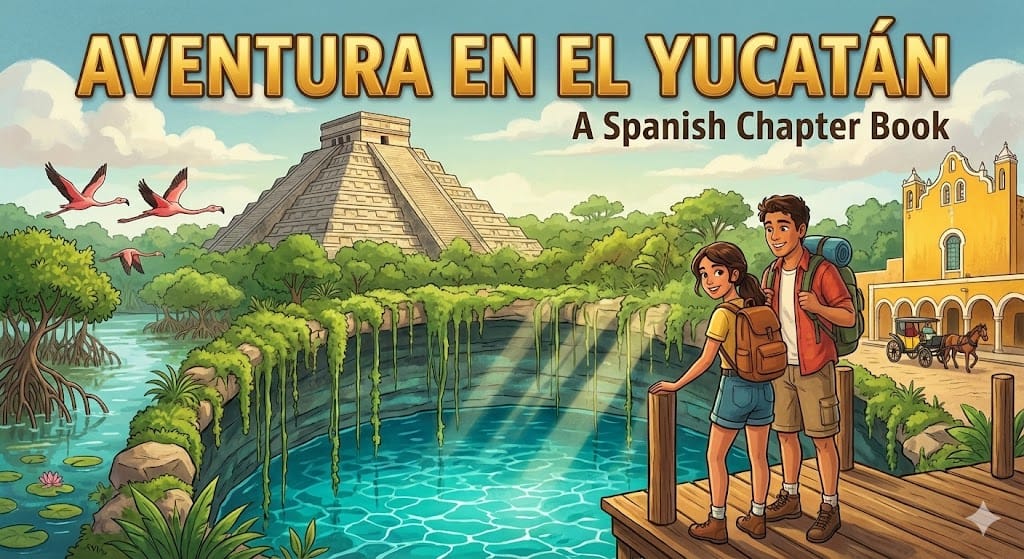
Join Carlos and Sofía as they explore ancient Mayan ruins, swim in mystical cenotes, and taste the vibrant flavors of Mexico.
{
"title": "Aventura en el Yucatán",
"language": "es",
"subtitle": "A Spanish A2 Chapter Book",
"chapters": [
{
"id": "chapter-1",
"title": "Capítulo 1: La Ciudad Blanca",
"content": [
"Carlos y Sofía aterrizaron en Mérida, la capital de Yucatán. La gente llama a Mérida «La Ciudad Blanca» porque muchos edificios antiguos están hechos de piedra caliza blanca. El aire era cálido y húmedo.",
"Caminaron por el Paseo de Montejo, una avenida ancha con mansiones elegantes de estilo francés. Carlos tomó muchas fotos de las casas. «Es como viajar en el tiempo», dijo Sofía. Por la noche, vieron gente bailando jarana en la plaza principal. La música era alegre y los bailarines llevaban trajes blancos impecables. Estaban listos para su aventura maya."
],
"translation": "Carlos and Sofía landed in Mérida, the capital of Yucatán. People call Mérida 'The White City' because many old buildings are made of white limestone. The air was warm and humid. They walked along the Paseo de Montejo, a wide avenue with elegant French-style mansions. Carlos took many photos of the houses. 'It's like traveling back in time,' said Sofía. At night, they watched people dancing jarana in the main square. The music was cheerful and the dancers wore impeccable white suits. They were ready for their Mayan adventure.",
"quiz": [
{
"question": "1. ¿Cómo llaman a la ciudad de Mérida?",
"options": [
{ "text": "a) La Ciudad Verde", "value": "wrong" },
{ "text": "b) La Ciudad Blanca", "value": "correct" },
{ "text": "c) La Ciudad Eterna", "value": "wrong" }
]
},
{
"question": "2. ¿Qué vieron en el Paseo de Montejo?",
"options": [
{ "text": "a) Pirámides", "value": "wrong" },
{ "text": "b) Mansiones elegantes", "value": "correct" },
{ "text": "c) Un zoológico", "value": "wrong" }
]
},
{
"question": "3. Vrai o Faux: El clima era frío y seco.",
"options": [
{ "text": "Vrai", "value": "wrong" },
{ "text": "Faux", "value": "correct" }
]
}
]
},
{
"id": "chapter-2",
"title": "Capítulo 2: Sabores del Mayab",
"content": [
"Tenían mucha hambre, así que entraron a un restaurante tradicional. El mesero les recomendó la cochinita pibil. Es carne de cerdo marinada con achiote y cocinada en un horno bajo tierra. También pidieron sopa de lima.",
"Cuando llegó la comida, Sofía probó una salsa verde. «¡Cuidado!», gritó el mesero, «es chile habanero y pica mucho». Sofía bebió mucha agua, pero se rió. La comida era deliciosa y diferente a todo lo que conocían. Aprendieron que el achiote da el color rojo a la carne y es una especia fundamental en la cocina yucateca."
],
"translation": "They were very hungry, so they entered a traditional restaurant. The waiter recommended the 'cochinita pibil.' It is pork meat marinated with achiote and cooked in an underground oven. They also ordered lime soup. When the food arrived, Sofía tasted a green sauce. 'Careful!' shouted the waiter, 'it is habanero pepper and it is very spicy.' Sofía drank a lot of water, but she laughed. The food was delicious and different from anything they knew. They learned that achiote gives the red color to the meat and is a fundamental spice in Yucatecan cuisine.",
"quiz": [
{
"question": "1. ¿Qué plato de carne pidieron?",
"options": [
{ "text": "a) Tacos al pastor", "value": "wrong" },
{ "text": "b) Cochinita pibil", "value": "correct" },
{ "text": "c) Pescado frito", "value": "wrong" }
]
},
{
"question": "2. ¿Qué pasó cuando Sofía probó la salsa verde?",
"options": [
{ "text": "a) Estaba dulce", "value": "wrong" },
{ "text": "b) Picaba mucho", "value": "correct" },
{ "text": "c) Estaba fría", "value": "wrong" }
]
},
{
"question": "3. Vrai o Faux: La cochinita pibil se cocina en un horno moderno de microondas.",
"options": [
{ "text": "Vrai", "value": "wrong" },
{ "text": "Faux", "value": "correct" }
]
}
]
},
{
"id": "chapter-3",
"title": "Capítulo 3: Camino a la Selva",
"content": [
"Al día siguiente, alquilaron un coche para ir a Chichén Itzá. La carretera era recta y estaba rodeada de selva baja. No había montañas, todo el terreno era plano. Carlos abrió la ventana y sintió el calor tropical.",
"Vieron muchas iguanas cruzando el camino y árboles de ceiba, que son sagrados para los mayas. El paisaje era muy verde. De repente, vieron un letrero que decía: «Zona Arqueológica a 10 kilómetros». La emoción creció. Estaban a punto de ver una de las maravillas del mundo moderno."
],
"translation": "The next day, they rented a car to go to Chichén Itzá. The road was straight and surrounded by low jungle. There were no mountains, the whole terrain was flat. Carlos opened the window and felt the tropical heat. They saw many iguanas crossing the road and ceiba trees, which are sacred to the Mayas. The landscape was very green. Suddenly, they saw a sign that said: 'Archeological Zone 10 kilometers.' The excitement grew. They were about to see one of the wonders of the modern world.",
"quiz": [
{
"question": "1. ¿Cómo era el terreno en Yucatán?",
"options": [
{ "text": "a) Montañoso", "value": "wrong" },
{ "text": "b) Plano", "value": "correct" },
{ "text": "c) Desértico", "value": "wrong" }
]
},
{
"question": "2. ¿Qué animales vieron cruzando el camino?",
"options": [
{ "text": "a) Leones", "value": "wrong" },
{ "text": "b) Iguanas", "value": "correct" },
{ "text": "c) Osos", "value": "wrong" }
]
},
{
"question": "3. Vrai o Faux: El árbol ceiba es sagrado para los mayas.",
"options": [
{ "text": "Vrai", "value": "correct" },
{ "text": "Faux", "value": "wrong" }
]
}
]
},
{
"id": "chapter-4",
"title": "Capítulo 4: La Pirámide de Kukulcán",
"content": [
"Entraron al sitio arqueológico y allí estaba: la pirámide de Kukulcán, también llamada «El Castillo». Era inmensa y geométrica. El guía explicó que la pirámide es un calendario gigante de piedra.",
"Tiene 365 escalones, uno para cada día del año. «Durante los equinoccios, la sombra del sol parece una serpiente que baja por la escalera», dijo el guía. Sofía miró las cabezas de serpiente en la base de la pirámide. Se sintió pequeña ante la grandeza de la arquitectura maya. Tomaron fotos, pero sabían que las imágenes no podían capturar la magia del momento."
],
"translation": "They entered the archaeological site and there it was: the pyramid of Kukulcán, also called 'The Castle.' It was immense and geometric. The guide explained that the pyramid is a giant stone calendar. It has 365 steps, one for each day of the year. 'During the equinoxes, the sun's shadow looks like a snake coming down the stairs,' said the guide. Sofía looked at the snake heads at the base of the pyramid. She felt small before the grandeur of Mayan architecture. They took photos, but knew that images could not capture the magic of the moment.",
"quiz": [
{
"question": "1. ¿Qué otro nombre tiene la pirámide de Kukulcán?",
"options": [
{ "text": "a) El Palacio", "value": "wrong" },
{ "text": "b) El Castillo", "value": "correct" },
{ "text": "c) La Torre", "value": "wrong" }
]
},
{
"question": "2. ¿Cuántos escalones tiene la pirámide en total?",
"options": [
{ "text": "a) 100", "value": "wrong" },
{ "text": "b) 365", "value": "correct" },
{ "text": "c) 50", "value": "wrong" }
]
},
{
"question": "3. Vrai o Faux: La sombra parece una serpiente durante el equinoccio.",
"options": [
{ "text": "Vrai", "value": "correct" },
{ "text": "Faux", "value": "wrong" }
]
}
]
},
{
"id": "chapter-5",
"title": "Capítulo 5: Ecos del Juego de Pelota",
"content": [
"Caminaron hacia el Gran Juego de Pelota. Es el campo más grande de Mesoamérica. Las paredes verticales tienen aros de piedra muy altos. El guía les pidió que aplaudieran una vez. ¡Clap!",
"El sonido rebotó siete veces contra las paredes. «La acústica es perfecta», explicó. Los mayas jugaban aquí con una pelota de caucho pesada, usando solo sus caderas. No podían usar las manos ni los pies. Carlos intentó imaginar lo difícil que era ese deporte. El juego tenía un significado religioso profundo sobre la vida y la muerte."
],
"translation": "They walked to the Great Ball Court. It is the largest field in Mesoamerica. The vertical walls have very high stone rings. The guide asked them to clap once. Clap! The sound bounced seven times against the walls. 'The acoustics are perfect,' he explained. The Mayas played here with a heavy rubber ball, using only their hips. They could not use their hands or feet. Carlos tried to imagine how difficult that sport was. The game had a deep religious meaning about life and death.",
"quiz": [
{
"question": "1. ¿Con qué parte del cuerpo golpeaban la pelota los mayas?",
"options": [
{ "text": "a) Con las manos", "value": "wrong" },
{ "text": "b) Con las caderas", "value": "correct" },
{ "text": "c) Con la cabeza", "value": "wrong" }
]
},
{
"question": "2. ¿Qué pasó cuando aplaudieron?",
"options": [
{ "text": "a) No se oyó nada", "value": "wrong" },
{ "text": "b) El sonido rebotó (eco)", "value": "correct" },
{ "text": "c) Empezó a llover", "value": "wrong" }
]
},
{
"question": "3. Vrai o Faux: Es el campo de juego más pequeño de la región.",
"options": [
{ "text": "Vrai", "value": "wrong" },
{ "text": "Faux", "value": "correct" }
]
}
]
},
{
"id": "chapter-6",
"title": "Capítulo 6: El Cenote Sagrado",
"content": [
"Después de caminar bajo el sol, necesitaban refrescarse. Fueron al Cenote Ik Kil. Un cenote es una piscina natural subterránea de agua dulce. Para los mayas, eran la entrada al inframundo.",
"Bajaron por una escalera de piedra. El agua era azul profundo y cristalina. Había lianas verdes colgando desde arriba hasta el agua. Carlos saltó al agua fría. «¡Es increíble!», gritó. Nadaron rodeados de pequeños peces negros. Miraron hacia arriba y vieron el cielo a través del agujero en la tierra. Fue una experiencia mística y relajante."
],
"translation": "After walking in the sun, they needed to cool off. They went to the Ik Kil Cenote. A cenote is a natural underground pool of fresh water. For the Mayas, they were the entrance to the underworld. They went down a stone staircase. The water was deep blue and crystal clear. There were green vines hanging from above down to the water. Carlos jumped into the cold water. 'It's incredible!' he shouted. They swam surrounded by small black fish. They looked up and saw the sky through the hole in the earth. It was a mystical and relaxing experience.",
"quiz": [
{
"question": "1. ¿Qué es un cenote?",
"options": [
{ "text": "a) Una montaña", "value": "wrong" },
{ "text": "b) Una piscina natural subterránea", "value": "correct" },
{ "text": "c) Un tipo de comida", "value": "wrong" }
]
},
{
"question": "2. ¿Cómo estaba el agua del cenote?",
"options": [
{ "text": "a) Caliente y sucia", "value": "wrong" },
{ "text": "b) Fría y cristalina", "value": "correct" },
{ "text": "c) Salada", "value": "wrong" }
]
},
{
"question": "3. Vrai o Faux: Los mayas creían que los cenotes eran entradas al inframundo.",
"options": [
{ "text": "Vrai", "value": "correct" },
{ "text": "Faux", "value": "wrong" }
]
}
]
},
{
"id": "chapter-7",
"title": "Capítulo 7: La Ciudad Amarilla",
"content": [
"Al día siguiente, visitaron Izamal. Es un \"Pueblo Mágico\" donde todas las casas están pintadas de amarillo brillante. El color brillaba bajo el sol fuerte. Visitaron el gran convento franciscano construido sobre una antigua pirámide maya.",
"Esta mezcla de culturas les pareció fascinante. Pasearon en una calesa, un carruaje tirado por caballos. El conductor les contó historias sobre la ciudad. Sofía compró un sombrero para protegerse del sol. En Izamal, el tiempo parecía detenerse. Todo era tranquilo, dorado y hermoso.",
" "
],
"translation": "The next day, they visited Izamal. It is a 'Magical Town' where all the houses are painted bright yellow. The color shone under the strong sun. They visited the great Franciscan convent built on top of an ancient Mayan pyramid. This mixture of cultures seemed fascinating to them. They took a ride in a 'calesa,' a horse-drawn carriage. The driver told them stories about the city. Sofía bought a hat to protect herself from the sun. In Izamal, time seemed to stand still. Everything was calm, golden, and beautiful.",
"quiz": [
{
"question": "1. ¿De qué color están pintadas las casas en Izamal?",
"options": [
{ "text": "a) Rojo", "value": "wrong" },
{ "text": "b) Amarillo", "value": "correct" },
{ "text": "c) Azul", "value": "wrong" }
]
},
{
"question": "2. ¿Sobre qué construyeron el convento?",
"options": [
{ "text": "a) Una playa", "value": "wrong" },
{ "text": "b) Una pirámide maya", "value": "correct" },
{ "text": "c) Un río", "value": "wrong" }
]
},
{
"question": "3. Vrai o Faux: Viajaron en un coche deportivo por la ciudad.",
"options": [
{ "text": "Vrai", "value": "wrong" },
{ "text": "Faux", "value": "correct" }
]
}
]
},
{
"id": "chapter-8",
"title": "Capítulo 8: El Oro Verde",
"content": [
"Viajaron a una antigua hacienda para aprender sobre el henequén. En el siglo XIX, el henequén era llamado «El Oro Verde» porque trajo mucha riqueza a Yucatán. Es una planta de agave usada para hacer cuerdas fuertes.",
"Vieron las máquinas antiguas que procesaban la fibra. Un trabajador les mostró cómo sacar la fibra de las hojas verdes y duras. Luego, subieron a un «truck», un pequeño vagón de madera tirado por una mula sobre rieles viejos. El paseo por los campos de agave fue nostálgico e interesante.",
" "
],
"translation": "They traveled to an old hacienda to learn about henequen. In the 19th century, henequen was called 'Green Gold' because it brought much wealth to Yucatán. It is an agave plant used to make strong ropes. They saw the old machines that processed the fiber. A worker showed them how to extract the fiber from the hard, green leaves. Then, they got on a 'truck,' a small wooden wagon pulled by a mule over old rails. The ride through the agave fields was nostalgic and interesting.",
"quiz": [
{
"question": "1. ¿Cómo llamaban al henequén en el pasado?",
"options": [
{ "text": "a) El Oro Verde", "value": "correct" },
{ "text": "b) La Plata Blanca", "value": "wrong" },
{ "text": "c) El Diamante Azul", "value": "wrong" }
]
},
{
"question": "2. ¿Para qué se usaba el henequén?",
"options": [
{ "text": "a) Para comer", "value": "wrong" },
{ "text": "b) Para hacer cuerdas", "value": "correct" },
{ "text": "c) Para medicina", "value": "wrong" }
]
},
{
"question": "3. Vrai o Faux: Viajaron en un vagón tirado por una mula.",
"options": [
{ "text": "Vrai", "value": "correct" },
{ "text": "Faux", "value": "wrong" }
]
}
]
},
{
"id": "chapter-9",
"title": "Capítulo 9: Flamencos en la Costa",
"content": [
"Querían ver el mar, así que fueron a Celestún, una reserva natural en la costa. Alquilaron una lancha para navegar por la ría. El agua era tranquila y estaba rodeada de manglares, árboles con raíces que crecen en el agua.",
"De repente, vieron una mancha rosa en el horizonte. ¡Eran cientos de flamencos! Los pájaros comían tranquilamente en el agua baja. Cuando volaron, sus alas rosas y negras se veían espectaculares contra el cielo azul. Carlos y Sofía guardaron silencio para no asustarlos. Era un espectáculo de la naturaleza inolvidable.",
" "
],
"translation": "They wanted to see the sea, so they went to Celestún, a nature reserve on the coast. They rented a boat to navigate the estuary. The water was calm and surrounded by mangroves, trees with roots that grow in the water. Suddenly, they saw a pink patch on the horizon. It was hundreds of flamingos! The birds were eating quietly in the shallow water. When they flew, their pink and black wings looked spectacular against the blue sky. Carlos and Sofía kept quiet so as not to scare them. It was an unforgettable spectacle of nature.",
"quiz": [
{
"question": "1. ¿Qué animales fueron a ver en Celestún?",
"options": [
{ "text": "a) Cocodrilos", "value": "wrong" },
{ "text": "b) Flamencos rosas", "value": "correct" },
{ "text": "c) Delfines", "value": "wrong" }
]
},
{
"question": "2. ¿Qué son los manglares?",
"options": [
{ "text": "a) Árboles con raíces en el agua", "value": "correct" },
{ "text": "b) Piedras grandes", "value": "wrong" },
{ "text": "c) Un tipo de barco", "value": "wrong" }
]
},
{
"question": "3. Vrai o Faux: Los flamencos eran de color verde.",
"options": [
{ "text": "Vrai", "value": "wrong" },
{ "text": "Faux", "value": "correct" }
]
}
]
},
{
"id": "chapter-10",
"title": "Capítulo 10: La Hamaca Perfecta",
"content": [
"Era el último día en Mérida. Sofía quería comprar un recuerdo especial. Fueron al mercado para comprar una hamaca. En Yucatán, mucha gente duerme en hamacas porque son frescas.",
"El vendedor les mostró hamacas de algodón y de nylon, de muchos colores. Sofía eligió una hamaca matrimonial de color turquesa. «Para recordar el color del cenote», dijo ella. Pagaron y dieron las gracias: «¡Gracias, nos vemos pronto!». Subieron al avión cansados pero felices, llevando un pedazo de Yucatán en sus maletas y en sus corazones."
],
"translation": "It was the last day in Mérida. Sofía wanted to buy a special souvenir. They went to the market to buy a hammock. In Yucatán, many people sleep in hammocks because they are cool. The seller showed them cotton and nylon hammocks, in many colors. Sofía chose a turquoise double hammock. 'To remember the color of the cenote,' she said. They paid and gave thanks: 'Thank you, see you soon!' They boarded the plane tired but happy, carrying a piece of Yucatán in their suitcases and in their hearts.",
"quiz": [
{
"question": "1. ¿Qué compró Sofía en el mercado?",
"options": [
{ "text": "a) Una hamaca", "value": "correct" },
{ "text": "b) Una guitarra", "value": "wrong" },
{ "text": "c) Unos zapatos", "value": "wrong" }
]
},
{
"question": "2. ¿Por qué la gente usa hamacas en Yucatán?",
"options": [
{ "text": "a) Porque son baratas", "value": "wrong" },
{ "text": "b) Porque son frescas", "value": "correct" },
{ "text": "c) Porque no hay camas", "value": "wrong" }
]
},
{
"question": "3. Vrai o Faux: Sofía eligió una hamaca de color rojo.",
"options": [
{ "text": "Vrai", "value": "wrong" },
{ "text": "Faux", "value": "correct" }
]
}
]
}
]
}