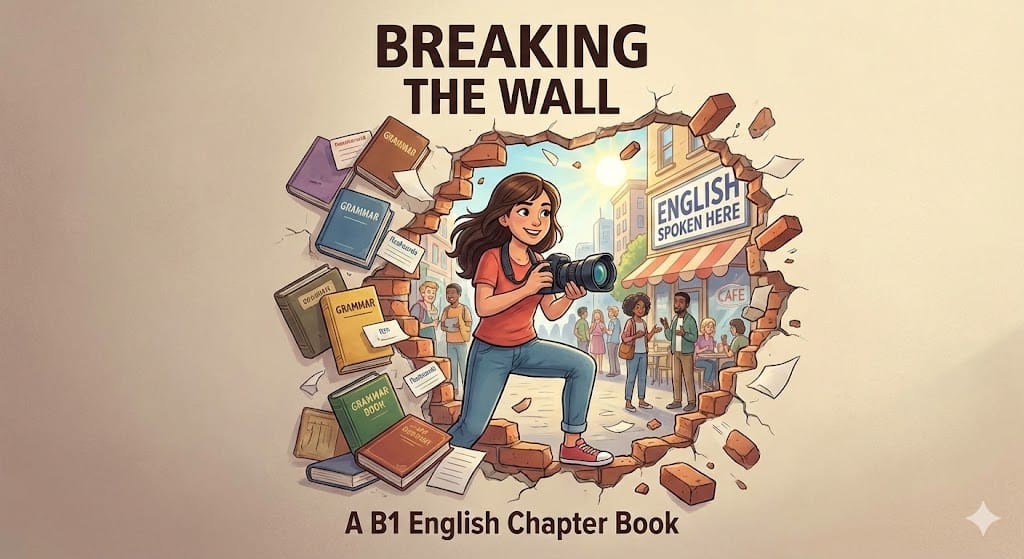
Discover how Maria escapes the intermediate language plateau in this engaging B1-level English story. Learn about content-based learning and how combining your personal hobbies with English can unlock true fluency.
{
"title": "Breaking the Wall",
"language": "en",
"subtitle": "A B1 English Chapter Book",
"chapters": [
{
"id": "chapter-1",
"title": "Chapter 1: The Invisible Wall",
"content": [
"Maria loved learning English. When she first started, everything was exciting and new. She learned how to say hello, order food in a restaurant, and talk about her daily routine. Her progress was very fast. In just six months, she felt confident and happy. But then, something strange happened. After a year of studying hard, she reached the intermediate level. Suddenly, her progress stopped completely. She felt like she had hit an invisible wall.",
"Maria knew a lot of grammar rules. She could complete all the exercises in her textbook perfectly. She also had a large vocabulary and used her flashcards every single day. However, when she tried to watch an English movie, she felt completely lost. The actors spoke too fast, and she couldn't understand their jokes. When she tried to speak with native speakers, she felt clumsy and slow. Her brain tried to remember the grammar rules before she opened her mouth, and she often froze. She felt very frustrated. She spent more hours doing grammar drills, but nothing changed. Sitting in a cafe looking at her heavy textbook, she realized that studying the Present Perfect tense again would not help her understand real conversations. The methods that helped her as a beginner were no longer working."
],
"quiz": [
{
"question": "1. What happens to Maria when she reaches the intermediate level?",
"options": [
{ "text": "a) She learns much faster.", "value": "wrong" },
{ "text": "b) She hits an invisible wall and her progress stops.", "value": "correct" },
{ "text": "c) She decides to stop learning English.", "value": "wrong" }
]
},
{
"question": "2. True or False: Maria's grammar textbooks help her understand English movies easily.",
"options": [
{ "text": "True", "value": "wrong" },
{ "text": "False", "value": "correct" }
]
},
{
"question": "3. How does Maria feel when she tries to speak with native speakers?",
"options": [
{ "text": "a) Confident and happy", "value": "wrong" },
{ "text": "b) Clumsy and slow", "value": "correct" },
{ "text": "c) Angry and tired", "value": "wrong" }
]
}
]
},
{
"id": "chapter-2",
"title": "Chapter 2: A New Approach",
"content": [
"The next week, Maria talked to her language teacher, Mr. Davis. She explained her frustration. \"I study every day, but I still can't have a real conversation,\" she sighed. Mr. Davis smiled kindly. \"Maria, you are at the intermediate plateau,\" he said. \"This is a normal phase. The problem is that you treat English like a math subject. You are trying to memorize rules instead of communicating.\"",
"He explained a new idea to her. \"To break through this wall, you must stop studying the language directly. You need to start learning other things through English.\" He told her that she should use English as a tool to explore her real interests. Maria thought about this. Her biggest passion was photography. She loved taking pictures of nature and city streets. Mr. Davis suggested that she put her grammar books away for a while. Instead, she should watch videos, read blogs, and listen to podcasts about photography, all in English. \"Your brain gets too tired when you think about grammar while speaking,\" he explained. \"If you focus on a topic you love, the language will become a natural tool.\" Maria felt hopeful for the first time in months. She went home and opened her laptop to search for photography tips."
],
"quiz": [
{
"question": "1. What does Mr. Davis say is Maria's main problem?",
"options": [
{ "text": "a) She doesn't study enough.", "value": "wrong" },
{ "text": "b) She treats English like a math subject.", "value": "correct" },
{ "text": "c) She needs to buy a new textbook.", "value": "wrong" }
]
},
{
"question": "2. What is Maria's biggest passion in life?",
"options": [
{ "text": "a) Cooking", "value": "wrong" },
{ "text": "b) Photography", "value": "correct" },
{ "text": "c) Traveling", "value": "wrong" }
]
},
{
"question": "3. True or False: Mr. Davis tells Maria to read more grammar books.",
"options": [
{ "text": "True", "value": "wrong" },
{ "text": "False", "value": "correct" }
]
}
]
},
{
"id": "chapter-3",
"title": "Chapter 3: The Power of Need",
"content": [
"Maria started her new learning journey that very evening. She found a popular English YouTube channel about digital photography. The first video she chose was a tutorial about taking pictures at night. At first, she was a little bit nervous. What if she didn't understand anything?",
"As the video played, she heard many new words. However, the speaker was demonstrating everything on his camera. Because Maria really wanted to learn how to take good night photos, she paid very close attention. When the speaker said words like \"shutter speed\" and \"exposure,\" she didn't write them down on a list. Instead, she looked at what he was doing and immediately understood the meaning. Her brain remembered the new words because they were useful right now. Later that week, she tried to follow a written guide to clean her camera lens. The guide was entirely in English. If she misunderstood the instructions, she could damage her expensive camera. This real-life situation forced her to read carefully. She successfully cleaned her lens and realized she had learned five new technical words without even trying. Using the language for a real task was much more powerful than memorizing lists."
],
"quiz": [
{
"question": "1. What kind of video does Maria watch on YouTube?",
"options": [
{ "text": "a) A photography tutorial", "value": "correct" },
{ "text": "b) A cooking show", "value": "wrong" },
{ "text": "c) A music video", "value": "wrong" }
]
},
{
"question": "2. True or False: Maria remembers new words because she needs them to use her camera.",
"options": [
{ "text": "True", "value": "correct" },
{ "text": "False", "value": "wrong" }
]
},
{
"question": "3. What happens when Maria cleans her camera lens?",
"options": [
{ "text": "a) She breaks the camera.", "value": "wrong" },
{ "text": "b) She learns five new words without trying.", "value": "correct" },
{ "text": "c) She calls a professional for help.", "value": "wrong" }
]
}
]
},
{
"id": "chapter-4",
"title": "Chapter 4: Reading for Meaning",
"content": [
"Maria used to have a big problem with vocabulary. She knew hundreds of isolated words from her mobile apps, but she didn't know how to put them together in a natural sentence. Now, by reading about photography, she discovered the power of context. She bought an English book about the history of famous photographers.",
"Some of the sentences were long, and the vocabulary was sometimes advanced. It was hard enough to challenge her, but not so hard that she wanted to give up. Because Maria already knew a lot about photography, she could guess the meaning of the difficult words. When she read a story about a photographer waiting for the \"perfect light,\" she understood the emotion behind the text. The words were no longer lonely items on a flashcard; they were part of a beautiful story. She focused her reading on this one topic for a whole month. She noticed that the same words appeared again and again. Words like \"focus,\" \"background,\" and \"capture\" were repeated naturally in different chapters. This natural repetition helped her move the words into her active memory. She didn't have to force herself to learn."
],
"quiz": [
{
"question": "1. How does Maria learn new words while reading the history book?",
"options": [
{ "text": "a) She writes them on flashcards.", "value": "wrong" },
{ "text": "b) She guesses the meaning from the context.", "value": "correct" },
{ "text": "c) She uses a dictionary for every word.", "value": "wrong" }
]
},
{
"question": "2. True or False: The book Maria reads is much too easy for her.",
"options": [
{ "text": "True", "value": "wrong" },
{ "text": "False", "value": "correct" }
]
},
{
"question": "3. Why is focusing on one topic helpful for Maria?",
"options": [
{ "text": "a) She naturally sees the same words repeated.", "value": "correct" },
{ "text": "b) It is faster to read.", "value": "wrong" },
{ "text": "c) She doesn't have to read many pages.", "value": "wrong" }
]
}
]
},
{
"id": "chapter-5",
"title": "Chapter 5: Becoming a User",
"content": [
"After three months of this new method, Maria noticed a huge change. She no longer felt the heavy pressure of translating every single word in her head. Because she had spent so much time reading and listening to photography content, the English phrases came to her mind naturally. She decided to join an online photography club where people from all over the world shared their pictures.",
"The official language of the club was English. She uploaded her best night photograph and wrote a short description of how she took it. Other members asked her questions about her camera settings. Maria replied to their comments with confidence. She didn't worry about using the perfect verb tense. She only cared about sharing her techniques and making friends. She realized that she had finally crossed the bridge. She had moved from saying, \"I am studying English,\" to proudly saying, \"I am an English speaker.\" The intermediate plateau was finally behind her. It had been a psychological barrier more than a language problem. By combining her passion with her target language, she transformed English from a scary school subject into a useful, everyday tool. She smiled, picked up her camera, and walked outside, ready to capture the world."
],
"quiz": [
{
"question": "1. What does Maria do after three months of this new method?",
"options": [
{ "text": "a) She joins an online photography club.", "value": "correct" },
{ "text": "b) She takes a difficult grammar test.", "value": "wrong" },
{ "text": "c) She stops learning English completely.", "value": "wrong" }
]
},
{
"question": "2. What does Maria care about most when talking to other club members?",
"options": [
{ "text": "a) Using perfect grammar.", "value": "wrong" },
{ "text": "b) Translating every word correctly.", "value": "wrong" },
{ "text": "c) Sharing her techniques and making friends.", "value": "correct" }
]
},
{
"question": "3. True or False: Maria finally feels like an English speaker, not just an English student.",
"options": [
{ "text": "True", "value": "correct" },
{ "text": "False", "value": "wrong" }
]
}
]
}
]
}