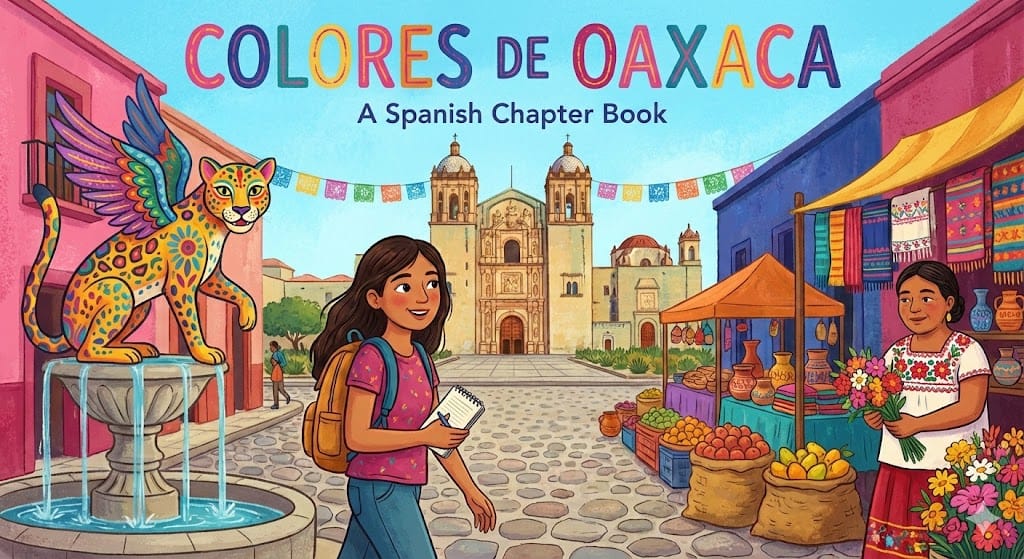
Explore the soul of Mexico with "Colores de Oaxaca", a Spanish A2 chapter book. Follow Elena through markets, festivals, and ancient ruins while mastering essential vocabulary and cultural nuances.
{
"title": "Colores de Oaxaca",
"language": "es",
"subtitle": "A Spanish A2 Chapter Book",
"chapters": [
{
"id": "chapter-1",
"title": "Capítulo 1: La Llegada a Oaxaca",
"content": [
"Elena llegó al aeropuerto de Oaxaca por la tarde. El sol brillaba y el aire olía a tierra seca y chocolate. Tomó un taxi hacia el centro de la ciudad. Mientras miraba por la ventana, vio casas de colores brillantes: azul, amarillo y rosa mexicano.",
"Ella estaba emocionada porque siempre quiso conocer el sur de México. El taxista le dijo: «Bienvenida a nuestra tierra, aquí la vida es más tranquila». Elena sonrió. Dejó sus maletas en el hotel y decidió caminar para explorar su nuevo hogar por las próximas dos semanas."
],
"translation": "Elena arrived at the Oaxaca airport in the afternoon. The sun was shining, and the air smelled of dry earth and chocolate. She took a taxi to the city center. As she looked out the window, she saw brightly colored houses: blue, yellow, and Mexican pink. She was excited because she always wanted to visit southern Mexico. The taxi driver told her, 'Welcome to our land; life is calmer here.' Elena smiled. She dropped her bags at the hotel and decided to walk to explore her new home for the next two weeks.",
"quiz": [
{
"question": "1. ¿A qué olía el aire cuando Elena llegó?",
"options": [
{ "text": "a) A mar", "value": "wrong" },
{ "text": "b) A chocolate", "value": "correct" },
{ "text": "c) A flores", "value": "wrong" }
]
},
{
"question": "2. Vrai o Faux: Elena se quedó en un hotel en el centro.",
"options": [
{ "text": "Vrai", "value": "correct" },
{ "text": "Faux", "value": "wrong" }
]
},
{
"question": "3. ¿De qué colores eran las casas que vio Elena?",
"options": [
{ "text": "a) Solo blanco y negro", "value": "wrong" },
{ "text": "b) Azul, amarillo y rosa", "value": "correct" },
{ "text": "c) Verde y gris", "value": "wrong" }
]
}
]
},
{
"id": "chapter-2",
"title": "Capítulo 2: El Zócalo y el Café",
"content": [
"El Zócalo de Oaxaca es el corazón de la ciudad. Hay muchos árboles grandes que dan sombra a la gente. Elena se sentó en una cafetería bajo los portales. Pidió un café de olla, que es café con canela y piloncillo.",
"Mientras bebía, observó a los vendedores de globos y a los músicos callejeros. El ambiente era muy alegre. Un niño vendía periódicos y un anciano leía un libro en una banca. Elena sacó su cuaderno y escribió sus primeras impresiones. Oaxaca no solo era hermosa, era vibrante y llena de vida."
],
"translation": "The Zocalo of Oaxaca is the heart of the city. There are many large trees that provide shade for the people. Elena sat in a cafe under the portals. She ordered a 'café de olla,' which is coffee with cinnamon and brown sugar. While she drank, she watched the balloon sellers and street musicians. The atmosphere was very cheerful. A boy was selling newspapers and an old man was reading a book on a bench. Elena took out her notebook and wrote her first impressions. Oaxaca was not only beautiful, it was vibrant and full of life.",
"quiz": [
{
"question": "1. ¿Qué ingredientes tiene el café de olla?",
"options": [
{ "text": "a) Leche y azúcar", "value": "wrong" },
{ "text": "b) Canela y piloncillo", "value": "correct" },
{ "text": "c) Vainilla y miel", "value": "wrong" }
]
},
{
"question": "2. Vrai o Faux: El Zócalo es un lugar muy silencioso.",
"options": [
{ "text": "Vrai", "value": "wrong" },
{ "text": "Faux", "value": "correct" }
]
},
{
"question": "3. ¿Qué hizo Elena mientras bebía su café?",
"options": [
{ "text": "a) Durmió", "value": "wrong" },
{ "text": "b) Escribió en su cuaderno", "value": "correct" },
{ "text": "c) Compró globos", "value": "wrong" }
]
}
]
},
{
"id": "chapter-3",
"title": "Capítulo 3: El Mercado de Sabores",
"content": [
"Elena visitó el Mercado 20 de Noviembre. Los pasillos estaban llenos de comida deliciosa. Ella vio grandes ollas con mole negro, una salsa famosa hecha con muchos chiles y chocolate. «¿Quiere probar?», preguntó una señora amable.",
"Elena probó el mole y le encantó el sabor complejo. También vio chapulines, que son saltamontes tostados con sal y limón. Al principio tuvo miedo, pero probó uno. ¡Era muy crujiente! Compró una bolsa de cacao y pan de yema para desayunar al día siguiente."
],
"translation": "Elena visited the '20 de Noviembre' Market. The aisles were full of delicious food. She saw large pots with 'mole negro,' a famous sauce made with many chilies and chocolate. 'Do you want to try?' a kind lady asked. Elena tried the mole and loved the complex flavor. She also saw 'chapulines,' which are grasshoppers toasted with salt and lime. At first she was afraid, but she tried one. It was very crunchy! She bought a bag of cocoa and 'pan de yema' (egg bread) for breakfast the next day.",
"quiz": [
{
"question": "1. ¿De qué está hecho el mole negro?",
"options": [
{ "text": "a) Solo chocolate", "value": "wrong" },
{ "text": "b) Chiles y chocolate", "value": "correct" },
{ "text": "c) Frutas tropicales", "value": "wrong" }
]
},
{
"question": "2. ¿Qué son los chapulines?",
"options": [
{ "text": "a) Saltamontes", "value": "correct" },
{ "text": "b) Pescados", "value": "wrong" },
{ "text": "c) Dulces", "value": "wrong" }
]
},
{
"question": "3. Vrai o Faux: Elena odió el sabor del mole.",
"options": [
{ "text": "Vrai", "value": "wrong" },
{ "text": "Faux", "value": "correct" }
]
}
]
},
{
"id": "chapter-4",
"title": "Capítulo 4: Criaturas Fantásticas",
"content": [
"Elena viajó al pueblo de San Martín Tilcajete. Allí, los artesanos crean alebrijes. Los alebrijes son figuras de madera talladas a mano que representan animales fantásticos. Tienen colores muy intensos y diseños detallados.",
"Elena entró a una tienda y vio un león con alas de águila y cola de serpiente. El artesano explicó que cada pieza es única y tiene un significado espiritual. Elena quedó impresionada por la paciencia necesaria. Decidió comprar un colibrí para recordar la magia del pueblo."
],
"translation": "Elena traveled to the town of San Martín Tilcajete. There, artisans create 'alebrijes.' Alebrijes are hand-carved wooden figures representing fantastic animals. They have very intense colors and detailed designs. Elena entered a shop and saw a lion with eagle wings and a snake tail. The artisan explained that each piece is unique and has a spiritual meaning. Elena was impressed by the patience needed. She decided to buy a hummingbird to remember the magic of the town.",
"quiz": [
{
"question": "1. ¿De qué material están hechos los alebrijes?",
"options": [
{ "text": "a) Metal", "value": "wrong" },
{ "text": "b) Madera", "value": "correct" },
{ "text": "c) Piedra", "value": "wrong" }
]
},
{
"question": "2. Vrai o Faux: Todos los alebrijes son exactamente iguales.",
"options": [
{ "text": "Vrai", "value": "wrong" },
{ "text": "Faux", "value": "correct" }
]
},
{
"question": "3. ¿Qué animal compró Elena?",
"options": [
{ "text": "a) Un perro", "value": "wrong" },
{ "text": "b) Un colibrí", "value": "correct" },
{ "text": "c) Un gato", "value": "wrong" }
]
}
]
},
{
"id": "chapter-5",
"title": "Capítulo 5: El Taller de Pedro",
"content": [
"En el taller, un joven llamado Pedro le enseñó a Elena cómo tallar la madera de copal. El copal es una madera suave y fácil de trabajar. Pedro usaba cuchillos muy afilados para dar forma a un jaguar.",
"«Mi abuelo me enseñó este oficio cuando yo tenía ocho años», dijo Pedro con orgullo. Elena intentó usar un pincel para pintar una línea, pero era difícil. Pedro se rió y la ayudó. Ella aprendió que el arte no es solo técnica, sino también historia familiar."
],
"translation": "In the workshop, a young man named Pedro showed Elena how to carve copal wood. Copal is a soft wood that is easy to work with. Pedro used very sharp knives to shape a jaguar. 'My grandfather taught me this craft when I was eight years old,' Pedro said with pride. Elena tried to use a brush to paint a line, but it was difficult. Pedro laughed and helped her. She learned that art is not just technique, but also family history.",
"quiz": [
{
"question": "1. ¿Cómo se llama la madera que usan para tallar?",
"options": [
{ "text": "a) Pino", "value": "wrong" },
{ "text": "b) Copal", "value": "correct" },
{ "text": "c) Roble", "value": "wrong" }
]
},
{
"question": "2. ¿Quién le enseñó el oficio a Pedro?",
"options": [
{ "text": "a) Su abuelo", "value": "correct" },
{ "text": "b) Un profesor", "value": "wrong" },
{ "text": "c) Elena", "value": "wrong" }
]
},
{
"question": "3. Vrai o Faux: Elena encontró muy fácil pintar las líneas.",
"options": [
{ "text": "Vrai", "value": "wrong" },
{ "text": "Faux", "value": "correct" }
]
}
]
},
{
"id": "chapter-6",
"title": "Capítulo 6: Esperando la Guelaguetza",
"content": [
"Toda la ciudad hablaba de la Guelaguetza. Es la fiesta más importante de Oaxaca. «Guelaguetza significa compartir», le explicó una mujer en la calle. Durante este festival, las siete regiones del estado se reúnen para bailar y cantar.",
"Elena compró un boleto para el auditorio en el Cerro del Fortín. Vio a la gente practicando en las plazas. Los hombres llevaban sombreros y las mujeres practicaban pasos de baile elegantes. Había una energía especial en el aire."
],
"translation": "The whole city was talking about the Guelaguetza. It is the most important festival in Oaxaca. 'Guelaguetza means to share,' a woman on the street explained to her. During this festival, the seven regions of the state gather to dance and sing. Elena bought a ticket for the auditorium on the Cerro del Fortín. She saw people practicing in the squares. The men wore hats and the women practiced elegant dance steps. There was a special energy in the air.",
"quiz": [
{
"question": "1. ¿Qué significa la palabra 'Guelaguetza'?",
"options": [
{ "text": "a) Bailar", "value": "wrong" },
{ "text": "b) Compartir", "value": "correct" },
{ "text": "c) Cantar", "value": "wrong" }
]
},
{
"question": "2. ¿Dónde se encuentra el auditorio principal?",
"options": [
{ "text": "a) En la playa", "value": "wrong" },
{ "text": "b) En el Cerro del Fortín", "value": "correct" },
{ "text": "c) En el aeropuerto", "value": "wrong" }
]
},
{
"question": "3. Vrai o Faux: Solo una región de Oaxaca participa en la fiesta.",
"options": [
{ "text": "Vrai", "value": "wrong" },
{ "text": "Faux", "value": "correct" }
]
}
]
},
{
"id": "chapter-7",
"title": "Capítulo 7: Los Colores del Huipil",
"content": [
"Elena admiraba los vestidos de las mujeres oaxaqueñas, llamados huipiles. Cada huipil tiene bordados que cuentan una historia sobre el pueblo de la mujer. Elena visitó una cooperativa de mujeres tejedoras que usan telares de cintura.",
"Una tejedora le mostró cómo obtener colores naturales de insectos y plantas. Elena compró un huipil blanco con flores rojas de la región del Istmo. Al ponérselo, se sintió conectada con la historia de las mujeres que mantienen viva esta tradición."
],
"translation": "Elena admired the dresses of the Oaxacan women, called 'huipiles.' Each huipil has embroidery that tells a story about the woman's town. Elena visited a women's weaving cooperative using backstrap looms. A weaver showed her how to get natural colors from insects and plants. Elena bought a white huipil with red flowers from the Isthmus region. Putting it on, she felt connected to the history of the women who keep this tradition alive.",
"quiz": [
{
"question": "1. ¿Cómo se llaman los vestidos tradicionales?",
"options": [
{ "text": "a) Huipiles", "value": "correct" },
{ "text": "b) Sarapes", "value": "wrong" },
{ "text": "c) Sombreros", "value": "wrong" }
]
},
{
"question": "2. Vrai o Faux: Los colores de los vestidos son siempre artificiales.",
"options": [
{ "text": "Vrai", "value": "wrong" },
{ "text": "Faux", "value": "correct" }
]
},
{
"question": "3. ¿Qué técnica antigua usan las tejedoras?",
"options": [
{ "text": "a) Máquina eléctrica", "value": "wrong" },
{ "text": "b) Telar de cintura", "value": "correct" },
{ "text": "c) Pegamento", "value": "wrong" }
]
}
]
},
{
"id": "chapter-8",
"title": "Capítulo 8: Música en las Calles",
"content": [
"Por la noche, las calles se llenaron de música. Elena escuchó el sonido de la marimba, un instrumento de madera que suena dulce y rítmico. Había una 'callejoneada', que es un desfile con música y baile por las calles estrechas.",
"La gente seguía a una banda de viento. Había marionetas gigantes llamadas 'monos de calenda'. Elena se unió al grupo y bailó con desconocidos. Todos reían y celebraban. Elena pensó que nunca había visto una fiesta tan comunitaria."
],
"translation": "At night, the streets filled with music. Elena heard the sound of the marimba, a wooden instrument that sounds sweet and rhythmic. There was a 'callejoneada,' which is a parade with music and dancing through the narrow streets. People followed a brass band. There were giant puppets called 'monos de calenda.' Elena joined the group and danced with strangers. Everyone was laughing and celebrating. Elena thought she had never seen such a communal party.",
"quiz": [
{
"question": "1. ¿Qué es una marimba?",
"options": [
{ "text": "a) Una flauta", "value": "wrong" },
{ "text": "b) Un instrumento de madera", "value": "correct" },
{ "text": "c) Un tipo de baile", "value": "wrong" }
]
},
{
"question": "2. ¿Cómo se llaman las marionetas gigantes?",
"options": [
{ "text": "a) Monos de calenda", "value": "correct" },
{ "text": "b) Alebrijes", "value": "wrong" },
{ "text": "c) Piñatas", "value": "wrong" }
]
},
{
"question": "3. Vrai o Faux: Elena miró el desfile desde su balcón sin participar.",
"options": [
{ "text": "Vrai", "value": "wrong" },
{ "text": "Faux", "value": "correct" }
]
}
]
},
{
"id": "chapter-9",
"title": "Capítulo 9: Las Ruinas de Monte Albán",
"content": [
"Elena tomó un autobús hacia Monte Albán, una antigua ciudad zapoteca en lo alto de una montaña. Desde allí, podía ver todo el valle de Oaxaca. Caminó entre las grandes pirámides y las plazas de piedra.",
"El guía explicó que los zapotecas eran astrónomos y matemáticos expertos. Elena subió a la Gran Plaza y sintió el viento fuerte. Era un lugar sagrado y silencioso, muy diferente del bullicio de la ciudad."
],
"translation": "Elena took a bus to Monte Albán, an ancient Zapotec city on top of a mountain. From there, she could see the entire Oaxaca valley. She walked among the large pyramids and stone squares. The guide explained that the Zapotecs were expert astronomers and mathematicians. Elena climbed to the Great Plaza and felt the strong wind. It was a sacred and silent place, very different from the bustle of the city.",
"quiz": [
{
"question": "1. ¿Quiénes construyeron Monte Albán?",
"options": [
{ "text": "a) Los Aztecas", "value": "wrong" },
{ "text": "b) Los Zapotecas", "value": "correct" },
{ "text": "c) Los Incas", "value": "wrong" }
]
},
{
"question": "2. Vrai o Faux: Monte Albán está en el centro de la ciudad.",
"options": [
{ "text": "Vrai", "value": "wrong" },
{ "text": "Faux", "value": "correct" }
]
},
{
"question": "3. ¿Qué podía ver Elena desde la montaña?",
"options": [
{ "text": "a) El océano", "value": "wrong" },
{ "text": "b) El valle de Oaxaca", "value": "correct" },
{ "text": "c) Un volcán", "value": "wrong" }
]
}
]
},
{
"id": "chapter-10",
"title": "Capítulo 10: Una Cena de Despedida",
"content": [
"Era su última noche. Elena fue a cenar a una terraza con vista a la Iglesia de Santo Domingo. Pidió una tlayuda, que es una tortilla grande y crujiente con frijoles, queso y carne.",
"Recordó todo lo que aprendió: el sabor del mole y la amabilidad de la gente. Al final de la cena, bebió un chocolate caliente. Miró las luces de la ciudad y se sintió agradecida. Oaxaca no era solo un viaje, era un recuerdo eterno."
],
"translation": "It was her last night. Elena went to dinner at a terrace with a view of the Santo Domingo Church. She ordered a 'tlayuda,' which is a large, crunchy tortilla with beans, cheese, and meat. She remembered everything she learned: the taste of mole and the kindness of the people. At the end of dinner, she drank a hot chocolate. She looked at the city lights and felt grateful. Oaxaca was not just a trip; it was an eternal memory.",
"quiz": [
{
"question": "1. ¿Qué es una tlayuda?",
"options": [
{ "text": "a) Una sopa", "value": "wrong" },
{ "text": "b) Una tortilla grande y crujiente", "value": "correct" },
{ "text": "c) Un postre", "value": "wrong" }
]
},
{
"question": "2. Vrai o Faux: Elena cenó con vista a una iglesia famosa.",
"options": [
{ "text": "Vrai", "value": "correct" },
{ "text": "Faux", "value": "wrong" }
]
},
{
"question": "3. ¿Qué bebió Elena al final de su cena?",
"options": [
{ "text": "a) Refresco", "value": "wrong" },
{ "text": "b) Chocolate caliente", "value": "correct" },
{ "text": "c) Jugo", "value": "wrong" }
]
}
]
}
]
}