{
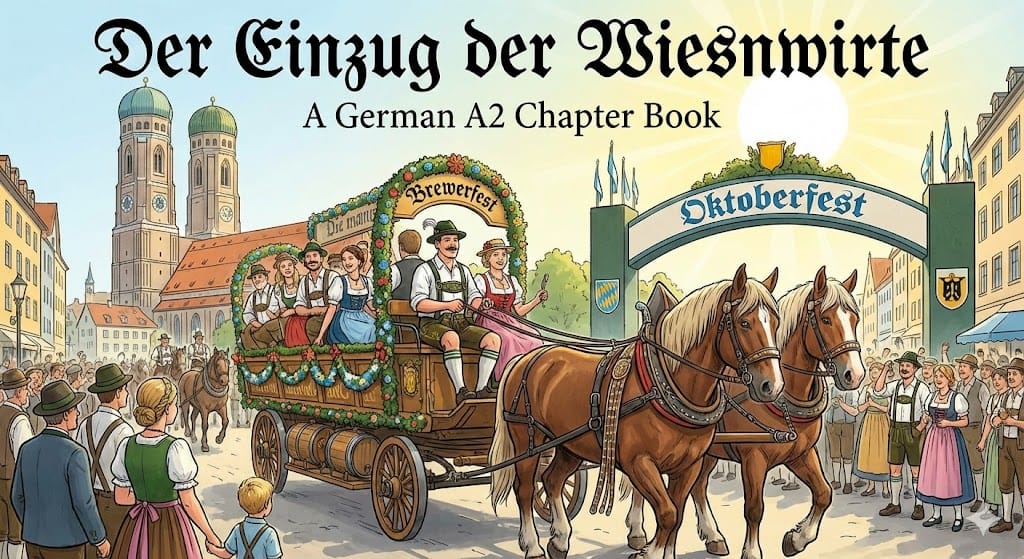
"title": "Der Einzug der Wiesnwirte",
"language": "de",
"subtitle": "A German A2 Chapter Book",
"chapters": [
{
"id": "chapter-1",
"title": "Chapitre 1: Die Ankunft in München",
"content": [
"Lukas stieg am Münchner Hauptbahnhof aus dem Zug. Es war ein sonniger Samstagmorgen im September. Der Bahnhof war voller Menschen, und die Stimmung war elektrisch. Überall sah Lukas Leute mit Koffern und traditionellen Hüten.",
"Er ging aus dem Bahnhof hinaus und atmete tief ein. Die Stadt roch nach Brezeln und süßen Mandeln. Lukas war aufgeregt. Er war extra für das Oktoberfest, oder die \"Wiesn\", wie die Einheimischen sagen, angereist. Er wollte den berühmten Einzug der Wiesnwirte sehen. Er checkte schnell in seinem Hotel in der Nähe der Sonnenstraße ein."
],
"translation": "Lukas stepped off the train at Munich Central Station. It was a sunny Saturday morning in September. The station was full of people, and the atmosphere was electric. Everywhere, Lukas saw people with suitcases and traditional hats. He walked out of the station and took a deep breath. The city smelled of pretzels and sweet almonds. Lukas was excited. He had traveled specifically for Oktoberfest, or the \"Wiesn\" as the locals say. He wanted to see the famous Entry of the Landlords. He quickly checked into his hotel near Sonnenstraße.",
"quiz": [
{
"question": "1. Why did Lukas travel to Munich?",
"options": [
{ "text": "a) For a business meeting", "value": "wrong" },
{ "text": "b) For Oktoberfest", "value": "correct" },
{ "text": "c) To visit his parents", "value": "wrong" }
]
},
{
"question": "2. What do locals call Oktoberfest?",
"options": [
{ "text": "a) Die Party", "value": "wrong" },
{ "text": "b) Das Bierfest", "value": "wrong" },
{ "text": "c) Die Wiesn", "value": "correct" }
]
},
{
"question": "3. True or False: It was raining when Lukas arrived.",
"options": [
{ "text": "a) True", "value": "wrong" },
{ "text": "b) False", "value": "correct" }
]
}
]
},
{
"id": "chapter-2",
"title": "Chapitre 2: Eine königliche Geschichte",
"content": [
"Auf dem Weg zum Festplatz traf Lukas einen Stadtführer namens Hans. Hans war freundlich und trug eine kurze Lederhose. Er erklärte Lukas die Geschichte des Festes.",
"„Weißt du, Lukas“, sagte Hans, „alles begann im Jahr 1810.“ Es war keine Bierparty, sondern eine Hochzeit. Kronprinz Ludwig heiratete Prinzessin Therese. Die Bürger von München waren eingeladen, vor den Stadttoren zu feiern. Deshalb heißt der große Platz heute noch „Theresienwiese“. Lukas war überrascht. Er wusste nicht, dass das Fest so alt und königlich war."
],
"translation": "On the way to the festival grounds, Lukas met a city guide named Hans. Hans was friendly and wore short leather breeches. He explained the history of the festival to Lukas. \"You know, Lukas,\" said Hans, \"it all began in the year 1810.\" It was not a beer party, but a wedding. Crown Prince Ludwig married Princess Therese. The citizens of Munich were invited to celebrate in front of the city gates. That is why the large square is still called \"Theresienwiese\" today. Lukas was surprised. He didn't know the festival was so old and royal.",
"quiz": [
{
"question": "1. Who explains the history to Lukas?",
"options": [
{ "text": "a) A police officer", "value": "wrong" },
{ "text": "b) A guide named Hans", "value": "correct" },
{ "text": "c) A waiter", "value": "wrong" }
]
},
{
"question": "2. True or False: Oktoberfest began as a birthday party.",
"options": [
{ "text": "a) True", "value": "wrong" },
{ "text": "b) False", "value": "correct" }
]
},
{
"question": "3. Who got married in 1810?",
"options": [
{ "text": "a) Ludwig and Therese", "value": "correct" },
{ "text": "b) Hans and Sophie", "value": "wrong" },
{ "text": "c) The Mayor and the Queen", "value": "wrong" }
]
}
]
},
{
"id": "chapter-3",
"title": "Chapitre 3: Die Vorbereitung der Wagen",
"content": [
"Am nächsten Morgen stand Lukas sehr früh auf. Er ging zu den großen Zelten, wo die Brauereien ihre Wagen vorbereiteten. Es war sehr geschäftig. Männer und Frauen schmückten die riesigen Prunkwagen mit frischen Blumen und bunten Bändern.",
"Jeder Wagen repräsentierte eine andere Münchner Brauerei. Sie waren aus Holz geschnitzt und sahen sehr edel aus. Auf den Wagen standen große Bierfässer aus Holz. Lukas machte viele Fotos. Die Liebe zum Detail war unglaublich. Alles musste perfekt sein für den großen Umzug durch die Stadt."
],
"translation": "The next morning, Lukas got up very early. He went to the large tents where the breweries were preparing their carriages. It was very busy. Men and women were decorating the huge magnificent carriages with fresh flowers and colorful ribbons. Each carriage represented a different Munich brewery. They were carved from wood and looked very noble. Large wooden beer barrels stood on the carriages. Lukas took many photos. The attention to detail was incredible. Everything had to be perfect for the grand parade through the city.",
"quiz": [
{
"question": "1. What were the people using to decorate the carriages?",
"options": [
{ "text": "a) Paint and glue", "value": "wrong" },
{ "text": "b) Flowers and ribbons", "value": "correct" },
{ "text": "c) Lights and electronics", "value": "wrong" }
]
},
{
"question": "2. What stood on the carriages?",
"options": [
{ "text": "a) Cars", "value": "wrong" },
{ "text": "b) Wooden beer barrels", "value": "correct" },
{ "text": "c) Musicians", "value": "wrong" }
]
},
{
"question": "3. True or False: Lukas slept late that morning.",
"options": [
{ "text": "a) True", "value": "wrong" },
{ "text": "b) False", "value": "correct" }
]
}
]
},
{
"id": "chapter-4",
"title": "Chapitre 4: Die Brauereipferde",
"content": [
"Plötzlich hörte Lukas ein lautes Klappern. Die Pferde kamen an! Es waren keine normalen Pferde. Es waren riesige Kaltblüter mit breiten Rücken und starken Beinen. Ihr Fell glänzte in der Sonne.",
"Die Besitzer legten den Pferden ihr Geschirr an. Das Leder war poliert und mit Silber verziert. Trotz des Lärms und der vielen Menschen blieben die Tiere ganz ruhig. Sie wussten genau, was ihre Aufgabe war. Lukas hatte großen Respekt vor diesen sanften Riesen. Sie waren die wahren Stars des Umzugs."
],
"translation": "Suddenly, Lukas heard a loud clattering. The horses were arriving! They were not normal horses. They were huge cold-blooded (draft) horses with broad backs and strong legs. Their coats shone in the sun. The owners put the harness on the horses. The leather was polished and decorated with silver. Despite the noise and the many people, the animals remained completely calm. They knew exactly what their job was. Lukas had great respect for these gentle giants. They were the true stars of the parade.",
"quiz": [
{
"question": "1. What kind of horses were they?",
"options": [
{ "text": "a) Small ponies", "value": "wrong" },
{ "text": "b) Racehorses", "value": "wrong" },
{ "text": "c) Huge draft horses (Kaltblüter)", "value": "correct" }
]
},
{
"question": "2. How did the horses behave?",
"options": [
{ "text": "a) They were calm", "value": "correct" },
{ "text": "b) They were nervous", "value": "wrong" },
{ "text": "c) They ran away", "value": "wrong" }
]
},
{
"question": "3. True or False: The horses' harness was decorated with plastic.",
"options": [
{ "text": "a) True", "value": "wrong" },
{ "text": "b) False", "value": "correct" }
]
}
]
},
{
"id": "chapter-5",
"title": "Chapitre 5: Alle tragen Tracht",
"content": [
"Lukas schaute sich um. Fast jeder trug traditionelle Kleidung, die man „Tracht“ nennt. Die Männer trugen Lederhosen mit Hosenträgern und karierte Hemden. Die Frauen trugen wunderschöne Dirndl in allen Farben: Blau, Rot, Grün und Pink.",
"Lukas fühlte sich in seiner Jeans etwas fremd. Er ging zu einem kleinen Stand und kaufte einen grauen Filzhut mit einer Feder. „Jetzt sehe ich auch ein bisschen bayerisch aus“, lachte er. Er lernte, dass Kleidung auf der Wiesn sehr wichtig ist. Es zeigt Respekt für die Tradition."
],
"translation": "Lukas looked around. Almost everyone was wearing traditional clothing, called \"Tracht.\" The men wore leather breeches (Lederhosen) with suspenders and checkered shirts. The women wore beautiful Dirndls in all colors: blue, red, green, and pink. Lukas felt a bit strange in his jeans. He went to a small stall and bought a gray felt hat with a feather. \"Now I look a bit Bavarian too,\" he laughed. He learned that clothing is very important at the Wiesn. It shows respect for tradition.",
"quiz": [
{
"question": "1. What is the traditional clothing called?",
"options": [
{ "text": "a) Anzug", "value": "wrong" },
{ "text": "b) Tracht", "value": "correct" },
{ "text": "c) Sportkleidung", "value": "wrong" }
]
},
{
"question": "2. What did Lukas buy?",
"options": [
{ "text": "a) A hat", "value": "correct" },
{ "text": "b) A shirt", "value": "wrong" },
{ "text": "c) Leather pants", "value": "wrong" }
]
},
{
"question": "3. True or False: The women wore jeans.",
"options": [
{ "text": "a) True", "value": "wrong" },
{ "text": "b) False", "value": "correct" }
]
}
]
},
{
"id": "chapter-6",
"title": "Chapitre 6: Die Musik beginnt",
"content": [
"Es war fast 11 Uhr. Die Musikkapellen stellten sich auf. Lukas sah viele Trompeten, Posaunen und große Trommeln. Die Musiker trugen stolz ihre Uniformen.",
"Dann fing die erste Kapelle an zu spielen. Es war laute, fröhliche Marschmusik. Der Rhythmus war ansteckend. Die Leute am Straßenrand begannen zu klatschen und zu winken. Die Musik ist das Herz des Oktoberfestes. Ohne die Blaskapellen wäre die Stimmung nicht so gut. Lukas wippte mit dem Fuß im Takt. Die Vorfreude stieg immer weiter."
],
"translation": "It was almost 11 o'clock. The music bands lined up. Lukas saw many trumpets, trombones, and big drums. The musicians proudly wore their uniforms. Then the first band started to play. It was loud, cheerful marching music. The rhythm was contagious. The people on the roadside began to clap and wave. Music is the heart of Oktoberfest. Without the brass bands, the atmosphere would not be so good. Lukas tapped his foot to the beat. The anticipation grew more and more.",
"quiz": [
{
"question": "1. What happened at 11 o'clock?",
"options": [
{ "text": "a) The parade ended", "value": "wrong" },
{ "text": "b) The bands started playing", "value": "correct" },
{ "text": "c) Everyone went home", "value": "wrong" }
]
},
{
"question": "2. What instruments did Lukas see?",
"options": [
{ "text": "a) Guitars and pianos", "value": "wrong" },
{ "text": "b) Violins and cellos", "value": "wrong" },
{ "text": "c) Trumpets and drums", "value": "correct" }
]
},
{
"question": "3. True or False: The music was sad and slow.",
"options": [
{ "text": "a) True", "value": "wrong" },
{ "text": "b) False", "value": "correct" }
]
}
]
},
{
"id": "chapter-7",
"title": "Chapitre 7: Der Weg durch die Stadt",
"content": [
"Der Zug setzte sich in Bewegung. Er zog von der Sonnenstraße durch das Stadtzentrum zur Theresienwiese. Tausende von Zuschauern standen an den Straßen.",
"Die Kellnerinnen auf den Wagen winkten und hielten große Bierkrüge hoch. Die Pferde zogen die schweren Wagen langsam über den Asphalt. Lukas lief ein Stück neben dem Zug her. Er wollte nichts verpassen. Die Stadt München präsentierte sich von ihrer besten Seite. Es war ein Fest der Farben und der Freude."
],
"translation": "The parade began to move. It moved from Sonnenstraße through the city center to the Theresienwiese. Thousands of spectators stood on the streets. The waitresses on the carriages waved and held up large beer mugs. The horses pulled the heavy wagons slowly over the asphalt. Lukas walked alongside the parade for a bit. He didn't want to miss anything. The city of Munich presented itself from its best side. It was a festival of colors and joy.",
"quiz": [
{
"question": "1. Where was the parade going?",
"options": [
{ "text": "a) To the airport", "value": "wrong" },
{ "text": "b) To the Theresienwiese", "value": "correct" },
{ "text": "c) To the train station", "value": "wrong" }
]
},
{
"question": "2. Who waved from the carriages?",
"options": [
{ "text": "a) The horses", "value": "wrong" },
{ "text": "b) The police", "value": "wrong" },
{ "text": "c) The waitresses", "value": "correct" }
]
},
{
"question": "3. True or False: There were no spectators.",
"options": [
{ "text": "a) True", "value": "wrong" },
{ "text": "b) False", "value": "correct" }
]
}
]
},
{
"id": "chapter-8",
"title": "Chapitre 8: Das Münchner Kindl",
"content": [
"Ganz vorne im Zug ritt eine besondere Figur. Es war eine junge Frau auf einem Pferd. Sie trug eine schwarze Kutte mit gelben Rändern.",
"„Das ist das Münchner Kindl“, erklärte ein alter Mann neben Lukas. „Es ist das Wappensymbol der Stadt.“ Ursprünglich war es ein Mönch, aber heute wird es meistens von einer jungen Frau dargestellt. Sie führte den Einzug der Wirte an. Sie winkte der Menge zu und lächelte. Für Lukas war das ein sehr traditioneller und schöner Moment."
],
"translation": "Right at the front of the parade rode a special figure. It was a young woman on a horse. She wore a black robe with yellow edges. \"That is the Munich Child (Münchner Kindl),\" explained an old man next to Lukas. \"It is the heraldic symbol of the city.\" Originally it was a monk, but today it is usually portrayed by a young woman. She led the Entry of the Landlords. She waved to the crowd and smiled. For Lukas, this was a very traditional and beautiful moment.",
"quiz": [
{
"question": "1. Who led the parade?",
"options": [
{ "text": "a) The King", "value": "wrong" },
{ "text": "b) The Münchner Kindl", "value": "correct" },
{ "text": "c) Lukas", "value": "wrong" }
]
},
{
"question": "2. What did the Münchner Kindl wear?",
"options": [
{ "text": "a) A black robe", "value": "correct" },
{ "text": "b) A white dress", "value": "wrong" },
{ "text": "c) Jeans and a t-shirt", "value": "wrong" }
]
},
{
"question": "3. True or False: The Münchner Kindl is the symbol of Berlin.",
"options": [
{ "text": "a) True", "value": "wrong" },
{ "text": "b) False", "value": "correct" }
]
}
]
},
{
"id": "chapter-9",
"title": "Chapitre 9: O'zapft is!",
"content": [
"Endlich erreichte der Zug die Theresienwiese. Alle strömten in das Schottenhamel-Festzelt. Es war unglaublich laut und voll. Alle warteten auf den wichtigsten Moment.",
"Es war kurz vor 12 Uhr mittags. Der Oberbürgermeister von München stand vor dem ersten Bierfass. Er hielt einen großen Hammer in der Hand. Um Punkt 12 Uhr schlug er den Zapfhahn in das Fass. Eins, zwei, drei Schläge! Dann rief er laut: „O'zapft is!“ (Es ist angezapft!). Das Oktoberfest war offiziell eröffnet."
],
"translation": "Finally, the parade reached the Theresienwiese. Everyone streamed into the Schottenhamel tent. It was incredibly loud and full. Everyone was waiting for the most important moment. It was shortly before 12 noon. The Lord Mayor of Munich stood in front of the first beer barrel. He held a large hammer in his hand. At exactly 12 o'clock, he struck the tap into the barrel. One, two, three blows! Then he shouted loudly: \"O'zapft is!\" (It is tapped!). Oktoberfest was officially opened.",
"quiz": [
{
"question": "1. What time does the festival officially open?",
"options": [
{ "text": "a) 10:00 AM", "value": "wrong" },
{ "text": "b) 12:00 PM (Noon)", "value": "correct" },
{ "text": "c) 6:00 PM", "value": "wrong" }
]
},
{
"question": "2. Who opens the first keg?",
"options": [
{ "text": "a) Lukas", "value": "wrong" },
{ "text": "b) The Münchner Kindl", "value": "wrong" },
{ "text": "c) The Lord Mayor", "value": "correct" }
]
},
{
"question": "3. What is the famous phrase shouted?",
"options": [
{ "text": "a) Hallo München!", "value": "wrong" },
{ "text": "b) O'zapft is!", "value": "correct" },
{ "text": "c) Bier her!", "value": "wrong" }
]
}
]
},
{
"id": "chapter-10",
"title": "Chapitre 10: Das erste Maß",
"content": [
"Nach dem Anstich begannen die Kellner, das Bier zu verteilen. Lukas fand einen Platz an einem langen Holztisch. Er bestellte eine „Maß“ (einen Liter Bier).",
"Er stieß mit seinen Tischnachbarn an. „Prost!“ riefen alle zusammen. Die Musik spielte wieder, und alle sangen mit. Lukas fühlte die echte bayerische „Gemütlichkeit“. Es war warm, freundlich und fröhlich. Er war froh, dass er den Einzug der Wiesnwirte gesehen hatte. Das war ein Erlebnis, das er nie vergessen würde."
],
"translation": "After the tapping, the waiters began to distribute the beer. Lukas found a seat at a long wooden table. He ordered a \"Maß\" (a liter of beer). He clinked glasses with his table neighbors. \"Prost!\" everyone shouted together. The music played again, and everyone sang along. Lukas felt the true Bavarian \"Gemütlichkeit\" (coziness). It was warm, friendly, and cheerful. He was glad he had seen the Entry of the Landlords. That was an experience he would never forget.",
"quiz": [
{
"question": "1. What size is a \"Maß\"?",
"options": [
{ "text": "a) A small glass", "value": "wrong" },
{ "text": "b) Half a liter", "value": "wrong" },
{ "text": "c) One liter", "value": "correct" }
]
},
{
"question": "2. What do people say when they toast?",
"options": [
{ "text": "a) Prost!", "value": "correct" },
{ "text": "b) Hallo!", "value": "wrong" },
{ "text": "c) Danke!", "value": "wrong" }
]
},
{
"question": "3. True or False: Lukas regretted coming to Munich.",
"options": [
{ "text": "a) True", "value": "wrong" },
{ "text": "b) False", "value": "correct" }
]
}
]
}
]
}