{
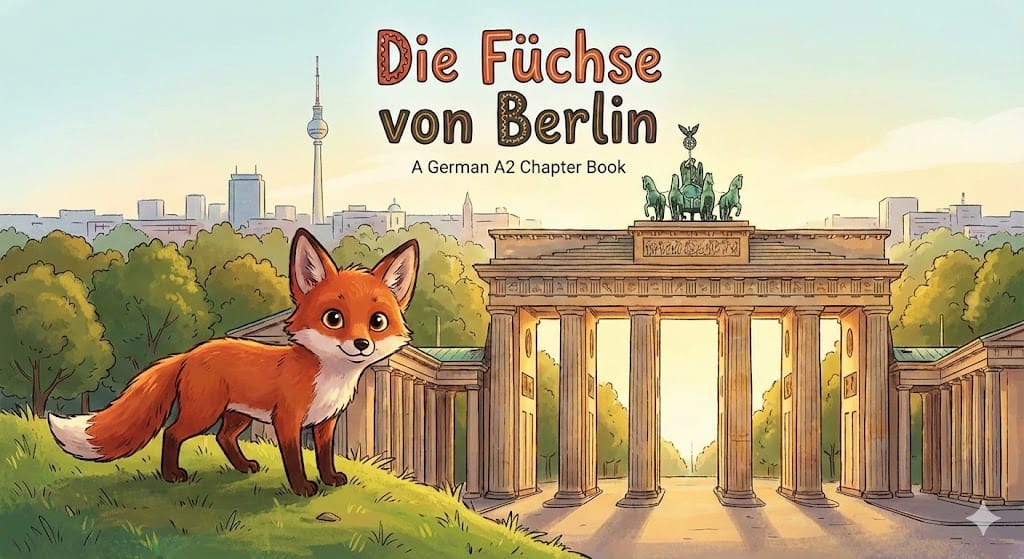
"title": "Die Füchse von Berlin",
"language": "de",
"subtitle": "A German A2 Chapter Book",
"chapters": [
{
"id": "chapter-1",
"title": "Chapitre 1: Das Haus im Tiergarten",
"content": [
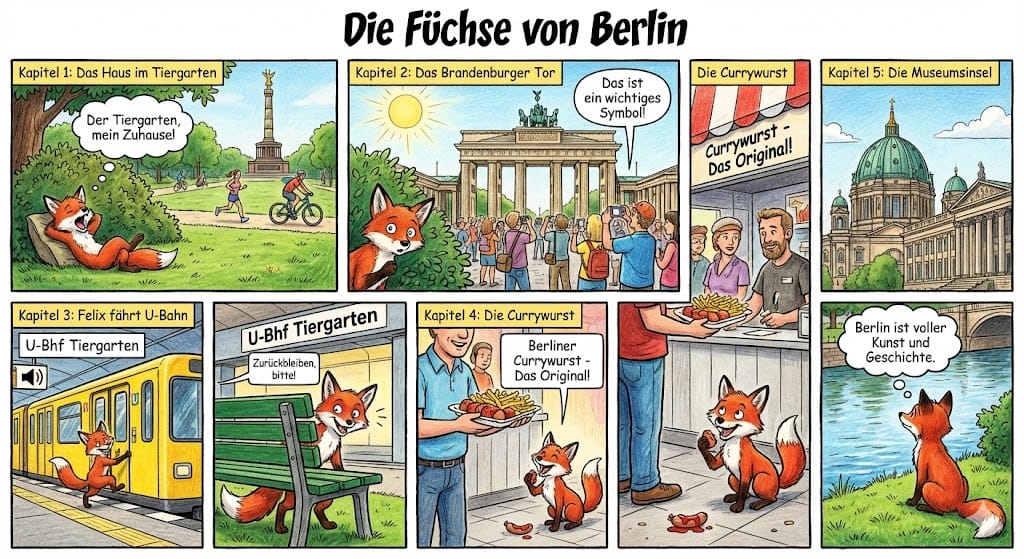
"Felix ist ein kleiner Rotfuchs. Er wohnt nicht im Wald, sondern mitten in Berlin. Sein Zuhause ist der Tiergarten, ein riesiger Park im Zentrum der Stadt. Am Morgen ist die Luft frisch. Felix schläft unter einem großen Busch in der Nähe der Siegessäule. Wenn er aufwacht, sieht er viele Jogger und Radfahrer auf den Wegen.",
"Der Tiergarten ist wie eine grüne Lunge für Berlin. Felix liebt sein Zuhause, denn hier ist es ruhig, aber die laute Stadt ist sehr nah. Heute möchte er ein Abenteuer erleben und die Stadt erkunden."
],
"translation": "Felix is a small red fox. He does not live in the forest, but in the middle of Berlin. His home is the Tiergarten, a huge park in the center of the city. In the morning, the air is fresh. Felix sleeps under a large bush near the Victory Column. When he wakes up, he sees many joggers and cyclists on the paths. The Tiergarten is like a green lung for Berlin. Felix loves his home because it is quiet here, but the loud city is very close. Today he wants to experience an adventure and explore the city.",
"quiz": [
{
"question": "1. Wo wohnt Felix?",
"options": [
{ "text": "a) In einem Wald außerhalb der Stadt", "value": "wrong" },
{ "text": "b) Im Tiergarten in Berlin", "value": "correct" },
{ "text": "c) In einem Zoo", "value": "wrong" }
]
},
{
"question": "2. Wer ist am Morgen im Park?",
"options": [
{ "text": "a) Nur Tiere", "value": "wrong" },
{ "text": "b) Autos und Busse", "value": "wrong" },
{ "text": "c) Jogger und Radfahrer", "value": "correct" }
]
},
{
"question": "3. True or False: Felix findet die Stadt zu laut und will wegziehen.",
"options": [
{ "text": "True", "value": "wrong" },
{ "text": "False", "value": "correct" }
]
}
]
},
{
"id": "chapter-2",
"title": "Chapitre 2: Das Brandenburger Tor",
"content": [
"Felix lief vorsichtig aus dem Park. Plötzlich stand er vor einem riesigen Bauwerk aus Stein. Es war das Brandenburger Tor. Es hat sechs große Säulen und oben drauf steht eine Statue mit Pferden, die Quadriga. Viele Touristen waren dort. Sie machten Fotos mit ihren Handys und Kameras.",
"Felix versteckte sich hinter einer Bank. Er wusste, dass dieses Tor ein wichtiges Symbol für Deutschland ist. Früher war die Stadt hier geteilt, aber jetzt können alle Menschen frei durch das Tor gehen. Felix fand das sehr beeindruckend."
],
"translation": "Felix walked cautiously out of the park. Suddenly, he stood in front of a huge stone structure. It was the Brandenburg Gate. It has six large columns and on top stands a statue with horses, the Quadriga. Many tourists were there. They were taking photos with their cell phones and cameras. Felix hid behind a bench. He knew that this gate is an important symbol for Germany. Formerly the city was divided here, but now all people can walk freely through the gate. Felix found that very impressive.",
"quiz": [
{
"question": "1. Was steht oben auf dem Brandenburger Tor?",
"options": [
{ "text": "a) Ein goldener Bär", "value": "wrong" },
{ "text": "b) Die Quadriga (Pferde)", "value": "correct" },
{ "text": "c) Eine Fahne", "value": "wrong" }
]
},
{
"question": "2. Was machen die Touristen am Tor?",
"options": [
{ "text": "a) Sie essen Pizza", "value": "wrong" },
{ "text": "b) Sie machen Fotos", "value": "correct" },
{ "text": "c) Sie schlafen", "value": "wrong" }
]
},
{
"question": "3. True or False: Das Tor war früher ein Symbol für die Teilung der Stadt.",
"options": [
{ "text": "True", "value": "correct" },
{ "text": "False", "value": "wrong" }
]
}
]
},
{
"id": "chapter-3",
"title": "Chapitre 3: Felix fährt U-Bahn",
"content": [
"Um mehr von der Stadt zu sehen, musste Felix reisen. Er sah ein großes gelbes Schild mit einem „U“. Er ging die Treppe hinunter in den Untergrund. Es roch nach Metall und alten Zeitungen. Ein gelber Zug fuhr laut in die Station ein. Das war die Berliner U-Bahn.",
"Eine Stimme sagte: „Zurückbleiben, bitte!“ Die Türen gingen auf und zu. Felix huschte schnell hinein, bevor die Türen schlossen. Er brauchte keine Fahrkarte, denn er war ein kleiner Fuchs. Er versteckte sich unter einem Sitz und schaute auf die Schuhe der Passagiere."
],
"translation": "To see more of the city, Felix had to travel. He saw a large yellow sign with a \"U\". He went down the stairs into the underground. It smelled of metal and old newspapers. A yellow train drove loudly into the station. That was the Berlin U-Bahn (subway). A voice said, \"Stand back, please!\" The doors opened and closed. Felix quickly scurried inside before the doors closed. He didn't need a ticket because he was a small fox. He hid under a seat and looked at the passengers' shoes.",
"quiz": [
{
"question": "1. Welche Farbe haben die U-Bahnen in Berlin oft?",
"options": [
{ "text": "a) Rot", "value": "wrong" },
{ "text": "b) Blau", "value": "wrong" },
{ "text": "c) Gelb", "value": "correct" }
]
},
{
"question": "2. Was bedeutet „Zurückbleiben, bitte“?",
"options": [
{ "text": "a) Please stand back", "value": "correct" },
{ "text": "b) Please come in", "value": "wrong" },
{ "text": "c) Please buy a ticket", "value": "wrong" }
]
},
{
"question": "3. True or False: Felix hat eine Fahrkarte gekauft.",
"options": [
{ "text": "True", "value": "wrong" },
{ "text": "False", "value": "correct" }
]
}
]
},
{
"id": "chapter-4",
"title": "Chapitre 4: Die Currywurst",
"content": [
"Felix stieg an einer Station aus und roch sofort etwas Leckeres. Es roch würzig und warm. An einem kleinen Imbissstand standen viele Leute. Sie aßen Wurst mit roter Soße und gelbem Pulver. Das war die berühmte Berliner Currywurst. Die Menschen aßen sie mit Pommes frites oder einem Brötchen.",
"Felix lief das Wasser im Mund zusammen. Zum Glück fiel einem Mann ein kleines Stück Wurst auf den Boden. Felix war schnell. Er schnappte sich das Stück und probierte es. Es war scharf, aber sehr gut!"
],
"translation": "Felix got off at a station and immediately smelled something delicious. It smelled spicy and warm. Many people stood at a small snack stand. They were eating sausage with red sauce and yellow powder. That was the famous Berlin Currywurst. People ate it with french fries or a bread roll. Felix's mouth was watering. Luckily, a man dropped a small piece of sausage on the ground. Felix was fast. He grabbed the piece and tasted it. It was spicy, but very good!",
"quiz": [
{
"question": "1. Was ist auf der Currywurst?",
"options": [
{ "text": "a) Senf und Gurken", "value": "wrong" },
{ "text": "b) Rote Soße und Currypulver", "value": "correct" },
{ "text": "c) Käse und Schinken", "value": "wrong" }
]
},
{
"question": "2. Wo kaufen die Leute die Wurst?",
"options": [
{ "text": "a) Im Supermarkt", "value": "wrong" },
{ "text": "b) An einem Imbissstand", "value": "correct" },
{ "text": "c) In der Apotheke", "value": "wrong" }
]
},
{
"question": "3. True or False: Felix mag den Geschmack der Currywurst nicht.",
"options": [
{ "text": "True", "value": "wrong" },
{ "text": "False", "value": "correct" }
]
}
]
},
{
"id": "chapter-5",
"title": "Chapitre 5: Die Museumsinsel",
"content": [
"Satt und zufrieden lief Felix weiter bis zum Fluss. Das war die Spree. In der Mitte des Flusses gab es eine Insel mit vielen alten, prächtigen Gebäuden. Das war die Museumsinsel. Hier gibt es fünf berühmte Museen. Felix sah das Alte Museum mit seinen vielen Säulen.",
"In der Nähe sah er auch eine riesige Kirche mit einer grünen Kuppel, den Berliner Dom. Alles sah sehr historisch und wichtig aus. Felix lernte, dass Berlin eine Stadt voller Kunst und Geschichte ist. Er setzte sich ans Ufer und beobachtete die Schiffe auf dem Wasser."
],
"translation": "Full and satisfied, Felix walked on to the river. That was the Spree. In the middle of the river, there was an island with many old, magnificent buildings. That was Museum Island. There are five famous museums here. Felix saw the Altes Museum (Old Museum) with its many columns. Nearby he also saw a huge church with a green dome, the Berlin Cathedral. Everything looked very historical and important. Felix learned that Berlin is a city full of art and history. He sat on the bank and watched the ships on the water.",
"quiz": [
{
"question": "1. Wie heißt der Fluss in Berlin?",
"options": [
{ "text": "a) Der Rhein", "value": "wrong" },
{ "text": "b) Die Donau", "value": "wrong" },
{ "text": "c) Die Spree", "value": "correct" }
]
},
{
"question": "2. Was steht auf der Insel?",
"options": [
{ "text": "a) Ein Fußballstadion", "value": "wrong" },
{ "text": "b) Fünf Museen", "value": "correct" },
{ "text": "c) Ein Einkaufszentrum", "value": "wrong" }
]
},
{
"question": "3. True or False: Der Berliner Dom hat eine grüne Kuppel.",
"options": [
{ "text": "True", "value": "correct" },
{ "text": "False", "value": "wrong" }
]
}
]
},
{
"id": "chapter-6",
"title": "Chapitre 6: Die Berliner Mauer",
"content": [
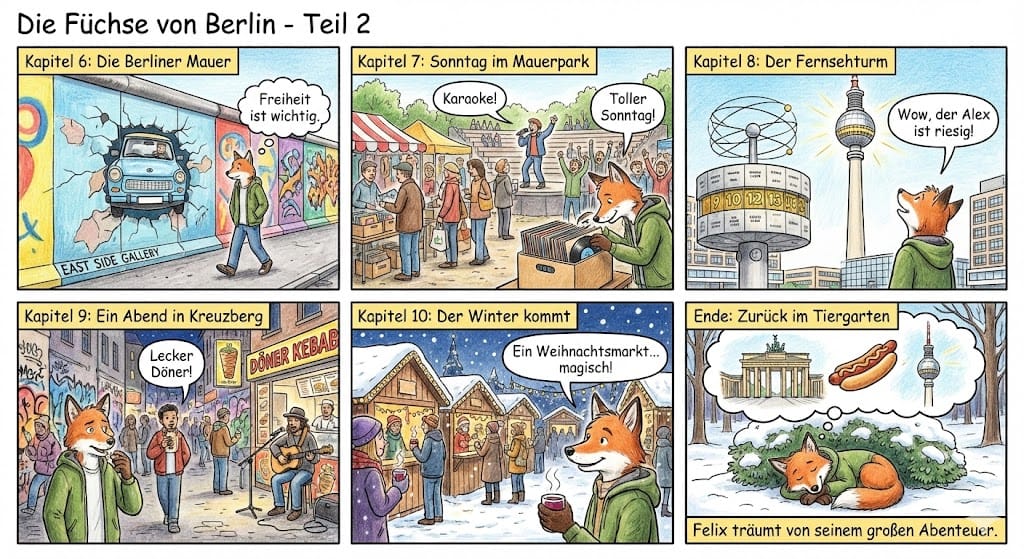
"Felix lief weiter Richtung Osten. Er kam an eine lange Wand aus Beton. Sie war sehr bunt bemalt. Das war die East Side Gallery. Es ist das längste Stück der Berliner Mauer, das noch steht. Früher war die Mauer grau und gefährlich. Sie teilte die Stadt in zwei Hälften.",
"Niemand durfte darüber klettern. Heute ist sie eine Galerie für Künstler aus der ganzen Welt. Felix sah ein Bild von einem Auto, das durch die Mauer bricht. Er verstand, dass Freiheit sehr wichtig für die Menschen in Berlin ist."
],
"translation": "Felix walked further east. He came to a long concrete wall. It was painted very colorfully. That was the East Side Gallery. It is the longest piece of the Berlin Wall that is still standing. Previously, the wall was gray and dangerous. It divided the city into two halves. No one was allowed to climb over it. Today it is a gallery for artists from all over the world. Felix saw a picture of a car breaking through the wall. He understood that freedom is very important for the people in Berlin.",
"quiz": [
{
"question": "1. Wie heißt dieser Teil der Mauer heute?",
"options": [
{ "text": "a) The Art Wall", "value": "wrong" },
{ "text": "b) East Side Gallery", "value": "correct" },
{ "text": "c) The Berlin Painting", "value": "wrong" }
]
},
{
"question": "2. Wie sah die Mauer früher aus?",
"options": [
{ "text": "a) Bunt und schön", "value": "wrong" },
{ "text": "b) Grau und gefährlich", "value": "correct" },
{ "text": "c) Aus Holz gemacht", "value": "wrong" }
]
},
{
"question": "3. True or False: Künstler haben die Mauer bemalt.",
"options": [
{ "text": "True", "value": "correct" },
{ "text": "False", "value": "wrong" }
]
}
]
},
{
"id": "chapter-7",
"title": "Chapitre 7: Sonntag im Mauerpark",
"content": [
"Es war Sonntag. In Deutschland sind am Sonntag die meisten Geschäfte geschlossen. Aber im Mauerpark war viel los. Felix sah Hunderte von Menschen. Es gab einen großen Flohmarkt. Leute verkauften alte Kleidung, Möbel und Bücher. Felix schnüffelte an einer Kiste mit alten Schallplatten.",
"Später hörte er laute Musik. In einem Amphitheater sang ein Mann vor vielen Zuschauern. Das war das berühmte Karaoke im Mauerpark. Die Leute klatschten und lachten. Die Stimmung war fröhlich und entspannt. Felix fand Sonntage in Berlin toll."
],
"translation": "It was Sunday. In Germany, most shops are closed on Sunday. But in Mauerpark, there was a lot going on. Felix saw hundreds of people. There was a large flea market. People were selling old clothes, furniture, and books. Felix sniffed at a box of old vinyl records. Later he heard loud music. In an amphitheater, a man was singing in front of many spectators. That was the famous karaoke in Mauerpark. People clapped and laughed. The atmosphere was cheerful and relaxed. Felix thought Sundays in Berlin were great.",
"quiz": [
{
"question": "1. Was ist am Sonntag in Deutschland normalerweise geschlossen?",
"options": [
{ "text": "a) Parks", "value": "wrong" },
{ "text": "b) Geschäfte", "value": "correct" },
{ "text": "c) Restaurants", "value": "wrong" }
]
},
{
"question": "2. Was findet im Mauerpark statt?",
"options": [
{ "text": "a) Ein Flohmarkt und Karaoke", "value": "correct" },
{ "text": "b) Ein Fußballspiel", "value": "wrong" },
{ "text": "c) Eine Parade", "value": "wrong" }
]
},
{
"question": "3. True or False: Felix kaufte eine alte Jacke.",
"options": [
{ "text": "True", "value": "wrong" },
{ "text": "False", "value": "correct" }
]
}
]
},
{
"id": "chapter-8",
"title": "Chapitre 8: Der Fernsehturm",
"content": [
"Felix kam zum Alexanderplatz. Die Berliner nennen diesen Platz einfach „Alex“. Dort sah er das höchste Gebäude in Deutschland: den Fernsehturm. Er ist 368 Meter hoch! Oben gibt es eine große Kugel, die in der Sonne glänzte. In der Kugel ist ein Restaurant, das sich langsam dreht.",
"Felix legte den Kopf in den Nacken, um die Spitze zu sehen. Er fühlte sich sehr klein. Viele Menschen trafen sich unter der Weltzeituhr auf dem Platz. Der Fernsehturm ist wie ein riesiger Kompass; man sieht ihn von fast überall in der Stadt."
],
"translation": "Felix came to Alexanderplatz. Berliners simply call this square \"Alex\". There he saw the tallest building in Germany: the TV Tower. It is 368 meters high! At the top, there is a large sphere that glistened in the sun. Inside the sphere is a restaurant that slowly rotates. Felix tilted his head back to see the top. He felt very small. Many people were meeting under the World Clock on the square. The TV Tower is like a huge compass; you can see it from almost everywhere in the city.",
"quiz": [
{
"question": "1. Welchen Spitznamen hat der Alexanderplatz?",
"options": [
{ "text": "a) Ali", "value": "wrong" },
{ "text": "b) Alex", "value": "correct" },
{ "text": "c) Platz der Einheit", "value": "wrong" }
]
},
{
"question": "2. Was ist besonders am Restaurant im Turm?",
"options": [
{ "text": "a) Es ist unter der Erde", "value": "wrong" },
{ "text": "b) Es dreht sich", "value": "correct" },
{ "text": "c) Es serviert nur Currywurst", "value": "wrong" }
]
},
{
"question": "3. True or False: Der Fernsehturm ist das höchste Gebäude in Deutschland.",
"options": [
{ "text": "True", "value": "correct" },
{ "text": "False", "value": "wrong" }
]
}
]
},
{
"id": "chapter-9",
"title": "Chapitre 9: Ein Abend in Kreuzberg",
"content": [
"Am Abend lief Felix in den Stadtteil Kreuzberg. Hier war die Atmosphäre ganz anders. Die Straßen waren voll mit jungen Leuten. Überall gab es Graffiti an den Wänden. Es roch wieder nach Essen, diesmal nach Döner Kebab. Berlin ist berühmt für seinen Döner.",
"Felix sah Musiker, die auf der Straße Gitarre spielten. Kreuzberg ist bekannt dafür, dass viele Kulturen hier zusammenleben. Es war laut, bunt und sehr lebendig. Felix mochte die Energie hier, auch wenn er langsam müde wurde."
],
"translation": "In the evening, Felix walked to the district of Kreuzberg. Here the atmosphere was completely different. The streets were full of young people. There was graffiti on the walls everywhere. It smelled like food again, this time like Döner Kebab. Berlin is famous for its Döner. Felix saw musicians playing guitar on the street. Kreuzberg is known for the fact that many cultures live together here. It was loud, colorful, and very lively. Felix liked the energy here, even though he was slowly getting tired.",
"quiz": [
{
"question": "1. Welches Essen ist typisch für den Abend in diesem Kapitel?",
"options": [
{ "text": "a) Sushi", "value": "wrong" },
{ "text": "b) Döner Kebab", "value": "correct" },
{ "text": "c) Eis", "value": "wrong" }
]
},
{
"question": "2. Wer spielte auf der Straße?",
"options": [
{ "text": "a) Musiker", "value": "correct" },
{ "text": "b) Fußballspieler", "value": "wrong" },
{ "text": "c) Polizisten", "value": "wrong" }
]
},
{
"question": "3. True or False: Kreuzberg ist ein sehr ruhiger und leerer Stadtteil.",
"options": [
{ "text": "True", "value": "wrong" },
{ "text": "False", "value": "correct" }
]
}
]
},
{
"id": "chapter-10",
"title": "Chapitre 10: Der Winter kommt",
"content": [
"Felix machte sich auf den Rückweg zum Tiergarten. Es wurde kälter und die ersten Schneeflocken fielen vom Himmel. Der Winter kam nach Berlin. Auf einem Platz sah er viele kleine Holzhütten mit Lichtern. Es roch nach Zimt und gebrannten Mandeln.",
"Das war ein Weihnachtsmarkt. Die Leute tranken heißen Glühwein, um sich zu wärmen. Alles funkelte und sah magisch aus. Felix war froh, wieder in seinem Park zu sein. Er kroch unter seinen Busch, rollte sich zusammen und träumte von seinem großen Tag in Berlin."
],
"translation": "Felix started his way back to the Tiergarten. It was getting colder and the first snowflakes fell from the sky. Winter was coming to Berlin. In a square, he saw many small wooden huts with lights. It smelled of cinnamon and roasted almonds. That was a Christmas market. People were drinking hot mulled wine (Glühwein) to warm themselves. Everything sparkled and looked magical. Felix was happy to be back in his park. He crawled under his bush, curled up, and dreamed of his big day in Berlin.",
"quiz": [
{
"question": "1. Welche Jahreszeit beginnt?",
"options": [
{ "text": "a) Sommer", "value": "wrong" },
{ "text": "b) Frühling", "value": "wrong" },
{ "text": "c) Winter", "value": "correct" }
]
},
{
"question": "2. Was trinken die Leute auf dem Weihnachtsmarkt?",
"options": [
{ "text": "a) Kalte Limonade", "value": "wrong" },
{ "text": "b) Heißen Glühwein", "value": "correct" },
{ "text": "c) Wasser", "value": "wrong" }
]
},
{
"question": "3. True or False: Felix schläft am Ende in einem Hotel.",
"options": [
{ "text": "True", "value": "wrong" },
{ "text": "False", "value": "correct" }
]
}
]
}
]
}