Learn about Germany's green city while practicing German.
{
"title": "Die Grüne Stadt",
"language": "de",
"subtitle": "A German A2 Science Story",
"chapters": [
{
"id": "chapter-1",
"title": "Kapitel 1: Ankunft mit dem Zug",
"content": [
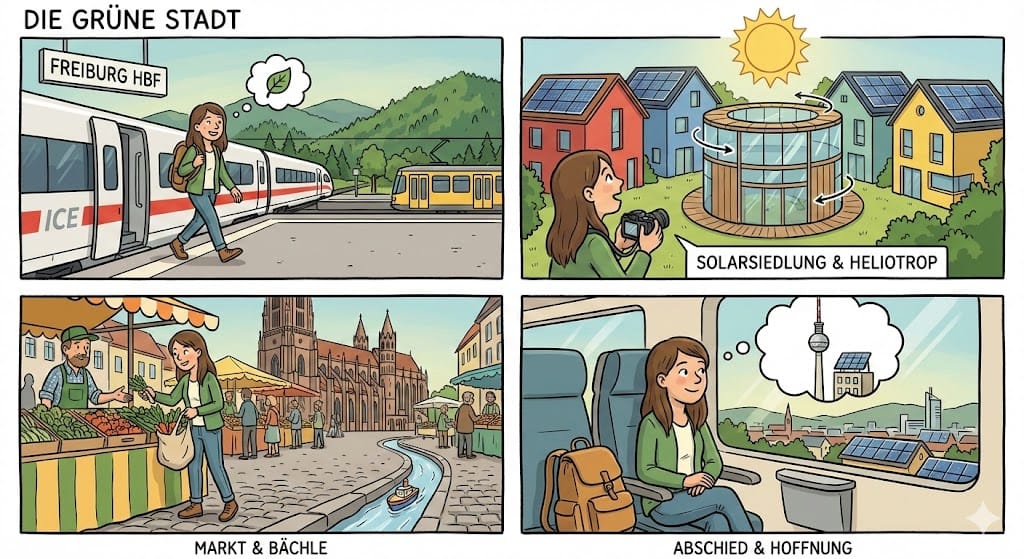
"Lena stieg aus dem ICE am Hauptbahnhof Freiburg aus. Sie trug einen schweren Rucksack, aber sie fühlte sich leicht. Lena ist Studentin der Umweltwissenschaften. Sie kommt aus Berlin, aber sie wollte sehen, wie eine \"Grüne Stadt\" funktioniert.",
"Die Luft war frisch, obwohl sie mitten in der Stadt war. Im Hintergrund sah sie die dunklen Tannen des Schwarzwaldes. Freiburg im Breisgau ist bekannt für sonniges Wetter, aber heute war es etwas bewölkt. Lena holte tief Luft. \"Hier beginnt mein Abenteuer,\" dachte sie. Sie suchte den Ausgang und ging zu der Straßenbahnhaltestelle. Sie wollte kein Taxi nehmen, um CO2 zu sparen."
],
"translation": "Lena got off the ICE train at Freiburg main station. She was carrying a heavy backpack, but she felt light. Lena is an environmental science student. She comes from Berlin, but she wanted to see how a \"Green City\" works. The air was fresh, even though she was in the middle of the city. In the background, she saw the dark fir trees of the Black Forest. Freiburg im Breisgau is known for sunny weather, but today it was a bit cloudy. Lena took a deep breath. \"My adventure begins here,\" she thought. She looked for the exit and walked to the tram stop. She didn't want to take a taxi in order to save CO2.",
"quiz": [
{
"question": "1. Woher kommt Lena?",
"options": [
{ "text": "a) Aus München", "value": "wrong" },
{ "text": "b) Aus Berlin", "value": "correct" },
{ "text": "c) Aus Freiburg", "value": "wrong" }
]
},
{
"question": "2. Was studiert Lena?",
"options": [
{ "text": "a) Umweltwissenschaften", "value": "correct" },
{ "text": "b) Germanistik", "value": "wrong" },
{ "text": "c) Kunstgeschichte", "value": "wrong" }
]
},
{
"question": "3. Wahr oder Falsch: Lena nimmt ein Taxi zum Hotel.",
"options": [
{ "text": "Wahr", "value": "wrong" },
{ "text": "Falsch", "value": "correct" }
]
}
]
},
{
"id": "chapter-2",
"title": "Kapitel 2: Die Solarsiedlung",
"content": [
"Am nächsten Morgen besuchte Lena den Stadtteil Vauban. Das ist ein berühmtes Viertel in Freiburg. Hier gibt es viele \"Plusenergiehäuser\". Lena wusste aus ihren Büchern, dass diese Häuser mehr Energie produzieren, als sie verbrauchen. Das war faszinierend.",
"Überall auf den Dächern sah sie blaue und schwarze Solarzellen. Die Sonne schien jetzt hell und die Technik arbeitete. Die Häuser waren bunt gestrichen: rot, gelb und blau. Es war sehr ruhig, weil es fast keine Autos auf den Straßen gab. Lena machte viele Fotos für ihre Universität. Sie notierte in ihr Heft: \"Die Zukunft der Architektur ist hier.\""
],
"translation": "The next morning, Lena visited the Vauban district. This is a famous neighborhood in Freiburg. There are many \"Plus-Energy Houses\" here. Lena knew from her books that these houses produce more energy than they consume. That was fascinating. Everywhere on the roofs, she saw blue and black solar panels. The sun was shining brightly now, and the technology was working. The houses were painted colorfully: red, yellow, and blue. It was very quiet because there were almost no cars on the streets. Lena took many photos for her university. She noted in her notebook: \"The future of architecture is here.\"",
"quiz": [
{
"question": "1. Was ist besonders an einem \"Plusenergiehaus\"?",
"options": [
{ "text": "a) Es ist sehr alt.", "value": "wrong" },
{ "text": "b) Es produziert mehr Energie, als es verbraucht.", "value": "correct" },
{ "text": "c) Es hat keine Fenster.", "value": "wrong" }
]
},
{
"question": "2. Was sieht Lena auf den Dächern?",
"options": [
{ "text": "a) Vögel", "value": "wrong" },
{ "text": "b) Antennen", "value": "wrong" },
{ "text": "c) Solarzellen", "value": "correct" }
]
},
{
"question": "3. Wahr oder Falsch: Im Stadtteil Vauban gibt es sehr viel Autoverkehr.",
"options": [
{ "text": "Wahr", "value": "wrong" },
{ "text": "Falsch", "value": "correct" }
]
}
]
},
{
"id": "chapter-3",
"title": "Kapitel 3: Fahrräder überall",
"content": [
"Um die Stadt besser zu erkunden, lieh sich Lena ein Fahrrad. In Freiburg ist das Fahrrad das wichtigste Verkehrsmittel. Es gibt breite Radwege und sogar spezielle Straßen nur für Fahrräder. Lena musste vorsichtig sein, denn die Radfahrer fuhren sehr schnell.",
"Sie klingelte, als ein Fußgänger auf dem Weg stand. \"Entschuldigung!\" rief sie freundlich. Es machte Spaß, an den Autos im Stau vorbeizufahren. Sie fühlte sich frei und sportlich. An der Universität sah sie einen riesigen Parkplatz, aber nicht für Autos, sondern für Hunderte von Fahrrädern. Das war echte, umweltfreundliche Mobilität."
],
"translation": "To explore the city better, Lena rented a bicycle. In Freiburg, the bicycle is the most important means of transport. There are wide bike paths and even special streets just for bicycles. Lena had to be careful because the cyclists rode very fast. She rang her bell when a pedestrian stood on the path. \"Excuse me!\" she called out in a friendly way. It was fun to ride past the cars in the traffic jam. She felt free and athletic. At the university, she saw a huge parking lot, but not for cars, but for hundreds of bicycles. That was true, eco-friendly mobility.",
"quiz": [
{
"question": "1. Welches Verkehrsmittel mietet Lena?",
"options": [
{ "text": "a) Ein Auto", "value": "wrong" },
{ "text": "b) Ein Fahrrad", "value": "correct" },
{ "text": "c) Einen Roller", "value": "wrong" }
]
},
{
"question": "2. Warum musste Lena vorsichtig sein?",
"options": [
{ "text": "a) Die Straßen waren glatt.", "value": "wrong" },
{ "text": "b) Die Radfahrer waren schnell.", "value": "correct" },
{ "text": "c) Das Fahrrad war kaputt.", "value": "wrong" }
]
},
{
"question": "3. Wahr oder Falsch: An der Universität gibt es einen großen Parkplatz nur für Fahrräder.",
"options": [
{ "text": "Wahr", "value": "correct" },
{ "text": "Falsch", "value": "wrong" }
]
}
]
},
{
"id": "chapter-4",
"title": "Kapitel 4: Mülltrennung ist wichtig",
"content": [
"Lena wollte einen Apfel essen und warf den Rest in einen Mülleimer. Ein alter Mann stoppte sie. \"Halt! Das gehört in den Biomüll,\" sagte er streng aber nett. Lena entschuldigte sich. In Deutschland ist Mülltrennung eine Wissenschaft.",
"Es gibt die Gelbe Tonne für Plastik, die Blaue Tonne für Papier, und die Braune Tonne für organische Abfälle wie Essen. Glas muss man zum Container bringen. Lena lernte schnell. Sie brachte auch ihre leere Wasserflasche zum Supermarkt zurück. Dort bekam sie 25 Cent \"Pfand\" zurück. Das System war kompliziert, aber sehr effizient für das Recycling."
],
"translation": "Lena wanted to eat an apple and threw the rest into a trash can. An old man stopped her. \"Stop! That belongs in the bio-waste,\" he said strictly but nicely. Lena apologized. In Germany, waste separation is a science. There is the Yellow Bin for plastic, the Blue Bin for paper, and the Brown Bin for organic waste like food. Glass must be taken to the container. Lena learned quickly. She also brought her empty water bottle back to the supermarket. There she got 25 cents \"Pfand\" (deposit) back. The system was complicated, but very efficient for recycling.",
"quiz": [
{
"question": "1. In welche Tonne kommt Papier?",
"options": [
{ "text": "a) Die Gelbe Tonne", "value": "wrong" },
{ "text": "b) Die Braune Tonne", "value": "wrong" },
{ "text": "c) Die Blaue Tonne", "value": "correct" }
]
},
{
"question": "2. Was bekam Lena im Supermarkt zurück?",
"options": [
{ "text": "a) Pfand", "value": "correct" },
{ "text": "b) Einen neuen Apfel", "value": "wrong" },
{ "text": "c) Eine Tüte", "value": "wrong" }
]
},
{
"question": "3. Wahr oder Falsch: Lena darf den Apfelrest in den Plastikmüll werfen.",
"options": [
{ "text": "Wahr", "value": "wrong" },
{ "text": "Falsch", "value": "correct" }
]
}
]
},
{
"id": "chapter-5",
"title": "Kapitel 5: Das Heliotrop",
"content": [
"Am Nachmittag besuchte Lena ein ganz besonderes Gebäude: das Heliotrop. Es wurde vom Architekten Rolf Disch gebaut. Das Haus sieht aus wie ein Baumhaus aus Glas und Holz. Das Besondere ist, dass es sich dreht. Es folgt der Sonne, genau wie eine Sonnenblume.",
"Wenn es Winter ist, dreht sich die Glasseite zur Sonne, um Wärme zu fangen. Im Sommer dreht sich die isolierte Seite zur Sonne, damit es kühl bleibt. Lena war beeindruckt von dieser Ingenieurskunst. \"Das ist intelligente Energie,\" sagte sie zu sich selbst. Sie kaufte eine Postkarte vom Heliotrop für ihre Eltern."
],
"translation": "In the afternoon, Lena visited a very special building: the Heliotrope. It was built by architect Rolf Disch. The house looks like a treehouse made of glass and wood. The special thing is that it rotates. It follows the sun, just like a sunflower. When it is winter, the glass side turns to the sun to catch heat. In summer, the insulated side turns to the sun so it stays cool. Lena was impressed by this engineering. \"That is intelligent energy,\" she said to herself. She bought a postcard of the Heliotrope for her parents.",
"quiz": [
{
"question": "1. Was macht das Heliotrop besonders?",
"options": [
{ "text": "a) Es steht unter der Erde.", "value": "wrong" },
{ "text": "b) Es dreht sich mit der Sonne.", "value": "correct" },
{ "text": "c) Es ist aus Stein gebaut.", "value": "wrong" }
]
},
{
"question": "2. Wie heißt der Architekt?",
"options": [
{ "text": "a) Rolf Disch", "value": "correct" },
{ "text": "b) Hans Müller", "value": "wrong" },
{ "text": "c) Lena Schmidt", "value": "wrong" }
]
},
{
"question": "3. Wahr oder Falsch: Im Winter dreht sich die Glasseite zur Sonne.",
"options": [
{ "text": "Wahr", "value": "correct" },
{ "text": "Falsch", "value": "wrong" }
]
}
]
},
{
"id": "chapter-6",
"title": "Kapitel 6: Der Markt am Münster",
"content": [
"Es war Samstag und Lena ging zum Münstermarkt. Der Markt liegt direkt vor dem großen Freiburger Münster, einer gotischen Kirche. Hier verkaufen Bauern aus der Region ihre Produkte. Lena kaufte Tomaten, Käse und Brot. Sie bemerkte, dass niemand Plastiktüten benutzte.",
"Alle hatten Körbe oder Stofftaschen. Die Produkte waren \"regional\" und \"saisonal\". Das bedeutet, sie kommen nicht von weit her. Das spart Transportkosten und schützt das Klima. Lena aß eine \"Lange Rote\", das ist die berühmte Bratwurst von Freiburg. Sie schmeckte köstlich nach den vielen Kilometern auf dem Fahrrad."
],
"translation": "It was Saturday and Lena went to the Minster Market. The market is located directly in front of the large Freiburg Minster, a Gothic church. Here, farmers from the region sell their products. Lena bought tomatoes, cheese, and bread. She noticed that no one used plastic bags. Everyone had baskets or cloth bags. The products were \"regional\" and \"seasonal.\" This means they do not come from far away. This saves transport costs and protects the climate. Lena ate a \"Lange Rote,\" which is the famous bratwurst of Freiburg. It tasted delicious after the many kilometers on the bicycle.",
"quiz": [
{
"question": "1. Wo findet der Markt statt?",
"options": [
{ "text": "a) Vor dem Bahnhof", "value": "wrong" },
{ "text": "b) Vor dem Münster", "value": "correct" },
{ "text": "c) Im Wald", "value": "wrong" }
]
},
{
"question": "2. Was bedeutet \"regional\"?",
"options": [
{ "text": "a) Produkte aus der Nähe", "value": "correct" },
{ "text": "b) Produkte aus dem Ausland", "value": "wrong" },
{ "text": "c) Produkte aus Plastik", "value": "wrong" }
]
},
{
"question": "3. Wahr oder Falsch: Lena benutzt viele Plastiktüten auf dem Markt.",
"options": [
{ "text": "Wahr", "value": "wrong" },
{ "text": "Falsch", "value": "correct" }
]
}
]
},
{
"id": "chapter-7",
"title": "Kapitel 7: Energie der Zukunft",
"content": [
"Lena hatte einen Termin an der Universität. Sie durfte eine Vorlesung über erneuerbare Energien besuchen. Der Professor sprach über Windkraft, Wasserkraft und Solarenergie. Er erklärte, dass Freiburg \"Green City\" heißt, weil die Bürger es so wollten.",
"Schon in den 1970er Jahren protestierten die Leute gegen ein Atomkraftwerk. Sie wollten saubere Energie. Lena schrieb fleißig mit. Sie lernte Wörter wie \"Nachhaltigkeit\" (sustainability) und \"Umweltschutz\". Nach der Vorlesung sprach sie mit Studenten. Alle waren motiviert, die Welt zu verbessern. Lena fühlte sich inspiriert. Wissenschaft kann wirklich helfen, Probleme zu lösen."
],
"translation": "Lena had an appointment at the university. She was allowed to attend a lecture on renewable energies. The professor spoke about wind power, hydropower, and solar energy. He explained that Freiburg is called \"Green City\" because the citizens wanted it that way. Already in the 1970s, people protested against a nuclear power plant. They wanted clean energy. Lena took notes diligently. She learned words like \"Nachhaltigkeit\" (sustainability) and \"Umweltschutz\" (environmental protection). After the lecture, she spoke with students. Everyone was motivated to improve the world. Lena felt inspired. Science can really help to solve problems.",
"quiz": [
{
"question": "1. Worüber sprach der Professor?",
"options": [
{ "text": "a) Über Geschichte", "value": "wrong" },
{ "text": "b) Über erneuerbare Energien", "value": "correct" },
{ "text": "c) Über Literatur", "value": "wrong" }
]
},
{
"question": "2. Warum heißt Freiburg \"Green City\"?",
"options": [
{ "text": "a) Weil die Bürger saubere Energie wollten.", "value": "correct" },
{ "text": "b) Weil alle Häuser grün gestrichen sind.", "value": "wrong" },
{ "text": "c) Weil es dort viel Geld gibt.", "value": "wrong" }
]
},
{
"question": "3. Wahr oder Falsch: Lena findet Wissenschaft nutzlos.",
"options": [
{ "text": "Wahr", "value": "wrong" },
{ "text": "Falsch", "value": "correct" }
]
}
]
},
{
"id": "chapter-8",
"title": "Kapitel 8: Ein Ausflug zum Schlossberg",
"content": [
"Nach so viel Lernen brauchte Lena Bewegung. Sie wanderte auf den Schlossberg. Der Weg war steil, aber schön. Oben hatte sie einen perfekten Blick über die ganze Stadt. Sie sah das Münster, die alten Dächer und die Solaranlagen in der Ferne.",
"Die Luft war hier oben noch sauberer. Lena dachte über den \"Treibhauseffekt\" nach. Bäume sind wichtig, weil sie CO2 speichern. Der Schwarzwald ist wie eine grüne Lunge für die Region. Sie setzte sich auf eine Bank und genoss die Stille. Ein Eichhörnchen kletterte auf einen Baum. Natur und Stadt waren hier in Harmonie."
],
"translation": "After so much learning, Lena needed exercise. She hiked up the Schlossberg (Castle Hill). The path was steep but beautiful. At the top, she had a perfect view over the whole city. She saw the Minster, the old roofs, and the solar systems in the distance. The air was even cleaner up here. Lena thought about the \"greenhouse effect.\" Trees are important because they store CO2. The Black Forest is like a green lung for the region. She sat on a bench and enjoyed the silence. A squirrel climbed a tree. Nature and city were in harmony here.",
"quiz": [
{
"question": "1. Wohin wandert Lena?",
"options": [
{ "text": "a) Auf den Schlossberg", "value": "correct" },
{ "text": "b) In den Keller", "value": "wrong" },
{ "text": "c) Zum Bahnhof", "value": "wrong" }
]
},
{
"question": "2. Warum sind Bäume wichtig für das Klima?",
"options": [
{ "text": "a) Sie spenden Schatten", "value": "wrong" },
{ "text": "b) Sie speichern CO2", "value": "correct" },
{ "text": "c) Sie sind grün", "value": "wrong" }
]
},
{
"question": "3. Wahr oder Falsch: Vom Schlossberg hat man keinen guten Blick auf die Stadt.",
"options": [
{ "text": "Wahr", "value": "wrong" },
{ "text": "Falsch", "value": "correct" }
]
}
]
},
{
"id": "chapter-9",
"title": "Kapitel 9: Das Bächle",
"content": [
"Wieder unten in der Altstadt, achtete Lena auf den Boden. Überall in den Gassen flossen kleine Wasserkanäle. Das sind die Freiburger \"Bächle\". Das Wasser kommt aus dem Fluss Dreisam. Früher nutzte man das Wasser zum Löschen von Feuer und für die Tiere.",
"Heute ist es eine Klimaanlage für die Stadt. Das Wasser kühlt die heißen Steine im Sommer. Es gibt eine lustige Legende: Wer aus Versehen in ein Bächle tritt, muss einen Freiburger oder eine Freiburgerin heiraten. Lena passte gut auf. Sie wollte noch nicht heiraten! Sie kaufte sich ein Eis und setzte sich neben das Wasser."
],
"translation": "Back down in the Old Town, Lena paid attention to the ground. Small water channels flowed everywhere in the alleys. These are the Freiburg \"Bächle\". The water comes from the river Dreisam. In the past, the water was used to extinguish fires and for animals. Today it is an air conditioner for the city. The water cools the hot stones in summer. There is a funny legend: Whoever accidentally steps into a Bächle must marry a Freiburg local. Lena was very careful. She didn't want to get married yet! She bought an ice cream and sat next to the water.",
"quiz": [
{
"question": "1. Woher kommt das Wasser in den Bächle?",
"options": [
{ "text": "a) Aus dem Rhein", "value": "wrong" },
{ "text": "b) Aus der Dreisam", "value": "correct" },
{ "text": "c) Aus der Donau", "value": "wrong" }
]
},
{
"question": "2. Welche Funktion haben die Bächle heute?",
"options": [
{ "text": "a) Sie kühlen die Stadt.", "value": "correct" },
{ "text": "b) Sie sind zum Schwimmen da.", "value": "wrong" },
{ "text": "c) Sie transportieren Boote.", "value": "wrong" }
]
},
{
"question": "3. Wahr oder Falsch: Die Legende sagt, wer in ein Bächle tritt, wird reich.",
"options": [
{ "text": "Wahr", "value": "wrong" },
{ "text": "Falsch", "value": "correct" }
]
}
]
},
{
"id": "chapter-10",
"title": "Kapitel 10: Abschied und Hoffnung",
"content": [
"Lenas Reise war zu Ende. Sie packte ihren Rucksack im Hotel. Sie hatte viel gelernt über Solarenergie, Mülltrennung und nachhaltiges Leben. Sie fühlte sich optimistisch. Wenn eine Stadt sich ändern kann, kann sich auch die Welt ändern.",
"Sie nahm den Zug zurück nach Berlin. In ihrem Kopf hatte sie viele Pläne. Vielleicht kann sie in Berlin auch ein Solar-Projekt starten? Oder mehr Fahrrad fahren? \"Auf Wiedersehen, Freiburg,\" flüsterte sie, als der Zug abfuhr. Sie wusste, dass sie eines Tages wiederkommen würde. Vielleicht als Ingenieurin für eine bessere Zukunft."
],
"translation": "Lena's trip was over. She packed her backpack in the hotel. She had learned a lot about solar energy, waste separation, and sustainable living. She felt optimistic. If a city can change, the world can change too. She took the train back to Berlin. In her head, she had many plans. Maybe she can start a solar project in Berlin too? Or ride a bicycle more? \"Goodbye, Freiburg,\" she whispered as the train departed. She knew that she would come back one day. Maybe as an engineer for a better future.",
"quiz": [
{
"question": "1. Wie fühlt sich Lena am Ende der Reise?",
"options": [
{ "text": "a) Traurig und müde", "value": "wrong" },
{ "text": "b) Optimistisch", "value": "correct" },
{ "text": "c) Wütend", "value": "wrong" }
]
},
{
"question": "2. Was möchte Lena in Berlin vielleicht tun?",
"options": [
{ "text": "a) Ein Auto kaufen", "value": "wrong" },
{ "text": "b) Ein Solar-Projekt starten", "value": "correct" },
{ "text": "c) Nichts tun", "value": "wrong" }
]
},
{
"question": "3. Wahr oder Falsch: Lena möchte nie wieder nach Freiburg kommen.",
"options": [
{ "text": "Wahr", "value": "wrong" },
{ "text": "Falsch", "value": "correct" }
]
}
]
}
]
}