{
"title": "Die Reise der Brüder Grimm",
"language": "de",
"subtitle": "A German A2 Chapter Book",
"chapters": [
{
"id": "chapter-1",
"title": "Kapitel 1: Zwei Brüder aus Hanau",
"content": [
"Jacob und Wilhelm Grimm wurden in den 1780er Jahren in Hanau geboren. Sie waren fast gleich alt und die besten Freunde. Ihre Familie war groß und glücklich. Als kleine Kinder spielten sie oft zusammen im Garten. Aber das Leben war nicht immer einfach.",
"Ihr Vater starb früh, als Jacob erst elf Jahre alt war. Die Familie hatte wenig Geld und musste sparen. Die Mutter war traurig, aber Jacob und Wilhelm versprachen, fleißig zu lernen. Sie wollten ihrer Familie helfen. Diese enge Bindung zwischen den Brüdern blieb ihr ganzes Leben lang bestehen. Sie teilten alles: Zimmer, Bücher und Träume."
],
"translation": "Jacob and Wilhelm Grimm were born in Hanau in the 1780s. They were almost the same age and best friends. Their family was large and happy. As small children, they often played together in the garden. But life was not always easy. Their father died early, when Jacob was only eleven years old. The family had little money and had to save. Their mother was sad, but Jacob and Wilhelm promised to study hard. They wanted to help their family. This close bond between the brothers lasted their whole lives. They shared everything: rooms, books, and dreams.",
"quiz": [
{
"question": "1. Wo wurden die Brüder geboren?",
"options": [
{ "text": "a) Berlin", "value": "wrong" },
{ "text": "b) Hanau", "value": "correct" },
{ "text": "c) München", "value": "wrong" }
]
},
{
"question": "2. Wahr oder Falsch: Die Familie hatte viel Geld nach dem Tod des Vaters.",
"options": [
{ "text": "Wahr", "value": "wrong" },
{ "text": "Falsch", "value": "correct" }
]
},
{
"question": "3. Was teilten die Brüder?",
"options": [
{ "text": "a) Nur das Essen", "value": "wrong" },
{ "text": "b) Zimmer, Bücher und Träume", "value": "correct" },
{ "text": "c) Nichts", "value": "wrong" }
]
}
]
},
{
"id": "chapter-2",
"title": "Kapitel 2: Studenten in Marburg",
"content": [
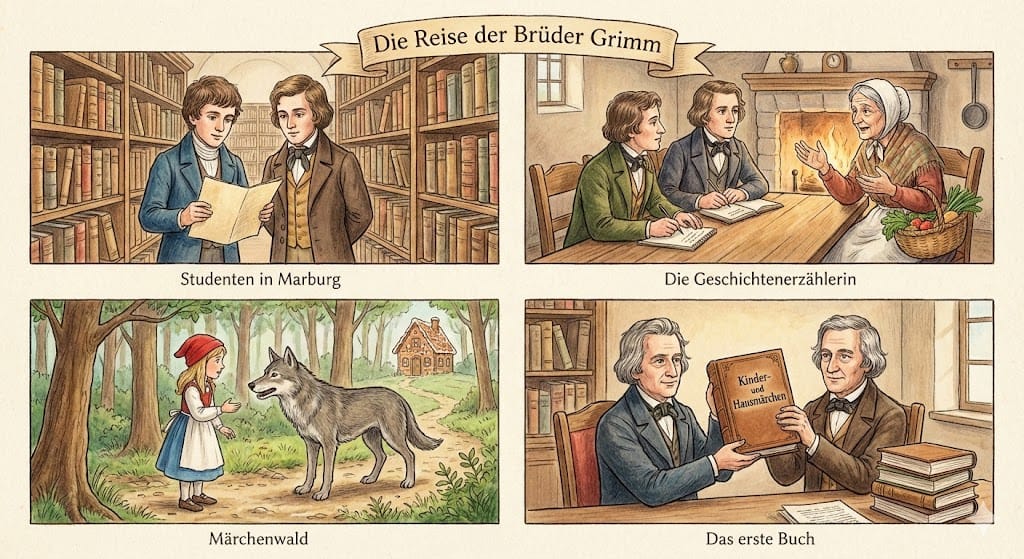
"Mit der Hilfe ihrer Tante gingen die Brüder zur Universität in Marburg. Sie wollten Jura studieren, um Anwälte zu werden. In Marburg war die Universität alt und berühmt. Ihr Professor, Herr von Savigny, hatte eine riesige private Bibliothek. Dort verbrachten Jacob und Wilhelm viele Stunden.",
"Sie lasen alte Bücher über Geschichte und Literatur. Diese alten Texte faszinierten sie mehr als die Gesetze. Sie lernten Mittelhochdeutsch und entdeckten die Poesie der Vergangenheit. In diesen Jahren verstanden sie, dass ihre wahre Leidenschaft nicht das Recht, sondern die Sprache und die alten Geschichten waren."
],
"translation": "With the help of their aunt, the brothers went to the university in Marburg. They wanted to study law to become lawyers. In Marburg, the university was old and famous. Their professor, Mr. von Savigny, had a huge private library. Jacob and Wilhelm spent many hours there. They read old books about history and literature. These old texts fascinated them more than the laws. They learned Middle High German and discovered the poetry of the past. In these years, they understood that their true passion was not law, but language and old stories.",
"quiz": [
{
"question": "1. Was wollten die Brüder ursprünglich studieren?",
"options": [
{ "text": "a) Medizin", "value": "wrong" },
{ "text": "b) Jura", "value": "correct" },
{ "text": "c) Kunst", "value": "wrong" }
]
},
{
"question": "2. Wer hatte eine große Bibliothek?",
"options": [
{ "text": "a) Ihre Tante", "value": "wrong" },
{ "text": "b) Der König", "value": "wrong" },
{ "text": "c) Professor von Savigny", "value": "correct" }
]
},
{
"question": "3. Wahr oder Falsch: Sie fanden Gesetze interessanter als alte Bücher.",
"options": [
{ "text": "Wahr", "value": "wrong" },
{ "text": "Falsch", "value": "correct" }
]
}
]
},
{
"id": "chapter-3",
"title": "Kapitel 3: Die Suche beginnt",
"content": [
"Zu dieser Zeit gab es in Deutschland viele kleine Königreiche. Die Menschen vergaßen langsam ihre Kultur. Jacob und Wilhelm wollten das verhindern. Sie hatten eine Idee: Sie wollten Geschichten sammeln, die sich die Leute mündlich erzählten. Es gab kein Internet und kein Fernsehen.",
"Die Großmütter erzählten den Enkelkindern Märchen am Feuer. Die Brüder reisten nicht weit, aber sie baten Freunde und Bekannte, ihnen Geschichten zu schicken. Sie glaubten, dass in diesen Märchen die Seele des deutschen Volkes lebte. Das war der Beginn einer großen Arbeit. Sie suchten nach Schätzen, die nicht aus Gold, sondern aus Wörtern waren."
],
"translation": "At this time, there were many small kingdoms in Germany. People were slowly forgetting their culture. Jacob and Wilhelm wanted to prevent that. They had an idea: they wanted to collect stories that people told each other orally. There was no internet and no television. Grandmothers told fairy tales to grandchildren by the fire. The brothers did not travel far, but they asked friends and acquaintances to send them stories. They believed that the soul of the German people lived in these fairy tales. That was the beginning of a great work. They were looking for treasures that were not made of gold, but of words.",
"quiz": [
{
"question": "1. Wie wurden die Geschichten weitergegeben?",
"options": [
{ "text": "a) Durch Bücher", "value": "wrong" },
{ "text": "b) Mündlich", "value": "correct" },
{ "text": "c) Durch das Radio", "value": "wrong" }
]
},
{
"question": "2. Wahr oder Falsch: Die Brüder suchten nach Goldmünzen.",
"options": [
{ "text": "Wahr", "value": "wrong" },
{ "text": "Falsch", "value": "correct" }
]
},
{
"question": "3. Was wollten die Brüder bewahren?",
"options": [
{ "text": "a) Die Kultur", "value": "correct" },
{ "text": "b) Die Gebäude", "value": "wrong" },
{ "text": "c) Die Kleidung", "value": "wrong" }
]
}
]
},
{
"id": "chapter-4",
"title": "Kapitel 4: Der deutsche Wald",
"content": [
"Viele Märchen der Brüder Grimm spielen im Wald. Der Wald war damals dunkel, groß und manchmal gefährlich. Für die Menschen war er ein Ort voller Geheimnisse. Bäume standen dicht zusammen und es gab wilde Tiere. In den Geschichten ist der Wald oft ein Ort der Prüfung.",
"Ein Held oder eine Heldin muss durch den Wald gehen, um das Ziel zu erreichen. Es gibt Hexen, Zwerge und sprechende Tiere. Der Wald symbolisiert das Unbekannte. Jacob und Wilhelm liebten die Natur. Sie wussten, dass der Wald in der deutschen Fantasie eine sehr wichtige Rolle spielt."
],
"translation": "Many of the Brothers Grimm's fairy tales take place in the forest. The forest back then was dark, large, and sometimes dangerous. For people, it was a place full of secrets. Trees stood close together and there were wild animals. In the stories, the forest is often a place of testing. A hero or heroine must go through the forest to reach the goal. There are witches, dwarves, and talking animals. The forest symbolizes the unknown. Jacob and Wilhelm loved nature. They knew that the forest plays a very important role in German imagination.",
"quiz": [
{
"question": "1. Wie war der Wald in den Geschichten?",
"options": [
{ "text": "a) Hell und sicher", "value": "wrong" },
{ "text": "b) Dunkel und geheimnisvoll", "value": "correct" },
{ "text": "c) Leer", "value": "wrong" }
]
},
{
"question": "2. Wahr oder Falsch: Der Wald ist oft ein Ort der Prüfung für den Helden.",
"options": [
{ "text": "Wahr", "value": "correct" },
{ "text": "Falsch", "value": "wrong" }
]
},
{
"question": "3. Was symbolisiert der Wald?",
"options": [
{ "text": "a) Das Unbekannte", "value": "correct" },
{ "text": "b) Die Stadt", "value": "wrong" },
{ "text": "c) Die Schule", "value": "wrong" }
]
}
]
},
{
"id": "chapter-5",
"title": "Kapitel 5: Die Geschichtenerzählerin",
"content": [
"Die Brüder brauchten gute Quellen für ihre Arbeit. Eine der wichtigsten Personen war Dorothea Viehmann. Sie war keine reiche Dame, sondern die Tochter eines Gastwirts. Sie verkaufte Gemüse auf dem Markt in Kassel. Dorothea kannte unglaublich viele alte Geschichten.",
"Sie hatte ein fantastisches Gedächtnis. Sie erzählte die Märchen immer wieder mit genau denselben Worten. Die Brüder schrieben alles schnell auf. Sie änderten fast nichts an ihren Worten. Ohne Dorothea Viehmann hätten wir heute viele berühmte Märchen nicht. Sie zeigte den Brüdern, dass Literatur dem einfachen Volk gehört."
],
"translation": "The brothers needed good sources for their work. One of the most important people was Dorothea Viehmann. She was not a rich lady, but the daughter of an innkeeper. She sold vegetables at the market in Kassel. Dorothea knew an incredibly large number of old stories. She had a fantastic memory. She told the fairy tales again and again with exactly the same words. The brothers wrote everything down quickly. They changed almost nothing of her words. Without Dorothea Viehmann, we would not have many famous fairy tales today. She showed the brothers that literature belongs to the common people.",
"quiz": [
{
"question": "1. Wer war Dorothea Viehmann?",
"options": [
{ "text": "a) Eine Prinzessin", "value": "wrong" },
{ "text": "b) Eine Gemüseverkäuferin", "value": "correct" },
{ "text": "c) Eine Lehrerin", "value": "wrong" }
]
},
{
"question": "2. Wahr oder Falsch: Dorothea änderte die Geschichten jedes Mal.",
"options": [
{ "text": "Wahr", "value": "wrong" },
{ "text": "Falsch", "value": "correct" }
]
},
{
"question": "3. Was hatte Dorothea?",
"options": [
{ "text": "a) Ein schlechtes Gedächtnis", "value": "wrong" },
{ "text": "b) Ein fantastisches Gedächtnis", "value": "correct" },
{ "text": "c) Viel Gold", "value": "wrong" }
]
}
]
},
{
"id": "chapter-6",
"title": "Kapitel 6: Rotkäppchen",
"content": [
"Eines der berühmtesten Märchen ist „Rotkäppchen“. Ein kleines Mädchen trägt eine rote Kappe. Die Mutter sagt: „Bleib auf dem Weg!“ Das Mädchen geht in den Wald, um die Großmutter zu besuchen. Aber sie trifft den bösen Wolf. Der Wolf ist charmant, aber gefährlich.",
"Er frisst die Großmutter und wartet auf das Mädchen. Diese Geschichte ist eine Warnung. Kinder sollen nicht mit Fremden sprechen. Die Version der Brüder Grimm endet gut: Ein Jäger rettet das Mädchen und die Großmutter. In älteren französischen Versionen gab es kein gutes Ende. Die Brüder wollten Hoffnung geben."
],
"translation": "One of the most famous fairy tales is \"Little Red Riding Hood\". A little girl wears a red cap. The mother says: \"Stay on the path!\" The girl goes into the forest to visit her grandmother. But she meets the big bad wolf. The wolf is charming but dangerous. He eats the grandmother and waits for the girl. This story is a warning. Children should not speak to strangers. The Brothers Grimm version ends well: A hunter saves the girl and the grandmother. In older French versions, there was no happy ending. The brothers wanted to give hope.",
"quiz": [
{
"question": "1. Was sagt die Mutter zu Rotkäppchen?",
"options": [
{ "text": "a) Lauf schnell", "value": "wrong" },
{ "text": "b) Bleib auf dem Weg", "value": "correct" },
{ "text": "c) Sprich mit dem Wolf", "value": "wrong" }
]
},
{
"question": "2. Wer rettet Rotkäppchen am Ende?",
"options": [
{ "text": "a) Der Vater", "value": "wrong" },
{ "text": "b) Ein Jäger", "value": "correct" },
{ "text": "c) Niemand", "value": "wrong" }
]
},
{
"question": "3. Wahr oder Falsch: Der Wolf ist ungefährlich.",
"options": [
{ "text": "Wahr", "value": "wrong" },
{ "text": "Falsch", "value": "correct" }
]
}
]
},
{
"id": "chapter-7",
"title": "Kapitel 7: Ein Haus aus Brot",
"content": [
"Ein anderes wichtiges Märchen ist „Hänsel und Gretel“. Es erzählt von großer Armut. Die Eltern haben kein Essen mehr und lassen die Kinder im Wald. Hänsel und Gretel haben Angst und Hunger. Plötzlich sehen sie ein Haus. Es ist aus Brot, Kuchen und Zucker gebaut! Es riecht wunderbar süß.",
"Aber im Haus wohnt eine böse Hexe, die Kinder isst. Das Märchen zeigt die Angst vor dem Hunger, die viele Menschen früher hatten. Gretel ist am Ende sehr mutig. Sie besiegt die Hexe und rettet ihren Bruder. Es ist eine Geschichte über Zusammenhalt."
],
"translation": "Another important fairy tale is \"Hansel and Gretel\". It tells of great poverty. The parents have no more food and leave the children in the forest. Hansel and Gretel are afraid and hungry. Suddenly they see a house. It is built of bread, cake, and sugar! It smells wonderfully sweet. But in the house lives an evil witch who eats children. The fairy tale shows the fear of hunger that many people used to have. Gretel is very brave in the end. She defeats the witch and saves her brother. It is a story about sticking together.",
"quiz": [
{
"question": "1. Woraus ist das Haus gebaut?",
"options": [
{ "text": "a) Holz und Stein", "value": "wrong" },
{ "text": "b) Brot, Kuchen und Zucker", "value": "correct" },
{ "text": "c) Gold und Silber", "value": "wrong" }
]
},
{
"question": "2. Wahr oder Falsch: Die Hexe ist freundlich.",
"options": [
{ "text": "Wahr", "value": "wrong" },
{ "text": "Falsch", "value": "correct" }
]
},
{
"question": "3. Wer besiegt die Hexe?",
"options": [
{ "text": "a) Hänsel", "value": "wrong" },
{ "text": "b) Der Vater", "value": "wrong" },
{ "text": "c) Gretel", "value": "correct" }
]
}
]
},
{
"id": "chapter-8",
"title": "Kapitel 8: Harte Arbeit am Schreibtisch",
"content": [
"Das Sammeln war nur der erste Schritt. Die wirkliche Arbeit passierte am Schreibtisch. Jacob und Wilhelm waren Wissenschaftler. Sie verglichen verschiedene Versionen einer Geschichte. Sie prüften die Grammatik und den Wortschatz. Jacob wollte, dass die Geschichten sehr original bleiben.",
"Wilhelm wollte sie poetischer und schöner machen, damit Kinder sie besser verstehen. Sie diskutierten oft darüber. Sie arbeiteten bis spät in die Nacht bei Kerzenlicht. Ihre Handschriften waren klein und ordentlich. Sie wollten ein Buch schaffen, das die deutsche Sprache perfekt zeigt. Es war harte, akademische Arbeit."
],
"translation": "Collecting was only the first step. The real work happened at the desk. Jacob and Wilhelm were scholars. They compared different versions of a story. They checked the grammar and the vocabulary. Jacob wanted the stories to remain very original. Wilhelm wanted to make them more poetic and beautiful so that children could understand them better. They often argued about this. They worked late into the night by candlelight. Their handwriting was small and neat. They wanted to create a book that showed the German language perfectly. It was hard, academic work.",
"quiz": [
{
"question": "1. Wer wollte die Geschichten poetischer machen?",
"options": [
{ "text": "a) Jacob", "value": "wrong" },
{ "text": "b) Wilhelm", "value": "correct" },
{ "text": "c) Dorothea", "value": "wrong" }
]
},
{
"question": "2. Wahr oder Falsch: Sie arbeiteten nur am Morgen.",
"options": [
{ "text": "Wahr", "value": "wrong" },
{ "text": "Falsch", "value": "correct" }
]
},
{
"question": "3. Was prüften sie?",
"options": [
{ "text": "a) Die Bilder", "value": "wrong" },
{ "text": "b) Grammatik und Wortschatz", "value": "correct" },
{ "text": "c) Den Preis des Buches", "value": "wrong" }
]
}
]
},
{
"id": "chapter-9",
"title": "Kapitel 9: Das erste Buch",
"content": [
"Im Jahr 1812 veröffentlichten sie endlich den ersten Band. Der Titel war „Kinder- und Hausmärchen“. Aber der Erfolg kam nicht sofort. Viele Eltern fanden die Geschichten zu grausam oder zu akademisch. Es gab keine Bilder im Buch. Kritiker sagten, es sei nicht gut für Kinder.",
"Die Brüder waren enttäuscht, aber sie gaben nicht auf. Wilhelm überarbeitete die Texte noch einmal. Er machte sie weicher und fügte christliche Motive hinzu. Erst die zweite Auflage mit Illustrationen wurde beliebt. Es dauerte Jahre, bis das Buch ein Bestseller wurde."
],
"translation": "In the year 1812, they finally published the first volume. The title was \"Children's and Household Tales\". But success did not come immediately. Many parents found the stories too cruel or too academic. There were no pictures in the book. Critics said it was not good for children. The brothers were disappointed, but they did not give up. Wilhelm revised the texts once more. He made them softer and added Christian motifs. Only the second edition with illustrations became popular. It took years for the book to become a bestseller.",
"quiz": [
{
"question": "1. Wann erschien der erste Band?",
"options": [
{ "text": "a) 1780", "value": "wrong" },
{ "text": "b) 1812", "value": "correct" },
{ "text": "c) 1900", "value": "wrong" }
]
},
{
"question": "2. Wahr oder Falsch: Das erste Buch war sofort ein riesiger Erfolg.",
"options": [
{ "text": "Wahr", "value": "wrong" },
{ "text": "Falsch", "value": "correct" }
]
},
{
"question": "3. Was fügte Wilhelm später hinzu?",
"options": [
{ "text": "a) Mehr Gewalt", "value": "wrong" },
{ "text": "b) Illustrationen und weichere Texte", "value": "correct" },
{ "text": "c) Neue Charaktere", "value": "wrong" }
]
}
]
},
{
"id": "chapter-10",
"title": "Kapitel 10: Ein Geschenk für die Welt",
"content": [
"Heute kennt jedes Kind die Brüder Grimm. Ihre Sammlung enthält über 200 Geschichten, wie Aschenputtel, Dornröschen und Schneewittchen. Das Buch wurde in über 160 Sprachen übersetzt. Es gehört zum Weltdokumentenerbe der UNESCO. In Deutschland gibt es die „Deutsche Märchenstraße“, eine Touristenroute von Hanau bis Bremen.",
"Jacob und Wilhelm waren mehr als nur Märchensammler; sie begannen auch das größte deutsche Wörterbuch. Aber ihr wichtigstes Geschenk bleibt die Magie der Märchen. Sie haben gezeigt, dass Träume und Geschichten zeitlos sind."
],
"translation": "Today, every child knows the Brothers Grimm. Their collection contains over 200 stories, such as Cinderella, Sleeping Beauty, and Snow White. The book has been translated into over 160 languages. It belongs to the UNESCO Memory of the World. In Germany, there is the \"German Fairy Tale Road\", a tourist route from Hanau to Bremen. Jacob and Wilhelm were more than just fairy tale collectors; they also started the largest German dictionary. But their most important gift remains the magic of fairy tales. They showed that dreams and stories are timeless.",
"quiz": [
{
"question": "1. Wie viele Sprachen wurden die Märchen übersetzt?",
"options": [
{ "text": "a) Über 50", "value": "wrong" },
{ "text": "b) Über 160", "value": "correct" },
{ "text": "c) Genau 10", "value": "wrong" }
]
},
{
"question": "2. Was ist die „Deutsche Märchenstraße“?",
"options": [
{ "text": "a) Ein Buch", "value": "wrong" },
{ "text": "b) Eine Touristenroute", "value": "correct" },
{ "text": "c) Eine Bibliothek", "value": "wrong" }
]
},
{
"question": "3. Wahr oder Falsch: Die Brüder schrieben auch ein Wörterbuch.",
"options": [
{ "text": "Wahr", "value": "correct" },
{ "text": "Falsch", "value": "wrong" }
]
}
]
}
]
}