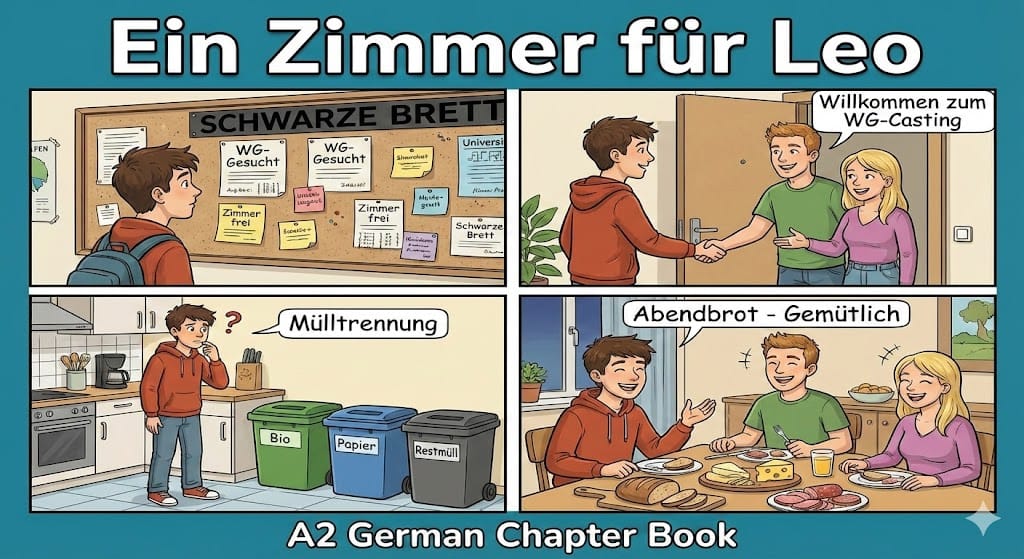
Join Leo on his journey to find the perfect student flat in Freiburg. This A2 German story covers essential vocabulary for housing, recycling, and student life in Germany.
{
"title": "Ein Zimmer für Leo",
"language": "de",
"subtitle": "A German A2 Chapter Book",
"chapters": [
{
"id": "chapter-1",
"title": "Kapitel 1: Ankunft in Freiburg",
"content": [
"Leo stieg am Hauptbahnhof in Freiburg aus dem Zug. Die Luft war frisch und die Stadt sah wunderschön aus. Viele Studenten liefen mit Rucksäcken und Büchern herum. Leo hatte nur einen großen Koffer und einen kleinen Rucksack.",
"Er war glücklich, aber auch ein bisschen nervös. Er hatte einen Studienplatz an der Universität, aber er hatte noch kein Zimmer. «Ich muss schnell eine Wohnung finden,» dachte Leo. Er kaufte sich einen Stadtplan und ein Brötchen. Sein Abenteuer in Deutschland begann genau jetzt. Er hoffte, nette Menschen zu treffen."
],
"translation": "Leo got off the train at the main station in Freiburg. The air was fresh and the city looked beautiful. Many students walked around with backpacks and books. Leo only had one large suitcase and a small backpack. He was happy, but also a little nervous. He had a study place at the university, but he didn't have a room yet. \"I must find an apartment quickly,\" thought Leo. He bought a city map and a bread roll. His adventure in Germany was beginning right now. He hoped to meet nice people.",
"quiz": [
{
"question": "1. Wo ist Leo angekommen?",
"options": [
{ "text": "a) Berlin", "value": "wrong" },
{ "text": "b) München", "value": "wrong" },
{ "text": "c) Freiburg", "value": "correct" }
]
},
{
"question": "2. Was hat Leo noch nicht?",
"options": [
{ "text": "a) Einen Koffer", "value": "wrong" },
{ "text": "b) Ein Zimmer", "value": "correct" },
{ "text": "c) Einen Studienplatz", "value": "wrong" }
]
},
{
"question": "3. True or False: Leo feels only happy.",
"options": [
{ "text": "True", "value": "wrong" },
{ "text": "False (He is also nervous)", "value": "correct" }
]
}
]
},
{
"id": "chapter-2",
"title": "Kapitel 2: Das Schwarze Brett",
"content": [
"Leo ging direkt zur Universität. Im Hauptgebäude gab es eine große Wand voller Zettel. Das war das «Schwarze Brett». Hier suchten Studenten nach Büchern, Jobs und Wohnungen. Leo las viele Anzeigen. Die Sprache war schwer zu verstehen.",
"Er sah viele Abkürzungen: «2er-WG», «NK» (Nebenkosten) und «ca.» (circa). Eine Anzeige gefiel ihm besonders gut. Dort stand: «Helles Zimmer in lustiger 3er-WG frei. Wir suchen einen netten Mitbewohner. Keine Haustiere.» Leo schrieb die Telefonnummer schnell auf ein Stück Papier. Das klang perfekt für ihn."
],
"translation": "Leo went directly to the university. In the main building, there was a large wall full of notes. That was the \"Black Board\" (bulletin board). Here students looked for books, jobs, and apartments. Leo read many ads. The language was hard to understand. He saw many abbreviations: \"2-person shared flat\", \"additional costs\", and \"approx.\". One ad pleased him particularly well. It read: \"Bright room in fun 3-person shared flat available. We are looking for a nice flatmate. No pets.\" Leo quickly wrote the phone number on a piece of paper. That sounded perfect for him.",
"quiz": [
{
"question": "1. Was ist das «Schwarze Brett»?",
"options": [
{ "text": "a) A blackboard for teaching", "value": "wrong" },
{ "text": "b) A bulletin board for ads", "value": "correct" },
{ "text": "c) A dark room", "value": "wrong" }
]
},
{
"question": "2. Was bedeutet «NK»?",
"options": [
{ "text": "a) Neue Küche", "value": "wrong" },
{ "text": "b) Nette Kinder", "value": "wrong" },
{ "text": "c) Nebenkosten", "value": "correct" }
]
},
{
"question": "3. True or False: The flat allows dogs.",
"options": [
{ "text": "True", "value": "wrong" },
{ "text": "False", "value": "correct" }
]
}
]
},
{
"id": "chapter-3",
"title": "Kapitel 3: Der Telefonanruf",
"content": [
"Leo hatte Angst vor dem Telefonieren. Sprechen war schwieriger als Lesen. Er atmete tief ein und wählte die Nummer. Ein junger Mann ging ans Telefon. «Hallo, hier ist Lukas,» sagte die Stimme. Leo antwortete höflich: «Guten Tag, mein Name ist Leo. Ich rufe wegen des Zimmers an.»",
"Er versuchte, klar und langsam zu sprechen. Lukas war sehr freundlich. Er duzte Leo sofort, was in WGs normal ist. «Komm doch vorbei und schau es dir an,» sagte Lukas. Sie vereinbarten einen Termin für den nächsten Tag um 14:00 Uhr."
],
"translation": "Leo was afraid of making phone calls. Speaking was more difficult than reading. He took a deep breath and dialed the number. A young man answered the phone. \"Hello, this is Lukas,\" said the voice. Leo answered politely: \"Good day, my name is Leo. I am calling about the room.\" He tried to speak clearly and slowly. Lukas was very friendly. He used \"Du\" with Leo immediately, which is normal in shared flats. \"Come by and take a look at it,\" said Lukas. They agreed on an appointment for the next day at 2:00 PM.",
"quiz": [
{
"question": "1. Warum hatte Leo Angst?",
"options": [
{ "text": "a) He lost his phone", "value": "wrong" },
{ "text": "b) Speaking is difficult", "value": "correct" },
{ "text": "c) He doesn't like Lukas", "value": "wrong" }
]
},
{
"question": "2. Wie heißt der Mann am Telefon?",
"options": [
{ "text": "a) Leo", "value": "wrong" },
{ "text": "b) Lukas", "value": "correct" },
{ "text": "c) Hans", "value": "wrong" }
]
},
{
"question": "3. True or False: They agreed to meet next week.",
"options": [
{ "text": "True", "value": "wrong" },
{ "text": "False", "value": "correct" }
]
}
]
},
{
"id": "chapter-4",
"title": "Kapitel 4: Pünktlichkeit ist wichtig",
"content": [
"Am nächsten Tag fuhr Leo mit der Straßenbahn zur Adresse. Der Termin war um 14:00 Uhr. Leo wusste, dass Pünktlichkeit in der deutschen Kultur sehr wichtig ist. Er wollte einen guten Eindruck machen. Deshalb kam er schon um 13:50 Uhr an.",
"Er wartete fünf Minuten vor der Haustür. Er wollte nicht zu früh klingeln, das ist unhöflich. Genau um 14:00 Uhr drückte er auf die Klingel. Sein Herz klopfte laut. Jemand summte die Tür auf und Leo ging die Treppe hinauf in den dritten Stock."
],
"translation": "The next day, Leo took the tram to the address. The appointment was at 2:00 PM. Leo knew that punctuality is very important in German culture. He wanted to make a good impression. Therefore, he arrived at 1:50 PM. He waited five minutes in front of the front door. He didn't want to ring too early, that is impolite. Exactly at 2:00 PM, he pressed the doorbell. His heart beat loudly. Someone buzzed the door open and Leo walked up the stairs to the third floor.",
"quiz": [
{
"question": "1. Wann war der Termin?",
"options": [
{ "text": "a) 13:50 Uhr", "value": "wrong" },
{ "text": "b) 14:00 Uhr", "value": "correct" },
{ "text": "c) 14:10 Uhr", "value": "wrong" }
]
},
{
"question": "2. Warum hat Leo gewartet?",
"options": [
{ "text": "a) He was lost", "value": "wrong" },
{ "text": "b) He wanted to be punctual, not early", "value": "correct" },
{ "text": "c) He forgot the number", "value": "wrong" }
]
},
{
"question": "3. True or False: The apartment is on the ground floor.",
"options": [
{ "text": "True", "value": "wrong" },
{ "text": "False", "value": "correct" }
]
}
]
},
{
"id": "chapter-5",
"title": "Kapitel 5: Das WG-Casting",
"content": [
"Lukas öffnete die Tür. Ein Mädchen stand neben ihm. «Hi, ich bin Hanna,» sagte sie. Das war das «WG-Casting». Es ist wie ein Vorstellungsgespräch für eine Wohnung. Sie setzten sich in die Küche und tranken Tee. Die Küche war gemütlich und etwas chaotisch.",
"Lukas und Hanna stellten viele Fragen. «Was studierst du?», «Kochst du gern?», «Rauchst du?». Leo erzählte von seiner Heimat und seinem Studium. Er fühlte sich wohl. Die Atmosphäre war locker. Er merkte, dass es wichtig war, sympathisch zu sein, nicht nur reich."
],
"translation": "Lukas opened the door. A girl stood next to him. \"Hi, I am Hanna,\" she said. This was the \"WG-Casting\" (flatshare interview). It is like a job interview for an apartment. They sat in the kitchen and drank tea. The kitchen was cozy and a bit chaotic. Lukas and Hanna asked many questions. \"What do you study?\", \"Do you like cooking?\", \"Do you smoke?\". Leo told them about his home country and his studies. He felt comfortable. The atmosphere was relaxed. He realized that it was important to be likable, not just rich.",
"quiz": [
{
"question": "1. Wer ist Hanna?",
"options": [
{ "text": "a) Lukas's mother", "value": "wrong" },
{ "text": "b) The landlady", "value": "wrong" },
{ "text": "c) The other flatmate", "value": "correct" }
]
},
{
"question": "2. Was haben sie in der Küche gemacht?",
"options": [
{ "text": "a) Cooked pasta", "value": "wrong" },
{ "text": "b) Drank tea and talked", "value": "correct" },
{ "text": "c) Signed the contract", "value": "wrong" }
]
},
{
"question": "3. True or False: Leo felt uncomfortable.",
"options": [
{ "text": "True", "value": "wrong" },
{ "text": "False", "value": "correct" }
]
}
]
},
{
"id": "chapter-6",
"title": "Kapitel 6: Die strenge Frage: Putzplan",
"content": [
"Plötzlich wurde Lukas ernst. Er zeigte auf einen Plan am Kühlschrank. Es waren viele Farben und Namen darauf. «Das ist unser Putzplan,» erklärte Lukas. «Sauberkeit ist uns sehr wichtig. Jeder muss einmal pro Woche putzen.»",
"In einer Woche putzt man das Bad, in der anderen den Flur oder die Küche. Leo nickte schnell. «Ich bin sehr ordentlich,» versprach er. Er wusste, dass der Putzplan in deutschen WGs heilig ist. Wenn man nicht putzt, gibt es Streit. Hanna lachte: «Keine Sorge, wir sind nicht die Polizei, aber wir mögen es sauber.»"
],
"translation": "Suddenly Lukas became serious. He pointed to a plan on the fridge. There were many colors and names on it. \"That is our cleaning schedule,\" explained Lukas. \"Cleanliness is very important to us. Everyone must clean once a week.\" In one week you clean the bathroom, in the other the hallway or the kitchen. Leo nodded quickly. \"I am very tidy,\" he promised. He knew that the cleaning schedule is sacred in German shared flats. If you don't clean, there is conflict. Hanna laughed: \"Don't worry, we aren't the police, but we like it clean.\"",
"quiz": [
{
"question": "1. Was hängt am Kühlschrank?",
"options": [
{ "text": "a) A calendar", "value": "wrong" },
{ "text": "b) A cleaning schedule", "value": "correct" },
{ "text": "c) A shopping list", "value": "wrong" }
]
},
{
"question": "2. Wie oft muss man putzen?",
"options": [
{ "text": "a) Once a month", "value": "wrong" },
{ "text": "b) Every day", "value": "wrong" },
{ "text": "c) Once a week", "value": "correct" }
]
},
{
"question": "3. True or False: Leo says he is messy.",
"options": [
{ "text": "True", "value": "wrong" },
{ "text": "False", "value": "correct" }
]
}
]
},
{
"id": "chapter-7",
"title": "Kapitel 7: Mülltrennung für Anfänger",
"content": [
"Hanna zeigte Leo den Rest der Küche. In der Ecke standen fünf verschiedene Eimer. Leo war verwirrt. «Warum so viele Eimer?» fragte er. Hanna erklärte die deutsche Mülltrennung. «Blau ist für Papier. Gelb ist für Plastik und Verpackungen. Braun ist für Bio-Müll, wie Bananenschalen. Und Schwarz ist für den Restmüll.»",
"Dann gab es noch einen Korb für Glas. Leo musste sich das alles merken. Es war kompliziert. Aber er wollte ein guter Mitbewohner sein. Er warf seinen Teebeutel vorsichtig in den braunen Eimer. Hanna lächelte zufrieden."
],
"translation": "Hanna showed Leo the rest of the kitchen. In the corner stood five different bins. Leo was confused. \"Why so many bins?\" he asked. Hanna explained German waste separation. \"Blue is for paper. Yellow is for plastic and packaging. Brown is for organic waste, like banana peels. And black is for residual waste.\" Then there was a basket for glass. Leo had to memorize all of this. It was complicated. But he wanted to be a good flatmate. He carefully threw his tea bag into the brown bin. Hanna smiled with satisfaction.",
"quiz": [
{
"question": "1. Wofür ist der blaue Eimer?",
"options": [
{ "text": "a) Plastic", "value": "wrong" },
{ "text": "b) Paper", "value": "correct" },
{ "text": "c) Glass", "value": "wrong" }
]
},
{
"question": "2. Wohin kommen Bananenschalen?",
"options": [
{ "text": "a) Yellow bin", "value": "wrong" },
{ "text": "b) Black bin", "value": "wrong" },
{ "text": "c) Brown bin", "value": "correct" }
]
},
{
"question": "3. True or False: Mülltrennung is simple for Leo.",
"options": [
{ "text": "True", "value": "wrong" },
{ "text": "False", "value": "correct" }
]
}
]
},
{
"id": "chapter-8",
"title": "Kapitel 8: Die Entscheidung",
"content": [
"Nach dem Treffen ging Leo zurück in sein Hostel. Er war müde, aber hoffnungsvoll. Lukas und Hanna hatten gesagt, dass sie sich heute Abend melden. Leo starrte auf sein Handy. Jede Minute fühlte sich wie eine Stunde an. Um 20:00 Uhr klingelte es endlich.",
"Es war Lukas. «Hey Leo,» sagte er. «Wir haben uns entschieden. Du kannst das Zimmer haben!» Leo jubelte laut. Er war so erleichtert. Sie besprachen kurz die Kaution und wann er einziehen konnte. Er würde schon am Samstag einziehen. Leo konnte es kaum glauben."
],
"translation": "After the meeting, Leo went back to his hostel. He was tired but hopeful. Lukas and Hanna had said they would get in touch this evening. Leo stared at his mobile phone. Every minute felt like an hour. At 8:00 PM it finally rang. It was Lukas. \"Hey Leo,\" he said. \"We have decided. You can have the room!\" Leo cheered loudly. He was so relieved. They briefly discussed the deposit and when he could move in. He would move in on Saturday. Leo could hardly believe it.",
"quiz": [
{
"question": "1. Wo wartete Leo?",
"options": [
{ "text": "a) In the park", "value": "wrong" },
{ "text": "b) In his hostel", "value": "correct" },
{ "text": "c) At the university", "value": "wrong" }
]
},
{
"question": "2. Was war die Antwort?",
"options": [
{ "text": "a) No", "value": "wrong" },
{ "text": "b) Maybe later", "value": "wrong" },
{ "text": "c) Yes", "value": "correct" }
]
},
{
"question": "3. True or False: Leo moves in next month.",
"options": [
{ "text": "True", "value": "wrong" },
{ "text": "False (On Saturday)", "value": "correct" }
]
}
]
},
{
"id": "chapter-9",
"title": "Kapitel 9: Das Bürgeramt",
"content": [
"Am Freitag unterschrieb Leo den Mietvertrag. Aber er hatte noch eine Aufgabe. Er musste sich beim Bürgeramt anmelden. In Deutschland muss jeder seine Adresse registrieren. Leo ging früh zum Amt. Er zog eine Nummer und wartete im Wartezimmer.",
"Es gab viele Leute und es dauerte lange. Nach zwei Stunden leuchtete seine Nummer auf dem Bildschirm auf. Er ging zum Schalter und gab dem Beamten seinen Pass und den Mietvertrag. Der Beamte stempelte ein Formular und gab es Leo. Jetzt war er offiziell ein Bürger von Freiburg."
],
"translation": "On Friday, Leo signed the rental contract. But he had one more task. He had to register at the Citizens' Office. In Germany, everyone must register their address. Leo went to the office early. He took a number and waited in the waiting room. There were many people and it took a long time. After two hours, his number lit up on the screen. He went to the counter and gave the official his passport and the rental contract. The official stamped a form and gave it to Leo. Now he was officially a citizen of Freiburg.",
"quiz": [
{
"question": "1. Was muss man beim Bürgeramt machen?",
"options": [
{ "text": "a) Buy a ticket", "value": "wrong" },
{ "text": "b) Register the address", "value": "correct" },
{ "text": "c) Pay rent", "value": "wrong" }
]
},
{
"question": "2. Wie lange hat Leo gewartet?",
"options": [
{ "text": "a) 10 minutes", "value": "wrong" },
{ "text": "b) 2 hours", "value": "correct" },
{ "text": "c) 5 hours", "value": "wrong" }
]
},
{
"question": "3. True or False: The official needed Leo's passport.",
"options": [
{ "text": "True", "value": "correct" },
{ "text": "False", "value": "wrong" }
]
}
]
},
{
"id": "chapter-10",
"title": "Kapitel 10: Das erste Abendbrot",
"content": [
"Am Samstag zog Leo ein. Er packte seinen Koffer aus und stellte Bücher in das Regal. Sein Zimmer war hell und freundlich. Am Abend klopfte Hanna an seine Tür. «Kommst du zum Abendbrot?» fragte sie. In der Küche war der Tisch gedeckt.",
"Es gab Brot, Käse, Wurst, Butter und Gewürzgurken. Es gab kein warmes Essen. Leo lernte, dass das traditionelle deutsche Abendessen oft kalt ist. Sie aßen zusammen, tranken Bier und lachten. Leo fühlte sich nicht mehr fremd. Er hatte ein neues Zuhause und neue Freunde gefunden."
],
"translation": "On Saturday, Leo moved in. He unpacked his suitcase and put books on the shelf. His room was bright and friendly. In the evening, Hanna knocked on his door. \"Are you coming for Abendbrot (dinner)?\" she asked. In the kitchen, the table was set. There was bread, cheese, sausage, butter, and pickles. There was no warm food. Leo learned that the traditional German dinner is often cold. They ate together, drank beer, and laughed. Leo no longer felt like a stranger. He had found a new home and new friends.",
"quiz": [
{
"question": "1. Was gab es zum Essen?",
"options": [
{ "text": "a) Pizza and Pasta", "value": "wrong" },
{ "text": "b) Bread, cheese, and sausage", "value": "correct" },
{ "text": "c) Soup", "value": "wrong" }
]
},
{
"question": "2. War das Essen warm oder kalt?",
"options": [
{ "text": "a) Warm", "value": "wrong" },
{ "text": "b) Cold", "value": "correct" },
{ "text": "c) Very hot", "value": "wrong" }
]
},
{
"question": "3. True or False: Leo felt lonely at the end.",
"options": [
{ "text": "True", "value": "wrong" },
{ "text": "False", "value": "correct" }
]
}
]
}
]
}