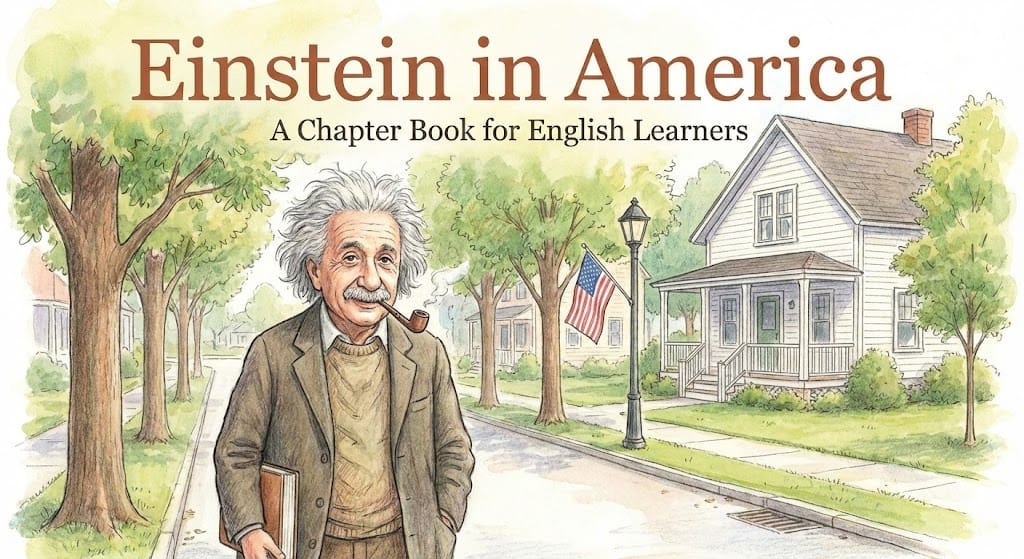
Improve your English reading skills with this A2-level chapter book about Albert Einstein’s life in America.
{
"title": "Einstein in America",
"language": "en",
"subtitle": "An English A2 Chapter Book with Thai Support",
"chapters": [
{
"id": "chapter-1",
"title": "Chapter 1: Goodbye to Europe",
"content": [
"In October 1933, Albert Einstein packed his bags. He was a famous scientist in Germany, but it was no longer safe for him there. He had to leave his home.",
"Albert boarded a large ship called the Westernland. He traveled across the Atlantic Ocean with his wife, Elsa. The journey was long and the ocean was vast. Albert felt sad to leave Europe, but he was also hopeful. He was going to America to find freedom. He looked at the blue water and thought about his new life. He knew that big changes were coming soon."
],
"translation": "ในเดือนตุลาคม ปี 1933 อัลเบิร์ต ไอน์สไตน์ เก็บกระเป๋าของเขา เขาเป็นนักวิทยาศาสตร์ที่มีชื่อเสียงในเยอรมนี แต่ที่นั่นไม่ปลอดภัยสำหรับเขาอีกต่อไป เขาจำเป็นต้องออกจากบ้าน อัลเบิร์ตขึ้นเรือใหญ่ที่ชื่อว่า *เวสเทิร์นแลนด์* เขาเดินทางข้ามมหาสมุทรแอตแลนติกกับเอลซ่า ภรรยาของเขา การเดินทางนั้นยาวนานและมหาสมุทรก็กว้างใหญ่ อัลเบิร์ตรู้สึกเศร้าที่ต้องจากยุโรปไป แต่เขาก็มีความหวัง เขาจะไปอเมริกาเพื่อหาเสรีภาพ เขามองดูน้ำสีฟ้าและคิดถึงชีวิตใหม่ของเขา เขารู้ว่าการเปลี่ยนแปลงครั้งใหญ่กำลังจะมาถึงในเร็วๆ นี้",
"quiz": [
{
"question": "1. True or False: Albert traveled alone to America.",
"options": [
{ "text": "True", "value": "wrong" },
{ "text": "False", "value": "correct" }
]
},
{
"question": "2. Why did Albert leave Germany?",
"options": [
{ "text": "a) He wanted a holiday.", "value": "wrong" },
{ "text": "b) It was not safe.", "value": "correct" },
{ "text": "c) He did not like the food.", "value": "wrong" }
]
},
{
"question": "3. How did he travel?",
"options": [
{ "text": "a) By airplane", "value": "wrong" },
{ "text": "b) By train", "value": "wrong" },
{ "text": "c) By ship", "value": "correct" }
]
}
]
},
{
"id": "chapter-2",
"title": "Chapter 2: The Statue of Liberty",
"content": [
"The ship arrived in New York Harbor. It was a busy morning. Albert stood on the deck and looked at the city skyline. He saw a very tall woman made of copper. It was the Statue of Liberty. She held a torch high in the air. This statue welcomed immigrants to the United States.",
"For Albert, she was a symbol of a fresh start. Reporters and photographers were waiting for him at the dock. Everyone wanted to take a picture of the genius. Albert smiled shyly. He was happy to finally be on American soil."
],
"translation": "เรือมาถึงอ่าวปอร์ตนิวยอร์ก เป็นเช้าที่วุ่นวาย อัลเบิร์ตยืนอยู่บนดาดฟ้าเรือและมองดูเส้นขอบฟ้าของเมือง เขาเห็นผู้หญิงตัวสูงมากที่ทำจากทองแดง นั่นคือเทพีเสรีภาพ เธอชูคบเพลิงสูงขึ้นไปในอากาศ รูปปั้นนี้ต้อนรับผู้อพยพสู่สหรัฐอเมริกา สำหรับอัลเบิร์ต เธอเป็นสัญลักษณ์ของการเริ่มต้นใหม่ นักข่าวและช่างภาพกำลังรอเขาอยู่ที่ท่าเรือ ทุกคนอยากถ่ายรูปอัจฉริยะคนนี้ อัลเบิร์ตยิ้มอย่างเขินอาย เขามีความสุขที่ได้มายืนอยู่บนแผ่นดินอเมริกาในที่สุด",
"quiz": [
{
"question": "1. What did Albert see in the harbor?",
"options": [
{ "text": "a) The Statue of Liberty", "value": "correct" },
{ "text": "b) The Golden Gate Bridge", "value": "wrong" },
{ "text": "c) The Eiffel Tower", "value": "wrong" }
]
},
{
"question": "2. True or False: There were no reporters waiting for Albert.",
"options": [
{ "text": "True", "value": "wrong" },
{ "text": "False", "value": "correct" }
]
},
{
"question": "3. What is the statue made of?",
"options": [
{ "text": "a) Gold", "value": "wrong" },
{ "text": "b) Stone", "value": "wrong" },
{ "text": "c) Copper", "value": "correct" }
]
}
]
},
{
"id": "chapter-3",
"title": "Chapter 3: Welcome to Princeton",
"content": [
"Albert did not stay in the busy city of New York. He moved to a small town called Princeton in New Jersey. Princeton was very different from the big city. It was quiet, green, and peaceful. There were many trees and beautiful old buildings.",
"Albert began working at the Institute for Advanced Study. It was a perfect place for thinking. He liked the calm atmosphere. In Princeton, people were friendly but respectful. Albert felt relaxed here. He could focus on his work without too much noise. This quiet town quickly became his new home."
],
"translation": "อัลเบิร์ตไม่ได้พักอยู่ในเมืองนิวยอร์กที่วุ่นวาย เขาย้ายไปที่เมืองเล็กๆ ชื่อพรินซ์ตัน ในรัฐนิวเจอร์ซีย์ พรินซ์ตันแตกต่างจากเมืองใหญ่มาก มันเงียบสงบ ร่มรื่น และสงบสุข มีต้นไม้มากมายและอาคารเก่าแก่ที่สวยงาม อัลเบิร์ตเริ่มทำงานที่สถาบันเพื่อการศึกษาระดับสูง มันเป็นสถานที่ที่สมบูรณ์แบบสำหรับการใช้ความคิด เขาชอบบรรยากาศที่เงียบสงบ ในพรินซ์ตัน ผู้คนเป็นมิตรแต่ก็ให้เกียรติกัน อัลเบิร์ตรู้สึกผ่อนคลายที่นี่ เขาสามารถจดจ่อกับงานของเขาโดยไม่มีเสียงรบกวนมากนัก เมืองที่เงียบสงบนี้กลายเป็นบ้านใหม่ของเขาอย่างรวดเร็ว",
"quiz": [
{
"question": "1. Where did Albert move to?",
"options": [
{ "text": "a) Chicago", "value": "wrong" },
{ "text": "b) Princeton", "value": "correct" },
{ "text": "c) Boston", "value": "wrong" }
]
},
{
"question": "2. True or False: Princeton was a very noisy city.",
"options": [
{ "text": "True", "value": "wrong" },
{ "text": "False", "value": "correct" }
]
},
{
"question": "3. Why did he like Princeton?",
"options": [
{ "text": "a) It was good for thinking", "value": "correct" },
{ "text": "b) It had big shopping malls", "value": "wrong" },
{ "text": "c) It was near the beach", "value": "wrong" }
]
}
]
},
{
"id": "chapter-4",
"title": "Chapter 4: The Professor’s House",
"content": [
"Albert bought a house at 112 Mercer Street. It was a simple white house with a nice garden. Inside, he made a study room on the second floor. This room had a large window that looked out at the trees. The room was full of books and papers.",
"Albert loved to sit in his favorite chair and read. He did not like expensive furniture. He preferred things that were comfortable. This house was his sanctuary. He lived there with his family and his stepdaughter, Margot. It was a warm and happy place full of ideas."
],
"translation": "อัลเบิร์ตซื้อบ้านที่เลขที่ 112 ถนนเมอร์เซอร์ มันเป็นบ้านสีขาวเรียบง่ายที่มีสวนสวย ภายในเขาทำห้องทำงานที่ชั้นสอง ห้องนี้มีหน้าต่างบานใหญ่ที่มองออกไปเห็นต้นไม้ ห้องเต็มไปด้วยหนังสือและเอกสาร อัลเบิร์ตชอบนั่งบนเก้าอี้ตัวโปรดและอ่านหนังสือ เขาไม่ชอบเฟอร์นิเจอร์ราคาแพง เขาชอบสิ่งที่สะดวกสบายมากกว่า บ้านหลังนี้เป็นสถานที่หลบภัยของเขา เขาอาศัยอยู่ที่นั่นกับครอบครัวและมาร์โกต์ ลูกเลี้ยงของเขา มันเป็นสถานที่ที่อบอุ่นและมีความสุข เต็มไปด้วยความคิดไอเดียต่างๆ",
"quiz": [
{
"question": "1. What color was the house?",
"options": [
{ "text": "a) Red", "value": "wrong" },
{ "text": "b) Blue", "value": "wrong" },
{ "text": "c) White", "value": "correct" }
]
},
{
"question": "2. Where was his study room?",
"options": [
{ "text": "a) In the basement", "value": "wrong" },
{ "text": "b) On the second floor", "value": "correct" },
{ "text": "c) In the kitchen", "value": "wrong" }
]
},
{
"question": "3. True or False: Albert liked expensive furniture.",
"options": [
{ "text": "True", "value": "wrong" },
{ "text": "False", "value": "correct" }
]
}
]
},
{
"id": "chapter-5",
"title": "Chapter 5: Walking to Work",
"content": [
"Every morning, Albert walked to his office. The walk was about one mile long. Albert did not like to drive cars. He thought walking was better for his brain. While he walked, he looked at the sky and the nature around him. Sometimes, he stopped to watch the birds.",
"The fresh air helped him solve difficult physics problems. The neighbors in Princeton often saw him. He wore a rumpled coat and a hat. He always waved and smiled at them. For Albert, the walk was the most important part of his daily routine."
],
"translation": "ทุกเช้า อัลเบิร์ตจะเดินไปที่ทำงานของเขา ระยะทางเดินประมาณหนึ่งไมล์ อัลเบิร์ตไม่ชอบขับรถยนต์ เขาคิดว่าการเดินดีต่อสมองของเขามากกว่า ขณะที่เขาเดิน เขาจะมองดูท้องฟ้าและธรรมชาติรอบตัว บางครั้งเขาก็หยุดดูนก อากาศบริสุทธิ์ช่วยให้เขาแก้ปัญหาฟิสิกส์ที่ยากๆ ได้ เพื่อนบ้านในพรินซ์ตันมักจะเห็นเขา เขาจะสวมเสื้อโค้ทที่ยับยู่ยี่และสวมหมวก เขาจะโบกมือและยิ้มให้พวกเขาเสมอ สำหรับอัลเบิร์ต การเดินเป็นส่วนที่สำคัญที่สุดในกิจวัตรประจำวันของเขา",
"quiz": [
{
"question": "1. How did Albert get to work?",
"options": [
{ "text": "a) He drove a car", "value": "wrong" },
{ "text": "b) He walked", "value": "correct" },
{ "text": "c) He rode a bicycle", "value": "wrong" }
]
},
{
"question": "2. True or False: The walk helped him think about physics.",
"options": [
{ "text": "True", "value": "correct" },
{ "text": "False", "value": "wrong" }
]
},
{
"question": "3. What did he do to the neighbors?",
"options": [
{ "text": "a) He ignored them", "value": "wrong" },
{ "text": "b) He waved and smiled", "value": "correct" },
{ "text": "c) He yelled at them", "value": "wrong" }
]
}
]
},
{
"id": "chapter-6",
"title": "Chapter 6: No Socks!",
"content": [
"People in America noticed that Albert was a bit eccentric. He had wild, grey hair that stood up in all directions. But his strangest habit was about his feet. Albert did not like to wear socks. Even in the winter, he wore shoes without socks.",
"He told his friends, \"Why wear socks? They only get holes in them.\" He wanted his life to be simple. Putting on socks was a waste of time for him. This funny habit made people like him even more. It showed that he did not care about being fashionable. He only cared about science."
],
"translation": "ผู้คนในอเมริกาสังเกตเห็นว่าอัลเบิร์ตเป็นคนแปลกนิดหน่อย เขามีผมสีเทายุ่งเหยิงชี้ไปทุกทิศทาง แต่นิสัยที่แปลกที่สุดของเขาเกี่ยวกับเท้าของเขา อัลเบิร์ตไม่ชอบใส่ถุงเท้า แม้แต่ในฤดูหนาว เขาก็สวมรองเท้าโดยไม่ใส่ถุงเท้า เขาบอกเพื่อนๆ ว่า \"ใส่ถุงเท้าทำไม? เดี๋ยวก็มีรู\" เขาต้องการให้ชีวิตของเขาเรียบง่าย การใส่ถุงเท้าเป็นการเสียเวลาสำหรับเขา นิสัยตลกๆ นี้ทำให้ผู้คนชอบเขามากยิ่งขึ้น มันแสดงให้เห็นว่าเขาไม่สนใจเรื่องแฟชั่น เขาแคร์แต่วิทยาศาสตร์เท่านั้น",
"quiz": [
{
"question": "1. What was unusual about Albert's hair?",
"options": [
{ "text": "a) It was blue", "value": "wrong" },
{ "text": "b) It was wild and grey", "value": "correct" },
{ "text": "c) He had no hair", "value": "wrong" }
]
},
{
"question": "2. Why did he not wear socks?",
"options": [
{ "text": "a) He could not afford them", "value": "wrong" },
{ "text": "b) They get holes and waste time", "value": "correct" },
{ "text": "c) He lost them", "value": "wrong" }
]
},
{
"question": "3. True or False: Albert cared a lot about fashion.",
"options": [
{ "text": "True", "value": "wrong" },
{ "text": "False", "value": "correct" }
]
}
]
},
{
"id": "chapter-7",
"title": "Chapter 7: Ice Cream and Summer",
"content": [
"In the summer, Albert liked to go on vacation. He often went to the coast near the water. He loved to go sailing on a small boat. Sailing was relaxing because he did not have to talk to anyone. He simply watched the wind and the waves.",
"On hot days, Albert discovered a delicious American treat: ice cream. He loved ice cream cones. Strawberry and chocolate were his favorite flavors. He was often seen walking near the beach, eating an ice cream cone like a happy child. It was a sweet break from his hard work."
],
"translation": "ในฤดูร้อน อัลเบิร์ตชอบไปพักร้อน เขามักจะไปที่ชายฝั่งใกล้น้ำ เขาชอบล่องเรือลำเล็กๆ การล่องเรือทำให้ผ่อนคลายเพราะเขาไม่ต้องคุยกับใคร เขาเพียงแค่มองดูสายลมและคลื่น ในวันที่อากาศร้อน อัลเบิร์ตค้นพบขนมแสนอร่อยของอเมริกัน นั่นคือไอศกรีม เขาชอบไอศกรีมโคน รสสตรอว์เบอร์รีและช็อกโกแลตเป็นรสโปรดของเขา มักจะมีคนเห็นเขาเดินอยู่ใกล้ชายหาด กินไอศกรีมโคนเหมือนเด็กที่มีความสุข มันเป็นการพักผ่อนที่หอมหวานจากการทำงานหนักของเขา",
"quiz": [
{
"question": "1. What did Albert like to do in the summer?",
"options": [
{ "text": "a) Go skiing", "value": "wrong" },
{ "text": "b) Go sailing", "value": "correct" },
{ "text": "c) Play football", "value": "wrong" }
]
},
{
"question": "2. What was his favorite summer treat?",
"options": [
{ "text": "a) Hot dogs", "value": "wrong" },
{ "text": "b) Ice cream", "value": "correct" },
{ "text": "c) Pizza", "value": "wrong" }
]
},
{
"question": "3. True or False: Sailing was stressful for him.",
"options": [
{ "text": "True", "value": "wrong" },
{ "text": "False", "value": "correct" }
]
}
]
},
{
"id": "chapter-8",
"title": "Chapter 8: The Citizenship Test",
"content": [
"Albert lived in America for several years. In 1940, he decided to become an official citizen. He wanted to belong to the United States. To do this, he had to take a test. He studied American history and government.",
"On the day of the test, he went to the courthouse in Trenton. A judge asked him questions about the law. Albert answered them correctly. He raised his hand and took an oath. He promised to be loyal to America. He was very proud that day. He was now a true American, just like his neighbors."
],
"translation": "อัลเบิร์ตอาศัยอยู่ในอเมริกาเป็นเวลาหลายปี ในปี 1940 เขาตัดสินใจที่จะเป็นพลเมืองอย่างเป็นทางการ เขาต้องการเป็นส่วนหนึ่งของสหรัฐอเมริกา เพื่อที่จะทำเช่นนี้ เขาต้องทำข้อสอบ เขาเรียนประวัติศาสตร์และการปกครองของอเมริกา ในวันสอบ เขาไปที่ศาลในเมืองเทรนตัน ผู้พิพากษาถามคำถามเกี่ยวกับกฎหมาย อัลเบิร์ตตอบได้ถูกต้อง เขายกมือขึ้นและกล่าวคำปฏิญาณ เขาัญญาว่าจะจงรักภักดีต่ออเมริกา เขารู้สึกภูมิใจมากในวันนั้น ตอนนี้เขาเป็นคนอเมริกันอย่างแท้จริง เช่นเดียวกับเพื่อนบ้านของเขา",
"quiz": [
{
"question": "1. What happened in 1940?",
"options": [
{ "text": "a) Albert bought a new car", "value": "wrong" },
{ "text": "b) Albert became a citizen", "value": "correct" },
{ "text": "c) Albert moved back to Germany", "value": "wrong" }
]
},
{
"question": "2. Where did he take the test?",
"options": [
{ "text": "a) At a school", "value": "wrong" },
{ "text": "b) At the courthouse", "value": "correct" },
{ "text": "c) At the library", "value": "wrong" }
]
},
{
"question": "3. True or False: Albert failed the test.",
"options": [
{ "text": "True", "value": "wrong" },
{ "text": "False", "value": "correct" }
]
}
]
},
{
"id": "chapter-9",
"title": "Chapter 9: Helping a Student",
"content": [
"One day, a young girl knocked on Albert’s door. She was a neighbor. She had a problem with her homework. \"I cannot do this math problem,\" she said. She heard that a very smart man lived in the white house.",
"Albert invited her inside. He did not act like a famous professor. He was kind and patient. He used a pencil to draw a picture for her. He explained the math simply. The girl understood immediately. In return, she gave him some candy. Albert laughed. He enjoyed helping children understand the wonders of mathematics."
],
"translation": "วันหนึ่ง มีเด็กหญิงตัวเล็กๆ มาเคาะประตูบ้านของอัลเบิร์ต เธอเป็นเพื่อนบ้าน เธอมีปัญหากับการบ้านของเธอ \"หนูทำโจทย์เลขข้อนี้ไม่ได้ค่ะ\" เธอกล่าว เธอได้ยินมาว่ามีชายที่ฉลาดมากๆ อาศัยอยู่ในบ้านสีขาว อัลเบิร์ตเชิญเธอเข้ามาข้างใน เขาไม่ได้ทำตัวเหมือนศาสตราจารย์ที่มีชื่อเสียง เขาใจดีและอดทน เขาใช้ดินสอวาดภาพให้เธอดู เขาอธิบายคณิตศาสตร์อย่างง่ายๆ เด็กหญิงเข้าใจทันที เพื่อเป็นการตอบแทน เธอให้ลูกกวาดแก่เขา อัลเบิร์ตหัวเราะ เขาชอบช่วยเหลือเด็กๆ ให้เข้าใจความมหัศจรรย์ของคณิตศาสตร์",
"quiz": [
{
"question": "1. Who knocked on Albert's door?",
"options": [
{ "text": "a) A police officer", "value": "wrong" },
{ "text": "b) A young girl", "value": "correct" },
{ "text": "c) A mailman", "value": "wrong" }
]
},
{
"question": "2. Why did she visit him?",
"options": [
{ "text": "a) She needed help with math", "value": "correct" },
{ "text": "b) She lost her cat", "value": "wrong" },
{ "text": "c) She wanted to sell cookies", "value": "wrong" }
]
},
{
"question": "3. What did she give Albert?",
"options": [
{ "text": "a) Money", "value": "wrong" },
{ "text": "b) Candy", "value": "correct" },
{ "text": "c) Flowers", "value": "wrong" }
]
}
]
},
{
"id": "chapter-10",
"title": "Chapter 10: A Man of Peace",
"content": [
"Albert Einstein was famous all over the world. He won the Nobel Prize and many awards. People called him a genius. However, Albert remained humble. He did not care about fame or money.",
"He cared about the future of the world. He wrote many letters to leaders. He asked them to stop wars and build peace. He wanted science to be used for good things, not for bombs. Until the end of his life, he worked for peace. He wanted a safe world for all children. He is remembered as a great scientist and a kind man."
],
"translation": "อัลเบิร์ต ไอน์สไตน์ มีชื่อเสียงไปทั่วโลก เขาได้รับรางวัลโนเบลและรางวัลมากมาย ผู้คนเรียกเขาว่าอัจฉริยะ อย่างไรก็ตาม อัลเบิร์ตยังคงถ่อมตัว เขาไม่สนใจเรื่องชื่อเสียงหรือเงินทอง เขาห่วงใยอนาคตของโลก เขาเขียนจดหมายมากมายถึงผู้นำประเทศ เขาขอให้พวกเขาหยุดสงครามและสร้างสันติภาพ เขาต้องการให้วิทยาศาสตร์ถูกนำไปใช้ในสิ่งที่ดี ไม่ใช่เพื่อทำระเบิด จนกระทั่งวาระสุดท้ายของชีวิต เขาทำงานเพื่อสันติภาพ เขาต้องการโลกที่ปลอดภัยสำหรับเด็กทุกคน เขาถูกจดจำในฐานะนักวิทยาศาสตร์ผู้ยิ่งใหญ่และชายผู้มีจิตใจเมตตา",
"quiz": [
{
"question": "1. What prize did Albert win?",
"options": [
{ "text": "a) The Nobel Prize", "value": "correct" },
{ "text": "b) The Oscar", "value": "wrong" },
{ "text": "c) The World Cup", "value": "wrong" }
]
},
{
"question": "2. What did he write to leaders about?",
"options": [
{ "text": "a) Peace", "value": "correct" },
{ "text": "b) Money", "value": "wrong" },
{ "text": "c) Weather", "value": "wrong" }
]
},
{
"question": "3. True or False: Albert wanted science to be used for bombs.",
"options": [
{ "text": "True", "value": "wrong" },
{ "text": "False", "value": "correct" }
]
}
]
}
]
}