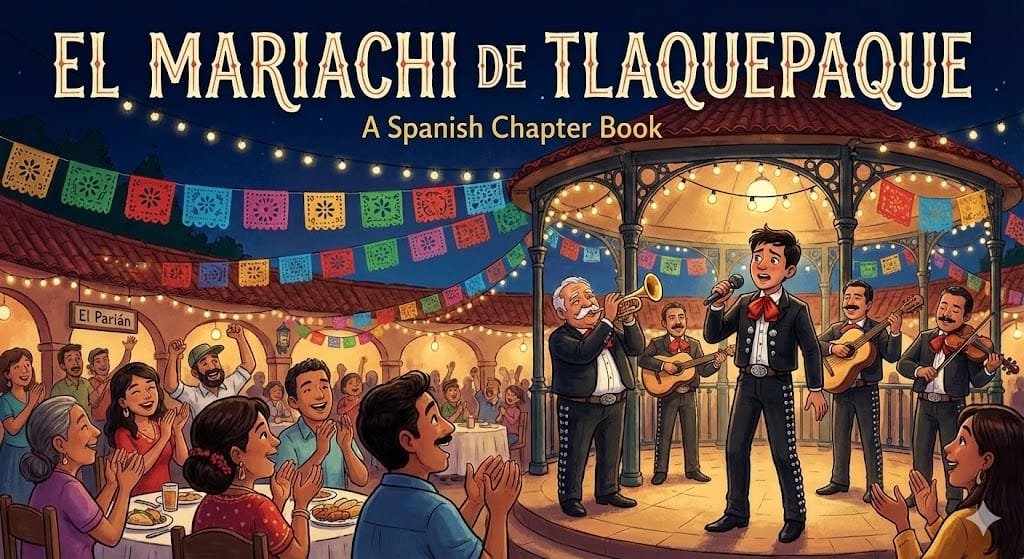
Follow Leo's journey from grammar struggles to singing onstage with a traditional Mariachi band, exploring cultural nuances along the way.
{
"title": "El Mariachi de Tlaquepaque",
"language": "es",
"subtitle": "A Spanish A2 Chapter Book",
"chapters": [
{
"id": "chapter-1",
"title": "Capítulo 1: Dificultades con la Gramática",
"content": [
"Leo estaba sentado en su clase de español en Guadalajara. Su profesora escribía verbos en la pizarra. «Ser» y «Estar» eran muy confusos para él. Leo miró su cuaderno lleno de errores y suspiró. «Nunca voy a hablar bien», pensó con tristeza.",
"Al terminar la clase, la profesora le dio un consejo: «Leo, necesitas salir del aula. El español está en las calles, no solo en los libros. Ve a Tlaquepaque esta tarde». Leo guardó sus libros, sintiéndose un poco desanimado, pero decidió seguir el consejo y tomar el autobús hacia el pueblo mágico."
],
"translation": "Leo was sitting in his Spanish class in Guadalajara. His teacher was writing verbs on the board. 'Ser' and 'Estar' were very confusing for him. Leo looked at his notebook full of mistakes and sighed. 'I am never going to speak well,' he thought with sadness. When class ended, the teacher gave him some advice: 'Leo, you need to get out of the classroom. Spanish is in the streets, not just in books. Go to Tlaquepaque this afternoon.' Leo put away his books, feeling a bit discouraged, but decided to follow the advice and take the bus to the magical town.",
"quiz": [
{
"question": "1. ¿Qué tema gramatical confundía a Leo?",
"options": [
{ "text": "a) El futuro", "value": "wrong" },
{ "text": "b) Ser y Estar", "value": "correct" },
{ "text": "c) El plural", "value": "wrong" }
]
},
{
"question": "2. Vrai o Faux: Leo se sentía muy feliz en clase.",
"options": [
{ "text": "Vrai", "value": "wrong" },
{ "text": "Faux", "value": "correct" }
]
},
{
"question": "3. ¿A dónde le recomendó ir la profesora?",
"options": [
{ "text": "a) A Tlaquepaque", "value": "correct" },
{ "text": "b) A Ciudad de México", "value": "wrong" },
{ "text": "c) A su casa", "value": "wrong" }
]
}
]
},
{
"id": "chapter-2",
"title": "Capítulo 2: Descubriendo Tlaquepaque",
"content": [
"El autobús dejó a Leo cerca de la calle Independencia. Tlaquepaque era muy diferente al centro moderno de Guadalajara. Era colorido, artístico y peatonal. Leo caminó despacio, mirando las tiendas.",
"Vio galerías de arte con esculturas de bronce y cerámica fina. Había paraguas de colores colgando sobre la calle, creando una sombra bonita. La gente caminaba tranquila y comía helados. Leo leyó los letreros de las tiendas en voz alta para practicar. «Galería de Arte... Restaurante Mexicano...». Poco a poco, empezó a sentirse más relajado y menos preocupado por la gramática."
],
"translation": "The bus dropped Leo off near Independencia Street. Tlaquepaque was very different from the modern center of Guadalajara. It was colorful, artistic, and pedestrian-friendly. Leo walked slowly, looking at the shops. He saw art galleries with bronze sculptures and fine ceramics. There were colorful umbrellas hanging over the street, creating a nice shade. People walked calmly and ate ice cream. Leo read the shop signs out loud to practice. 'Art Gallery... Mexican Restaurant...' Little by little, he began to feel more relaxed and less worried about grammar.",
"quiz": [
{
"question": "1. ¿Cómo es la calle Independencia?",
"options": [
{ "text": "a) Llena de coches", "value": "wrong" },
{ "text": "b) Peatonal y artística", "value": "correct" },
{ "text": "c) Oscura y sucia", "value": "wrong" }
]
},
{
"question": "2. ¿Qué colgaba sobre la calle?",
"options": [
{ "text": "a) Luces de navidad", "value": "wrong" },
{ "text": "b) Paraguas de colores", "value": "correct" },
{ "text": "c) Ropa", "value": "wrong" }
]
},
{
"question": "3. Vrai o Faux: Leo leyó los letreros en silencio.",
"options": [
{ "text": "Vrai", "value": "wrong" },
{ "text": "Faux", "value": "correct" }
]
}
]
},
{
"id": "chapter-3",
"title": "Capítulo 3: El Sonido de la Trompeta",
"content": [
"De repente, Leo escuchó música. Era el sonido fuerte y claro de una trompeta. Siguió el sonido por un callejón estrecho con flores en las paredes. Al final del callejón, encontró una casa antigua con la puerta abierta.",
"Adentro, un grupo de músicos practicaba. Había violines, guitarras y trompetas. Leo se quedó parado en la puerta, fascinado. La música era vibrante y llena de emoción. Un hombre mayor con bigote blanco lo vio y dejó de tocar. «¿Te gusta la música, joven?», preguntó el hombre con una voz amable pero firme."
],
"translation": "Suddenly, Leo heard music. It was the loud, clear sound of a trumpet. He followed the sound down a narrow alley with flowers on the walls. At the end of the alley, he found an old house with the door open. Inside, a group of musicians was practicing. There were violins, guitars, and trumpets. Leo stood at the door, fascinated. The music was vibrant and full of emotion. An older man with a white mustache saw him and stopped playing. 'Do you like music, young man?' the man asked with a kind but firm voice.",
"quiz": [
{
"question": "1. ¿Qué instrumento escuchó Leo primero?",
"options": [
{ "text": "a) Un violín", "value": "wrong" },
{ "text": "b) Una trompeta", "value": "correct" },
{ "text": "c) Un tambor", "value": "wrong" }
]
},
{
"question": "2. ¿Dónde encontró a los músicos?",
"options": [
{ "text": "a) En una casa antigua", "value": "correct" },
{ "text": "b) En el parque", "value": "wrong" },
{ "text": "c) En la escuela", "value": "wrong" }
]
},
{
"question": "3. Vrai o Faux: El hombre mayor se enojó con Leo.",
"options": [
{ "text": "Vrai", "value": "wrong" },
{ "text": "Faux", "value": "correct" }
]
}
]
},
{
"id": "chapter-4",
"title": "Capítulo 4: El Maestro Don Pepe",
"content": [
"«Sí, me gusta mucho», respondió Leo. «Hola, ¿cómo estás tú?». El hombre sonrió y corrigió a Leo suavemente. «Aquí, cuando hablamos con una persona mayor, usamos 'usted' para mostrar respeto. Soy Don Pepe».",
"Leo se puso rojo de vergüenza. «Perdón, ¿cómo está usted, Don Pepe?». Don Pepe lo invitó a pasar. Le explicó que esa era una escuela de Mariachi. Leo le contó que él estudiaba español, pero que era muy difícil. «La música es un idioma universal», dijo Don Pepe. «Si quieres aprender español, canta con nosotros»."
],
"translation": "'Yes, I like it very much,' answered Leo. 'Hi, how are you (informal)?' The man smiled and corrected Leo gently. 'Here, when we speak to an older person, we use 'usted' to show respect. I am Don Pepe.' Leo turned red with embarrassment. 'Sorry, how are you (formal), Don Pepe?' Don Pepe invited him in. He explained that this was a Mariachi school. Leo told him that he was studying Spanish, but it was very difficult. 'Music is a universal language,' said Don Pepe. 'If you want to learn Spanish, sing with us.'",
"quiz": [
{
"question": "1. ¿Cómo se llama el hombre mayor?",
"options": [
{ "text": "a) Don Juan", "value": "wrong" },
{ "text": "b) Don Pepe", "value": "correct" },
{ "text": "c) Don Carlos", "value": "wrong" }
]
},
{
"question": "2. ¿Por qué corrigió Don Pepe a Leo?",
"options": [
{ "text": "a) Por su pronunciación", "value": "wrong" },
{ "text": "b) Por usar 'tú' en lugar de 'usted'", "value": "correct" },
{ "text": "c) Por hablar inglés", "value": "wrong" }
]
},
{
"question": "3. Vrai o Faux: Don Pepe invitó a Leo a cantar.",
"options": [
{ "text": "Vrai", "value": "correct" },
{ "text": "Faux", "value": "wrong" }
]
}
]
},
{
"id": "chapter-5",
"title": "Capítulo 5: Guitarrón y Vihuela",
"content": [
"Don Pepe le mostró los instrumentos. Leo señaló una guitarra pequeña. «Esa es la vihuela», explicó Don Pepe. «Tiene cinco cuerdas y un sonido agudo». Luego, le mostró una guitarra muy grande y ancha. «Y este es el guitarrón. Es el corazón del mariachi porque lleva el ritmo bajo».",
"Leo intentó sostener el guitarrón. ¡Era muy grande y pesado! Todos los músicos se rieron amablemente. Leo aprendió palabras nuevas como «cuerdas», «ritmo» y «madera». Le parecía mucho más interesante aprender vocabulario tocando instrumentos que leyendo un libro de texto."
],
"translation": "Don Pepe showed him the instruments. Leo pointed to a small guitar. 'That is the vihuela,' explained Don Pepe. 'It has five strings and a high-pitched sound.' Then, he showed him a very large and wide guitar. 'And this is the guitarrón. It is the heart of the mariachi because it carries the bass rhythm.' Leo tried to hold the guitarrón. It was very big and heavy! All the musicians laughed kindly. Leo learned new words like 'strings,' 'rhythm,' and 'wood.' It seemed much more interesting to learn vocabulary by touching instruments than by reading a textbook.",
"quiz": [
{
"question": "1. ¿Cuál instrumento es pequeño y agudo?",
"options": [
{ "text": "a) La vihuela", "value": "correct" },
{ "text": "b) El guitarrón", "value": "wrong" },
{ "text": "c) La trompeta", "value": "wrong" }
]
},
{
"question": "2. ¿Cuál instrumento es el 'corazón' del mariachi?",
"options": [
{ "text": "a) El violín", "value": "wrong" },
{ "text": "b) El guitarrón", "value": "correct" },
{ "text": "c) La flauta", "value": "wrong" }
]
},
{
"question": "3. Vrai o Faux: El guitarrón es muy ligero.",
"options": [
{ "text": "Vrai", "value": "wrong" },
{ "text": "Faux", "value": "correct" }
]
}
]
},
{
"id": "chapter-6",
"title": "Capítulo 6: La Letra de la Canción",
"content": [
"Don Pepe le dio a Leo una hoja de papel con la letra de «Cielito Lindo». «Lee y repite», ordenó Don Pepe. Leo leyó: «De la sierra morena...». Don Pepe lo detuvo. «Más pasión, Leo. ¡Abre la boca!»",
"Pasaron la tarde practicando la canción. Leo tenía que pronunciar cada vocal claramente. La música le ayudaba a recordar las frases. Cuando cantaba «canta y no llores», entendió el significado emocional de las palabras. Ya no pensaba en las reglas gramaticales, solo sentía la música y el idioma fluyendo juntos."
],
"translation": "Don Pepe gave Leo a sheet of paper with the lyrics to 'Cielito Lindo.' 'Read and repeat,' ordered Don Pepe. Leo read: 'De la sierra morena...' Don Pepe stopped him. 'More passion, Leo. Open your mouth!' They spent the afternoon practicing the song. Leo had to pronounce every vowel clearly. The music helped him remember the phrases. When he sang 'sing and don't cry,' he understood the emotional meaning of the words. He no longer thought about grammar rules, he just felt the music and the language flowing together.",
"quiz": [
{
"question": "1. ¿Qué canción practicaron?",
"options": [
{ "text": "a) La Bamba", "value": "wrong" },
{ "text": "b) Cielito Lindo", "value": "correct" },
{ "text": "c) Las Mañanitas", "value": "wrong" }
]
},
{
"question": "2. ¿Qué le pidió Don Pepe a Leo?",
"options": [
{ "text": "a) Más silencio", "value": "wrong" },
{ "text": "b) Más pasión", "value": "correct" },
{ "text": "c) Más velocidad", "value": "wrong" }
]
},
{
"question": "3. Vrai o Faux: La música ayudó a Leo con su pronunciación.",
"options": [
{ "text": "Vrai", "value": "correct" },
{ "text": "Faux", "value": "wrong" }
]
}
]
},
{
"id": "chapter-7",
"title": "Capítulo 7: El Traje de Charro",
"content": [
"Unos días después, Don Pepe trajo un traje especial. «El mariachi debe verse elegante», dijo. Era un traje de charro negro con botones de plata a los lados de los pantalones. También había un moño rojo grande para el cuello.",
"Leo se probó el sombrero de ala ancha. Pesaba mucho y tenía bordados dorados. Se miró en el espejo y se sintió como una persona diferente. «El traje representa orgullo y tradición», explicó Don Pepe. Leo se sintió honrado de usarlo, aunque fuera solo por un momento. Aprendió palabras como «bordado», «plata» y «botines»."
],
"translation": "A few days later, Don Pepe brought a special suit. 'The mariachi must look elegant,' he said. It was a black charro suit with silver buttons on the sides of the pants. There was also a large red bow tie for the neck. Leo tried on the wide-brimmed hat. It was very heavy and had gold embroidery. He looked in the mirror and felt like a different person. 'The suit represents pride and tradition,' explained Don Pepe. Leo felt honored to wear it, even if only for a moment. He learned words like 'embroidery,' 'silver,' and 'boots.'",
"quiz": [
{
"question": "1. ¿De qué color era el traje de charro?",
"options": [
{ "text": "a) Blanco", "value": "wrong" },
{ "text": "b) Negro", "value": "correct" },
{ "text": "c) Azul", "value": "wrong" }
]
},
{
"question": "2. ¿Qué material tenían los botones?",
"options": [
{ "text": "a) Oro", "value": "wrong" },
{ "text": "b) Plata", "value": "correct" },
{ "text": "c) Plástico", "value": "wrong" }
]
},
{
"question": "3. Vrai o Faux: El sombrero era muy ligero.",
"options": [
{ "text": "Vrai", "value": "wrong" },
{ "text": "Faux", "value": "correct" }
]
}
]
},
{
"id": "chapter-8",
"title": "Capítulo 8: Miedo Escénico",
"content": [
"Don Pepe anunció una sorpresa: «El viernes tocaremos en El Parián y Leo cantará una estrofa». Leo sintió pánico. «¡No puedo! Mi español no es perfecto», tartamudeó. Le dolía el estómago de los nervios.",
"Don Pepe puso una mano en su hombro. «El público no busca perfección, busca corazón. Si te equivocas, sigue cantando. Eso es ser valiente». Leo respiró profundo. Tenía miedo, pero también quería demostrarse a sí mismo que podía hacerlo. Practicó frente al espejo del hotel mil veces: «Ay, ay, ay, ay... canta y no llores»."
],
"translation": "Don Pepe announced a surprise: 'On Friday we will play at El Parián and Leo will sing a verse.' Leo felt panic. 'I can't! My Spanish isn't perfect,' he stuttered. His stomach hurt from nerves. Don Pepe put a hand on his shoulder. 'The audience isn't looking for perfection, they are looking for heart. If you make a mistake, keep singing. That is being brave.' Leo breathed deeply. He was afraid, but he also wanted to prove to himself that he could do it. He practiced in front of the hotel mirror a thousand times: 'Ay, ay, ay, ay... sing and don't cry.'",
"quiz": [
{
"question": "1. ¿Dónde iban a tocar el viernes?",
"options": [
{ "text": "a) En El Parián", "value": "correct" },
{ "text": "b) En la iglesia", "value": "wrong" },
{ "text": "c) En el estadio", "value": "wrong" }
]
},
{
"question": "2. ¿Qué sentía Leo?",
"options": [
{ "text": "a) Hambre", "value": "wrong" },
{ "text": "b) Pánico", "value": "correct" },
{ "text": "c) Aburrimiento", "value": "wrong" }
]
},
{
"question": "3. Vrai o Faux: Don Pepe le dijo que el público busca perfección.",
"options": [
{ "text": "Vrai", "value": "wrong" },
{ "text": "Faux", "value": "correct" }
]
}
]
},
{
"id": "chapter-9",
"title": "Capítulo 9: Una Noche en El Parián",
"content": [
"El Parián es el centro de la fiesta en Tlaquepaque. Es una plaza rodeada de restaurantes y cantinas. La noche del viernes, el lugar estaba lleno de gente, risas y olor a tequila y birria.",
"El grupo de Don Pepe subió al quiosco central. Las luces brillaban sobre ellos. Leo miró a la multitud. Vio turistas y familias mexicanas cenando. Su profesora de español estaba allí y lo saludó con la mano. El ruido de los platos y las conversaciones llenaba el aire. El corazón de Leo latía muy rápido, como el ritmo de la vihuela."
],
"translation": "El Parián is the center of the party in Tlaquepaque. It is a square surrounded by restaurants and bars. On Friday night, the place was full of people, laughter, and the smell of tequila and birria. Don Pepe's group went up to the central kiosk. The lights shone on them. Leo looked at the crowd. He saw tourists and Mexican families having dinner. His Spanish teacher was there and waved at him. The noise of plates and conversations filled the air. Leo's heart beat very fast, like the rhythm of the vihuela.",
"quiz": [
{
"question": "1. ¿Qué es El Parián?",
"options": [
{ "text": "a) Una playa", "value": "wrong" },
{ "text": "b) Una plaza con restaurantes", "value": "correct" },
{ "text": "c) Un museo silencioso", "value": "wrong" }
]
},
{
"question": "2. ¿A quién vio Leo en el público?",
"options": [
{ "text": "a) A su profesora", "value": "correct" },
{ "text": "b) A su mamá", "value": "wrong" },
{ "text": "c) A nadie", "value": "wrong" }
]
},
{
"question": "3. Vrai o Faux: El lugar estaba vacío y silencioso.",
"options": [
{ "text": "Vrai", "value": "wrong" },
{ "text": "Faux", "value": "correct" }
]
}
]
},
{
"id": "chapter-10",
"title": "Capítulo 10: El Concierto Final",
"content": [
"Las trompetas sonaron y la canción comenzó. Cuando llegó su turno, Leo cerró los ojos y cantó con fuerza. No pensó en los verbos irregulares. Solo pensó en la alegría de estar en México.",
"Su voz tembló un poco, pero cantó con sentimiento. Cuando terminó, la gente aplaudió y gritó «¡Bravo!». Don Pepe le dio un abrazo fuerte. Al bajar del escenario, su profesora le dijo: «Hoy tu español fue perfecto porque fue sincero». Leo sonrió; había aprendido que el idioma no es solo reglas, es conexión."
],
"translation": "The trumpets sounded and the song began. When his turn came, Leo closed his eyes and sang loudly. He didn't think about irregular verbs. He only thought about the joy of being in Mexico. His voice trembled a little, but he sang with feeling. When he finished, the people clapped and shouted 'Bravo!' Don Pepe gave him a strong hug. Getting off the stage, his teacher told him: 'Today your Spanish was perfect because it was sincere.' Leo smiled; he had learned that language is not just rules, it is connection.",
"quiz": [
{
"question": "1. ¿Qué hizo la gente cuando Leo terminó de cantar?",
"options": [
{ "text": "a) Se fue", "value": "wrong" },
{ "text": "b) Aplaudieron y gritaron Bravo", "value": "correct" },
{ "text": "c) Lloraron de tristeza", "value": "wrong" }
]
},
{
"question": "2. ¿Qué le dijo su profesora?",
"options": [
{ "text": "a) Que fue horrible", "value": "wrong" },
{ "text": "b) Que su español fue sincero", "value": "correct" },
{ "text": "c) Que debe estudiar más verbos", "value": "wrong" }
]
},
{
"question": "3. Vrai o Faux: Leo pensó mucho en la gramática mientras cantaba.",
"options": [
{ "text": "Vrai", "value": "wrong" },
{ "text": "Faux", "value": "correct" }
]
}
]
}
]
}