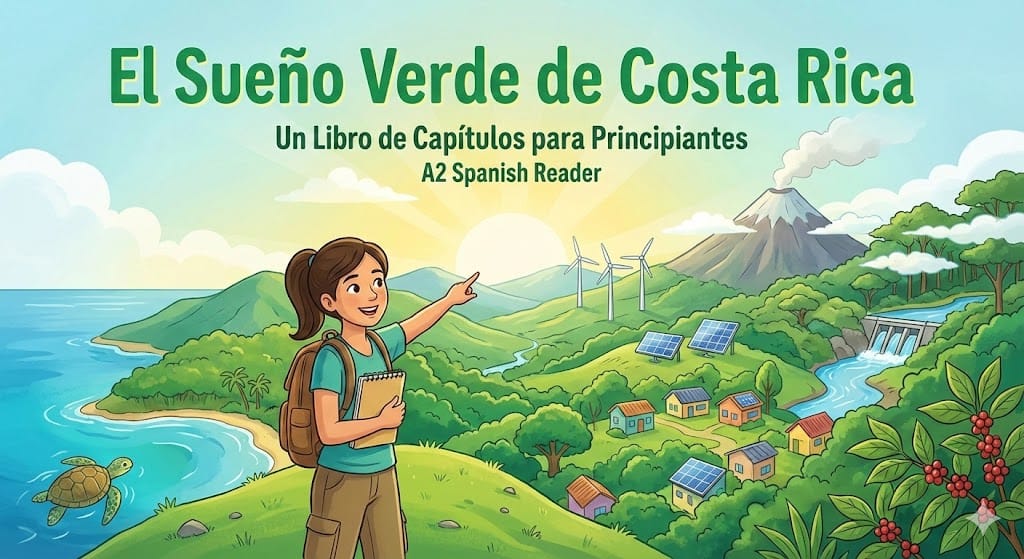
Discover "El Sueño Verde de Costa Rica," a bilingual Spanish chapter book for A2 learners. Explore Costa Rica’s fight against climate change while learning key vocabulary about nature, sustainability, and green energy.
{
"title": "El Sueño Verde de Costa Rica",
"language": "es",
"subtitle": "A Spanish A2 Chapter Book",
"chapters": [
{
"id": "chapter-1",
"title": "Chapitre 1: ¡Pura Vida!",
"content": [
"Elena aterrizó en el aeropuerto de San José con una mochila y mucha curiosidad. El aire era cálido y húmedo. Su guía, Mateo, la esperaba con una gran sonrisa.",
"—¡Bienvenida a Costa Rica! —dijo él—. Aquí decimos \"Pura Vida\".",
"Elena sonrió. Había escuchado esa frase. Mateo explicó que no es solo un saludo. Significa vivir en paz, apreciar la naturaleza y ser feliz. Mientras viajaban hacia el hotel, Elena miró por la ventana. Todo era verde. Las montañas rodeaban la ciudad. Ella sabía que este viaje le enseñaría mucho sobre cómo cuidar el planeta."
],
"translation": "Elena landed at the San José airport with a backpack and a lot of curiosity. The air was warm and humid. Her guide, Mateo, was waiting for her with a big smile. \"Welcome to Costa Rica!\" he said. \"Here we say 'Pura Vida'.\" Elena smiled. She had heard that phrase. Mateo explained that it is not just a greeting. It means living in peace, appreciating nature, and being happy. As they traveled toward the hotel, Elena looked out the window. Everything was green. Mountains surrounded the city. She knew that this trip would teach her a lot about how to take care of the planet.",
"quiz": [
{
"question": "1. ¿Qué frase usan los costarricenses para saludar?",
"options": [
{ "text": "a) Buenos días", "value": "wrong" },
{ "text": "b) Pura Vida", "value": "correct" },
{ "text": "c) Hasta luego", "value": "wrong" }
]
},
{
"question": "2. True or False: \"Pura Vida\" is only used to say hello.",
"options": [
{ "text": "a) True", "value": "wrong" },
{ "text": "b) False", "value": "correct" }
]
},
{
"question": "3. ¿Qué vio Elena por la ventana?",
"options": [
{ "text": "a) Nieve", "value": "wrong" },
{ "text": "b) Desierto", "value": "wrong" },
{ "text": "c) Montañas verdes", "value": "correct" }
]
}
]
},
{
"id": "chapter-2",
"title": "Chapitre 2: Energía del Agua y del Viento",
"content": [
"Al día siguiente, viajaron hacia el norte. Elena vio unos molinos de viento gigantes en las colinas.",
"—¿De dónde viene la electricidad aquí? —preguntó Elena.",
"—Casi toda nuestra energía es renovable —respondió Mateo con orgullo—. Usamos la fuerza del agua, del viento y el calor de los volcanes.",
"Mateo le contó que Costa Rica pasó meses enteros usando solo energía limpia. No necesitan quemar carbón ni petróleo para tener luz. Elena estaba impresionada. Era un país pequeño, pero era un líder mundial en energía verde. El futuro ya estaba aquí."
],
"translation": "The next day, they traveled north. Elena saw giant windmills on the hills. \"Where does the electricity come from here?\" asked Elena. \"Almost all our energy is renewable,\" answered Mateo with pride. \"We use the power of water, wind, and the heat from volcanoes.\" Mateo told her that Costa Rica spent entire months using only clean energy. They don't need to burn coal or oil to have light. Elena was impressed. It was a small country, but it was a world leader in green energy. The future was already here.",
"quiz": [
{
"question": "1. ¿Qué tipo de energía usa principalmente Costa Rica?",
"options": [
{ "text": "a) Renovable", "value": "correct" },
{ "text": "b) Nuclear", "value": "wrong" },
{ "text": "c) Carbón", "value": "wrong" }
]
},
{
"question": "2. True or False: Costa Rica uses heat from volcanoes for electricity.",
"options": [
{ "text": "a) True", "value": "correct" },
{ "text": "b) False", "value": "wrong" }
]
},
{
"question": "3. ¿Qué vio Elena en las colinas?",
"options": [
{ "text": "a) Paneles solares", "value": "wrong" },
{ "text": "b) Molinos de viento", "value": "correct" },
{ "text": "c) Fábricas", "value": "wrong" }
]
}
]
},
{
"id": "chapter-3",
"title": "Chapitre 3: El Bosque que Respira",
"content": [
"Llegaron a Monteverde, un famoso bosque nuboso. La niebla cubría los árboles altos. Todo estaba muy silencioso y fresco.",
"—Este bosque actúa como los pulmones de la tierra —susurró Mateo.",
"Caminaron por puentes colgantes entre las copas de los árboles. Elena vio orquídeas y musgo en las ramas. Mateo explicó que los árboles absorben el dióxido de carbono, un gas malo para el clima. Proteger estos bosques es vital para luchar contra el cambio climático. Elena respiró profundo. El aire se sentía increíblemente limpio y puro."
],
"translation": "They arrived in Monteverde, a famous cloud forest. Fog covered the tall trees. Everything was very silent and cool. \"This forest acts like the lungs of the earth,\" whispered Mateo. They walked across hanging bridges among the treetops. Elena saw orchids and moss on the branches. Mateo explained that trees absorb carbon dioxide, a bad gas for the climate. Protecting these forests is vital to fight against climate change. Elena breathed deeply. The air felt incredibly clean and pure.",
"quiz": [
{
"question": "1. ¿Cómo se llama el bosque que visitaron?",
"options": [
{ "text": "a) San José", "value": "wrong" },
{ "text": "b) Monteverde", "value": "correct" },
{ "text": "c) Amazonas", "value": "wrong" }
]
},
{
"question": "2. True or False: The forest is hot and dry.",
"options": [
{ "text": "a) True", "value": "wrong" },
{ "text": "b) False", "value": "correct" }
]
},
{
"question": "3. ¿Qué absorben los árboles?",
"options": [
{ "text": "a) Oxígeno", "value": "wrong" },
{ "text": "b) Agua", "value": "wrong" },
{ "text": "c) Dióxido de carbono", "value": "correct" }
]
}
]
},
{
"id": "chapter-4",
"title": "Chapitre 4: Más Árboles, Por Favor",
"content": [
"Mateo le mostró a Elena fotos antiguas.",
"—Hace cincuenta años, cortamos muchos árboles para las granjas —dijo él triste—. Casi perdimos nuestros bosques.",
"Pero la historia cambió. El gobierno decidió pagar a los agricultores para proteger los árboles en lugar de cortarlos.",
"—¿Funcionó? —preguntó Elena.",
"—¡Sí! —exclamó Mateo—. Hemos duplicado la cantidad de bosques.",
"Ahora, la jungla ha regresado. Los animales tienen casa otra vez. Elena pensó que era una idea brillante. Es posible reparar el daño que los humanos hacen a la naturaleza."
],
"translation": "Mateo showed Elena old photos. \"Fifty years ago, we cut down many trees for farms,\" he said sadly. \"We almost lost our forests.\" But history changed. The government decided to pay farmers to protect trees instead of cutting them. \"Did it work?\" asked Elena. \"Yes!\" exclaimed Mateo. \"We have doubled the amount of forests.\" Now, the jungle has returned. Animals have a home again. Elena thought it was a brilliant idea. It is possible to repair the damage humans do to nature.",
"quiz": [
{
"question": "1. True or False: Costa Rica has fewer forests now than 50 years ago.",
"options": [
{ "text": "a) True", "value": "wrong" },
{ "text": "b) False", "value": "correct" }
]
},
{
"question": "2. ¿Qué hizo el gobierno con los agricultores?",
"options": [
{ "text": "a) Les pagó para proteger árboles", "value": "correct" },
{ "text": "b) Les quitó sus tierras", "value": "wrong" },
{ "text": "c) Les vendió madera", "value": "wrong" }
]
},
{
"question": "3. ¿Quiénes tienen casa otra vez gracias a los bosques?",
"options": [
{ "text": "a) Los coches", "value": "wrong" },
{ "text": "b) Los animales", "value": "correct" },
{ "text": "c) Las fábricas", "value": "wrong" }
]
}
]
},
{
"id": "chapter-5",
"title": "Chapitre 5: Café sin Veneno",
"content": [
"En el Valle Central, visitaron una plantación de café. Elena amaba el café, pero no sabía cómo crecía. El agricultor, Don Carlos, les mostró sus plantas.",
"—Aquí no usamos químicos peligrosos —dijo Don Carlos.",
"El café crecía bajo la sombra de otros árboles. Esto ayudaba a los pájaros y mantenía el suelo sano. Era una agricultura sostenible. Elena probó una taza. El sabor era suave y delicioso.",
"—Sabe mejor porque respetamos la tierra —sonrió Don Carlos. Elena compró una bolsa para llevar a casa."
],
"translation": "In the Central Valley, they visited a coffee plantation. Elena loved coffee, but she didn't know how it grew. The farmer, Don Carlos, showed them his plants. \"Here we don't use dangerous chemicals,\" said Don Carlos. The coffee grew under the shade of other trees. This helped the birds and kept the soil healthy. It was sustainable agriculture. Elena tasted a cup. The flavor was smooth and delicious. \"It tastes better because we respect the earth,\" smiled Don Carlos. Elena bought a bag to take home.",
"quiz": [
{
"question": "1. ¿Qué producto cultiva Don Carlos?",
"options": [
{ "text": "a) Bananas", "value": "wrong" },
{ "text": "b) Café", "value": "correct" },
{ "text": "c) Cacao", "value": "wrong" }
]
},
{
"question": "2. True or False: Don Carlos uses dangerous chemicals.",
"options": [
{ "text": "a) True", "value": "wrong" },
{ "text": "b) False", "value": "correct" }
]
},
{
"question": "3. ¿Por qué sabe mejor el café según Don Carlos?",
"options": [
{ "text": "a) Por el azúcar", "value": "wrong" },
{ "text": "b) Porque respetan la tierra", "value": "correct" },
{ "text": "c) Porque es caro", "value": "wrong" }
]
}
]
},
{
"id": "chapter-6",
"title": "Chapitre 6: Adiós al Plástico",
"content": [
"Elena y Mateo fueron a la playa el fin de semana. Hacía calor y Elena quería un jugo de frutas. Compró uno en un pequeño quiosco.",
"—Sin pajilla (popote), por favor —dijo Elena.",
"La vendedora sonrió.",
"—No tenemos pajillas de plástico. Están prohibidas en muchos lugares aquí.",
"Mateo explicó que Costa Rica quiere eliminar los plásticos de un solo uso. Platos, vasos y tenedores de plástico contaminan el mar. Ahora usan materiales que se descomponen rápido. La playa estaba muy limpia, sin basura en la arena."
],
"translation": "Elena and Mateo went to the beach on the weekend. It was hot and Elena wanted a fruit juice. She bought one at a small kiosk. \"No straw, please,\" said Elena. The seller smiled. \"We don't have plastic straws. They are banned in many places here.\" Mateo explained that Costa Rica wants to eliminate single-use plastics. Plastic plates, cups, and forks pollute the sea. Now they use materials that decompose quickly. The beach was very clean, with no trash on the sand.",
"quiz": [
{
"question": "1. ¿Qué pidió Elena con su jugo?",
"options": [
{ "text": "a) Mucho hielo", "value": "wrong" },
{ "text": "b) Sin pajilla", "value": "correct" },
{ "text": "c) Una botella de plástico", "value": "wrong" }
]
},
{
"question": "2. ¿Qué quiere eliminar Costa Rica?",
"options": [
{ "text": "a) El turismo", "value": "wrong" },
{ "text": "b) Los plásticos de un solo uso", "value": "correct" },
{ "text": "c) La fruta", "value": "wrong" }
]
},
{
"question": "3. True or False: The beach was dirty.",
"options": [
{ "text": "a) True", "value": "wrong" },
{ "text": "b) False", "value": "correct" }
]
}
]
},
{
"id": "chapter-7",
"title": "Chapitre 7: Las Tortugas de Tortuguero",
"content": [
"Viajaron en bote por los canales de Tortuguero. Era un lugar salvaje. De repente, el capitán detuvo el motor.",
"—Miren allí —señaló.",
"Una tortuga marina nadaba cerca del bote. Mateo explicó que el cambio climático es peligroso para ellas. La temperatura de la arena decide si las tortugas nacen machos o hembras. Si hace demasiado calor, nacen demasiadas hembras.",
"—Protegemos sus nidos para salvar la especie —dijo Mateo.",
"Elena se sintió triste pero esperanzada. El trabajo de conservación en Costa Rica era muy importante para el mundo."
],
"translation": "They traveled by boat through the canals of Tortuguero. It was a wild place. Suddenly, the captain stopped the engine. \"Look over there,\" he pointed. A sea turtle was swimming near the boat. Mateo explained that climate change is dangerous for them. The sand temperature decides if turtles are born male or female. If it is too hot, too many females are born. \"We protect their nests to save the species,\" said Mateo. Elena felt sad but hopeful. Conservation work in Costa Rica was very important for the world.",
"quiz": [
{
"question": "1. ¿Cómo viajaron por Tortuguero?",
"options": [
{ "text": "a) En coche", "value": "wrong" },
{ "text": "b) En bote", "value": "correct" },
{ "text": "c) En avión", "value": "wrong" }
]
},
{
"question": "2. ¿Qué afecta si las tortugas son machos o hembras?",
"options": [
{ "text": "a) La comida", "value": "wrong" },
{ "text": "b) La temperatura de la arena", "value": "correct" },
{ "text": "c) El agua", "value": "wrong" }
]
},
{
"question": "3. True or False: Elena felt hopeless.",
"options": [
{ "text": "a) True", "value": "wrong" },
{ "text": "b) False", "value": "correct" }
]
}
]
},
{
"id": "chapter-8",
"title": "Chapitre 8: El Autobús Eléctrico",
"content": [
"De regreso en la ciudad, Mateo llevó a Elena a una parada de autobús.",
"—Escucha —dijo él cuando llegó el autobús.",
"Elena no escuchó nada. El vehículo era muy silencioso.",
"—Es un autobús eléctrico —explicó Mateo—. No echa humo negro.",
"El transporte es el mayor problema para el clima en Costa Rica porque hay muchos coches. Pero el gobierno está cambiando los autobuses y trenes a electricidad. Elena subió al autobús. Era moderno, limpio y tenía aire acondicionado. Viajar verde era cómodo."
],
"translation": "Back in the city, Mateo took Elena to a bus stop. \"Listen,\" he said when the bus arrived. Elena heard nothing. The vehicle was very silent. \"It is an electric bus,\" explained Mateo. \"It doesn't put out black smoke. Transportation is the biggest problem for the climate in Costa Rica because there are many cars. But the government is changing buses and trains to electricity. Elena got on the bus. It was modern, clean, and had air conditioning. Green travel was comfortable.",
"quiz": [
{
"question": "1. ¿Por qué era silencioso el autobús?",
"options": [
{ "text": "a) Estaba apagado", "value": "wrong" },
{ "text": "b) Era eléctrico", "value": "correct" },
{ "text": "c) Estaba lejos", "value": "wrong" }
]
},
{
"question": "2. ¿Cuál es el mayor problema para el clima en Costa Rica?",
"options": [
{ "text": "a) Las fábricas", "value": "wrong" },
{ "text": "b) La agricultura", "value": "wrong" },
{ "text": "c) El transporte", "value": "correct" }
]
},
{
"question": "3. True or False: The bus was uncomfortable.",
"options": [
{ "text": "a) True", "value": "wrong" },
{ "text": "b) False", "value": "correct" }
]
}
]
},
{
"id": "chapter-9",
"title": "Chapitre 9: Ecoturismo Responsable",
"content": [
"En su última cena, Elena agradeció a Mateo.",
"—Gracias por enseñarme tanto.",
"Mateo le dijo que su visita ayudaba al país.",
"—Esto es ecoturismo —dijo él—. El dinero que gastas en hoteles y tours paga los parques nacionales. Ayuda a las familias locales.",
"Pero hay una regla importante: \"Solo deja huellas, solo toma fotografías\". Elena entendió. Ser turista conlleva una responsabilidad. No se debe destruir lo que se viene a admirar. Ella prometió ser una viajera responsable siempre."
],
"translation": "At her last dinner, Elena thanked Mateo. \"Thank you for teaching me so much.\" Mateo told her that her visit helped the country. \"This is ecotourism,\" he said. \"The money you spend on hotels and tours pays for the national parks. It helps local families.\" But there is an important rule: \"Leave only footprints, take only photos.\" Elena understood. Being a tourist carries a responsibility. One must not destroy what one comes to admire. She promised to be a responsible traveler always.",
"quiz": [
{
"question": "1. ¿A qué ayuda el dinero del ecoturismo?",
"options": [
{ "text": "a) A los parques nacionales", "value": "correct" },
{ "text": "b) A las grandes fábricas", "value": "wrong" },
{ "text": "c) A comprar petróleo", "value": "wrong" }
]
},
{
"question": "2. ¿Cuál es la regla del ecoturismo?",
"options": [
{ "text": "a) Llevarse plantas a casa", "value": "wrong" },
{ "text": "b) Solo dejar huellas", "value": "correct" },
{ "text": "c) Tirar basura", "value": "wrong" }
]
},
{
"question": "3. True or False: Elena promised to be a responsible traveler.",
"options": [
{ "text": "a) True", "value": "correct" },
{ "text": "b) False", "value": "wrong" }
]
}
]
},
{
"id": "chapter-10",
"title": "Chapitre 10: Carbono Neutral",
"content": [
"Era el último día. Elena miraba el atardecer sobre el océano Pacífico. Costa Rica tenía un plan ambicioso: ser un país \"carbono neutral\". Eso significa no producir más contaminación de la que los bosques pueden limpiar.",
"—Es un gran sueño para un país pequeño —pensó Elena.",
"Pero ellos estaban trabajando duro para lograrlo. Elena se sintió inspirada. Ella no podía cambiar todo el mundo sola, pero podía cambiar sus hábitos en casa. Podía reciclar, usar menos plástico y plantar árboles. El sueño verde de Costa Rica ahora era su sueño también."
],
"translation": "It was the last day. Elena watched the sunset over the Pacific Ocean. Costa Rica had an ambitious plan: to be a \"carbon neutral\" country. That means not producing more pollution than the forests can clean up. \"It is a big dream for a small country,\" thought Elena. But they were working hard to achieve it. Elena felt inspired. She could not change the whole world alone, but she could change her habits at home. She could recycle, use less plastic, and plant trees. Costa Rica's green dream was now her dream too.",
"quiz": [
{
"question": "1. ¿Cuál es el plan ambicioso de Costa Rica?",
"options": [
{ "text": "a) Ser el país más rico", "value": "wrong" },
{ "text": "b) Ser carbono neutral", "value": "correct" },
{ "text": "c) Tener más coches", "value": "wrong" }
]
},
{
"question": "2. ¿Qué significa carbono neutral?",
"options": [
{ "text": "a) No producir más contaminación de la que se puede limpiar", "value": "correct" },
{ "text": "b) No usar electricidad", "value": "wrong" },
{ "text": "c) No tener bosques", "value": "wrong" }
]
},
{
"question": "3. ¿Cómo se sintió Elena al final?",
"options": [
{ "text": "a) Cansada", "value": "wrong" },
{ "text": "b) Aburrida", "value": "wrong" },
{ "text": "c) Inspirada", "value": "correct" }
]
}
]
}
]
}