A1 English: Can Do
This course provides a variety of activities to support A1-A2 level students in achieving CEFR Can-Do goals.
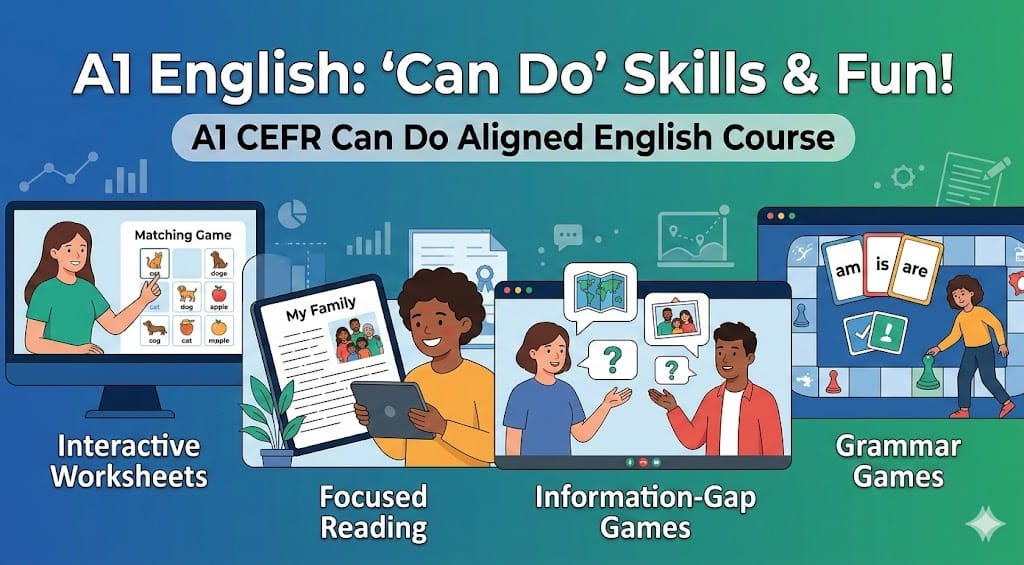
This course provides a variety of activities to support A1-A2 level students in achieving CEFR Can-Do goals. The content focuses on common topics, making it ideal for supplementing existing curriculum or providing remedial practice. Key features include Text-to-Speech functionality for reading and pronunciation support, as well as immediate feedback and re-do opportunities.
Note: Absolute beginners, who are not familiar with the English alphabet, might want to start with a free app called Duolingo ABC.
Module 1: Hello, World! (Personal Identification)
The goal of this module is to equip students with the absolute basics to introduce themselves and understand others.
Lesson 1: Greetings & Goodbyes
Can-Do: I can greet people formally and informally and say goodbye.
Focus: Hello, good morning, see you later, basic verb to be (I am / You are).
Worksheet, Focused Reading, Information-Gap
Lesson 2: What is your name?
Can-Do: I can introduce myself and spell my name.
Focus: The Alphabet, asking for repetition (Can you repeat that?).
Worksheet, Focused Reading, Information-Gap
Lesson 3: Numbers & Age
Can-Do: I can say my age and understand basic numbers.
Focus: Numbers 1–100, How old are you?, I am [X] years old.
Worksheet, Focused Reading, Word Blaster (Lessons 1-3)
Lesson 4: Where are you from?
Can-Do: I can ask and answer questions about where I live and my nationality.
Focus: Countries and nationalities, verb to be (He/She/It/We/They).
Worksheet, Focused Reading, Grammar Hearts - Verb TO BE
Lesson 5: Jobs & Occupations
Can-Do: I can state what I do for a living.
Focus: Common jobs (teacher, doctor, student), indefinite articles (a/an).
Worksheet, Focused Reading, Word Blaster (Lessons 4-5)
Module 2: My Circle (People & Possessions)
This module shifts the focus from the individual to the people and things immediately around them.
Lesson 6: My Family
Can-Do: I can name and introduce my family members.
Focus: Family vocabulary (mother, brother, aunt), possessive adjectives (my, your, his, her).
Worksheet
Lesson 7: Describing People
Can-Do: I can describe what people look like in a simple way.
Focus: Physical adjectives (tall, short, old), modifiers (very, quite).
Worksheet
Lesson 8: Everyday Objects
Can-Do: I can identify and name common everyday items.
Focus: Classroom/bag objects (pen, phone, keys), demonstratives (this/that/these/those), plural nouns.
Worksheet
Lesson 9: Personal Possessions
Can-Do: I can talk about the things I own.
Focus: The verb have got / has got (or simple have/has).
Worksheet
Lesson 10: Colors & Clothes
Can-Do: I can describe what someone is wearing.
Focus: Basic clothing and colors, adjective word order (e.g., a red shirt).
Worksheet
Module 3: Daily Life (Time & Routines)
Students learn to structure their day and describe their habits, which introduces the core engine of English: the Present Simple tense.
Lesson 11: Days, Months, & Dates
Can-Do: I can state the date and talk about days of the week.
Focus: Days, months, ordinal numbers (1st, 2nd, 3rd).
Worksheet
Lesson 12: Telling the Time
Can-Do: I can ask for and tell the time.
Focus: O'clock, half past, quarter to/past, prepositions of time (in, on, at).
Worksheet
Lesson 13: My Daily Routine
Can-Do: I can describe a typical day in my life.
Focus: Present Simple affirmative (I/You/We/They), common action verbs (wake up, eat, work).
Worksheet
Lesson 14: Their Daily Routine
Can-Do: I can describe someone else's day.
Focus: Present Simple 3rd person singular (He/She/It), adding -s/-es.
Worksheet
Lesson 15: Free Time & Hobbies
Can-Do: I can talk about what I do in my free time.
Focus: Hobby vocabulary, adverbs of frequency (always, sometimes, never).
Worksheet
More modules will be coming soon.