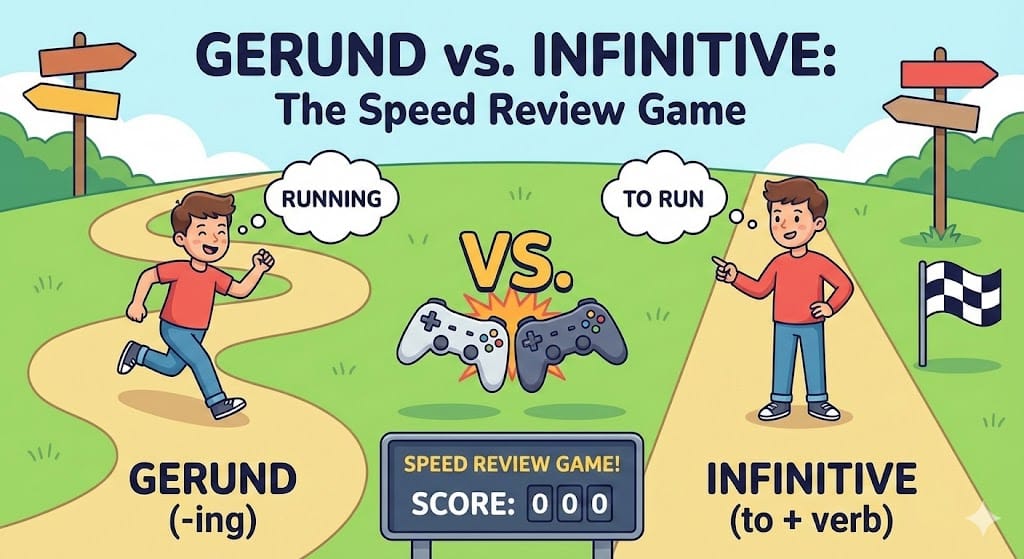
The choice between the -ing form (gerund) and the infinitive (to + verb) often depends on the main verb that precedes it. While it can feel like a game of memorization, there are several patterns and "rules of thumb" that make the logic clearer.
[
{
"title": "Gerund vs. Infinitive: The Challenge",
"questions": [
{
"category": "Verb + Gerund",
"question": "I really enjoy ____ books on the weekend.",
"options": ["reading", "to read", "Either"],
"answer": "reading",
"explanation": "The verb **enjoy** is always followed by the gerund (-ing)."
},
{
"category": "Verb + Infinitive",
"question": "We decided ____ to Spain for our holiday.",
"options": ["going", "to go", "Either"],
"answer": "to go",
"explanation": "**Decide** points to a future intent, so it takes the infinitive (to + verb)."
},
{
"category": "Flexible Verb",
"question": "It started ____, so we went inside.",
"options": ["raining", "to rain", "Either"],
"answer": "Either",
"explanation": "**Start** is flexible. 'It started raining' and 'It started to rain' are both correct."
},
{
"category": "Preposition + Gerund",
"question": "She is very good at ____ pictures.",
"options": ["painting", "to paint", "Either"],
"answer": "painting",
"explanation": "After a preposition (like **at**), we always use the -ing form."
},
{
"category": "Meaning Shifter",
"question": "I stopped ____ junk food to get healthy.",
"options": ["eating", "to eat", "Either"],
"answer": "eating",
"explanation": "**Stop + -ing** means you quit a habit completely. 'To eat' would mean you paused to eat."
},
{
"category": "Flexible Verb",
"question": "I love ____ to music while I work.",
"options": ["listening", "to listen", "Either"],
"answer": "Either",
"explanation": "**Love** is a flexible verb. Both forms are acceptable with no major change in meaning."
},
{
"category": "Verb + Infinitive",
"question": "They promised ____ me with my homework.",
"options": ["helping", "to help", "Either"],
"answer": "to help",
"explanation": "**Promise** relates to a future action, so it is followed by the infinitive."
},
{
"category": "Verb + Gerund",
"question": "Please avoid ____ loud noises in the library.",
"options": ["making", "to make", "Either"],
"answer": "making",
"explanation": "**Avoid** is always followed by the gerund (-ing)."
},
{
"category": "Flexible Verb",
"question": "They continued ____ despite the noise.",
"options": ["working", "to work", "Either"],
"answer": "Either",
"explanation": "**Continue** is flexible. You can use either form."
},
{
"category": "Meaning Shifter",
"question": "We stopped ____ some coffee on our way home.",
"options": ["buying", "to buy", "Either"],
"answer": "to buy",
"explanation": "Here, **Stop + Infinitive** means you paused one action in order to do another."
},
{
"category": "Verb + Gerund",
"question": "Have you finished ____ your room yet?",
"options": ["cleaning", "to clean", "Either"],
"answer": "cleaning",
"explanation": "**Finish** indicates completing an action, so it always takes the gerund."
},
{
"category": "Adjective + Infinitive",
"question": "It is difficult ____ this math problem.",
"options": ["solving", "to solve", "Either"],
"answer": "to solve",
"explanation": "After adjectives (like **difficult**), we usually use the infinitive."
},
{
"category": "Subject as Gerund",
"question": "____ is a great way to stay fit.",
"options": ["Swimming", "To swim", "Either"],
"answer": "Swimming",
"explanation": "When the verb is the subject of the sentence (the activity itself), we generally use the -ing form."
},
{
"category": "Meaning Shifter",
"question": "I remember ____ the lights before I left.",
"options": ["turning off", "to turn off", "Either"],
"answer": "turning off",
"explanation": "**Remember + -ing** refers to a memory of a past event."
},
{
"category": "Meaning Shifter",
"question": "Please remember ____ your homework.",
"options": ["doing", "to do", "Either"],
"answer": "to do",
"explanation": "**Remember + Infinitive** is a reminder to perform a future task."
},
{
"category": "Verb + Infinitive",
"question": "I want ____ a new car next year.",
"options": ["buying", "to buy", "Either"],
"answer": "to buy",
"explanation": "**Want** expresses a desire for the future, so it takes the infinitive."
},
{
"category": "Verb + Gerund",
"question": "Would you mind ____ the window?",
"options": ["opening", "to open", "Either"],
"answer": "opening",
"explanation": "**Mind** (in requests) requires the gerund form."
},
{
"category": "Verb + Infinitive",
"question": "He plans ____ to college in the fall.",
"options": ["going", "to go", "Either"],
"answer": "to go",
"explanation": "**Plan** talks about the future, so it uses the infinitive."
},
{
"category": "Verb + Gerund",
"question": "My brother keeps ____ my clothes!",
"options": ["taking", "to take", "Either"],
"answer": "taking",
"explanation": "**Keep** (meaning continue) is always followed by the -ing form."
},
{
"category": "Meaning Shifter",
"question": "I'll never forget ____ the ocean for the first time.",
"options": ["seeing", "to see", "Either"],
"answer": "seeing",
"explanation": "**Forget + -ing** is used for memories of the past."
},
{
"category": "Meaning Shifter",
"question": "Don't forget ____ your mother.",
"options": ["calling", "to call", "Either"],
"answer": "to call",
"explanation": "**Forget + Infinitive** is used for necessary tasks or duties you must not skip."
},
{
"category": "Verb + Infinitive",
"question": "I hope ____ you again soon.",
"options": ["seeing", "to see", "Either"],
"answer": "to see",
"explanation": "**Hope** is about the future, so it uses the infinitive."
},
{
"category": "Preposition + Gerund",
"question": "He left the party without ____ goodbye.",
"options": ["saying", "to say", "Either"],
"answer": "saying",
"explanation": "**Without** is a preposition, so the verb following it must be -ing."
},
{
"category": "Flexible Verb",
"question": "I prefer ____ tea over coffee.",
"options": ["drinking", "to drink", "Either"],
"answer": "Either",
"explanation": "**Prefer** is flexible. You can prefer 'drinking' or prefer 'to drink'."
},
{
"category": "Meaning Shifter",
"question": "The soup has no flavor. Try ____ some salt.",
"options": ["adding", "to add", "Either"],
"answer": "adding",
"explanation": "**Try + -ing** means to experiment. 'To add' would mean making a difficult effort to put it in."
}
]
}
]
1. Verbs Followed by the Gerund (-ing)
We typically use the -ing form when the action is viewed as a general experience, a habit, or something that has already started/happened.
Common verbs:Enjoy, dislike, finish, quit, mind, suggest, avoid, keep.
The Pattern: Verb + -ing.
I enjoy running. (The act of running in general)
She finished writing the report. (The task was already in progress)
2. Verbs Followed by the Infinitive (to + verb)
The infinitive often points toward future events, intentions, or goals. It suggests an action that hasn't happened yet at the moment of the first verb.
Common verbs:Plan, hope, want, decide, promise, agree, offer, refuse.
The Pattern: Verb + to + base form.
I plan to eat out tonight. (The eating hasn't happened yet)
They decided to move. (A future intent)
3. The "Meaning Shifters"
Some verbs can take both forms, but the meaning changes significantly. This is where English gets a bit tricky.
Verb
Followed by -ing (Past/Process)
Followed by Infinitive (Future/Intent)
Stop
I stopped smoking. (I quit the habit)
I stopped to smoke. (I paused my walk in order to smoke)
Remember
I remember locking the door. (I have a memory of doing it)
Remember to lock the door. (Don't forget to do it in the future)
Forget
I'll never forget meeting him. (A memory of a past event)
I forgot to meet him. (I didn't show up)
Try
Try adding salt. (Experiment to see if it works)
Try to reach the shelf. (Make an effort to do something difficult)
4. Other Reliable Patterns
Beyond specific verbs, there are structural rules you can rely on:
After Prepositions: Always use -ing.
I’m good at cooking. / She left without saying goodbye.
As the Subject: Use -ing when the verb is the "thing" you are talking about.
Swimming is great exercise.
After Adjectives: Usually use the infinitive.
It is difficult to breathe. / I'm happy to help.
5. Verbs with No Change in Meaning
A few verbs are flexible and don't care which one you use. The meaning remains the same.
Begin, start, continue, hate, love, prefer, like.
"It started to rain" and "It started raining" are both perfectly correct.
Would you like me to create a short practice quiz or a list of the most common "tricky" verbs to help you internalize these?