[
{
"title": "Grammar Speed Run: Have to & Don't have to",
"questions": [
{
"category": "Affirmative (He/She/It)",
"question": "He ____ wear a uniform at his job. It's a rule.",
"options": ["has to", "have to", "haves to", "having to"],
"answer": "has to",
"explanation": "With third-person singular subjects (He, She, It), we use **has to**."
},
{
"category": "Affirmative (I/You/We/They)",
"question": "We ____ study for the exam tomorrow. It's very important.",
"options": ["have to", "has to", "having to", "had to"],
"answer": "have to",
"explanation": "With plural subjects and 'I/You', we use **have to** to show necessity."
},
{
"category": "Negative (Meaning)",
"question": "Today is a holiday! I ____ go to school.",
"options": ["don't have to", "have to", "doesn't have to", "must"],
"answer": "don't have to",
"explanation": "We use **don't have to** when something is not necessary or there is a choice."
},
{
"category": "Negative (He/She/It)",
"question": "She is on vacation. She ____ work today.",
"options": ["doesn't have to", "don't have to", "hasn't to", "not has to"],
"answer": "doesn't have to",
"explanation": "With 'She', we use **doesn't have to** to show lack of necessity."
},
{
"category": "Question Form",
"question": "____ you have to clean your room?",
"options": ["Do", "Does", "Are", "Have"],
"answer": "Do",
"explanation": "We use **Do** + subject + **have to** to form questions with 'you'."
},
{
"category": "Question Form",
"question": "____ John have to take the bus?",
"options": ["Does", "Do", "Is", "Has"],
"answer": "Does",
"explanation": "We use **Does** + subject + **have to** to form questions with singular names/subjects (John)."
},
{
"category": "Affirmative (I/You/We/They)",
"question": "I ____ go to the ATM. I have no cash.",
"options": ["have to", "has to", "must to", "having to"],
"answer": "have to",
"explanation": "Use **have to** when something is necessary. The example in the text is 'I have to go to the ATM'."
},
{
"category": "Negative (I/You/We/They)",
"question": "You ____ bring food. We will provide lunch.",
"options": ["don't have to", "doesn't have to", "no have to", "have not to"],
"answer": "don't have to",
"explanation": "It is not necessary to bring food, so we use **don't have to**."
},
{
"category": "Short Answers",
"question": "Do you have to leave now? Yes, I ____.",
"options": ["do", "have", "am", "have to"],
"answer": "do",
"explanation": "The short answer matches the auxiliary verb: 'Yes, I **do**'."
},
{
"category": "Short Answers",
"question": "Does she have to cook? No, she ____.",
"options": ["doesn't", "don't", "hasn't", "isn't"],
"answer": "doesn't",
"explanation": "The negative short answer for 'Does' is 'No, she **doesn't**'."
},
{
"category": "Question Structure",
"question": "What time ____ we have to be there?",
"options": ["do", "does", "are", "have"],
"answer": "do",
"explanation": "With 'we', the question form uses the auxiliary **do**."
},
{
"category": "Affirmative (He/She/It)",
"question": "My brother ____ practice piano every day.",
"options": ["has to", "have to", "haves to", "must to"],
"answer": "has to",
"explanation": "My brother (he) requires the third-person form: **has to**."
},
{
"category": "Negative (Meaning)",
"question": "The museum is free. You ____ pay for a ticket.",
"options": ["don't have to", "have to", "mustn't", "doesn't have to"],
"answer": "don't have to",
"explanation": "Because it is free, paying is not necessary. We use **don't have to**."
},
{
"category": "Question Error Correction",
"question": "Does he ____ study tonight?",
"options": ["have to", "has to", "must", "haves to"],
"answer": "have to",
"explanation": "After 'Does', we always use the base form **have to**, not 'has to'."
},
{
"category": "Affirmative vs Negative",
"question": "It's a holiday! We ____ go to work.",
"options": ["don't have to", "have to", "doesn't have to", "must"],
"answer": "don't have to",
"explanation": "Since it's a holiday, work is not necessary."
},
{
"category": "Affirmative vs Negative",
"question": "The fridge is empty. I ____ go to the supermarket.",
"options": ["have to", "don't have to", "has to", "doesn't have to"],
"answer": "have to",
"explanation": "Because the fridge is empty, going to the store is necessary."
},
{
"category": "Negative (He/She/It)",
"question": "It's warm outside. He ____ wear a jacket.",
"options": ["doesn't have to", "don't have to", "hasn't to", "no has to"],
"answer": "doesn't have to",
"explanation": "With 'He', we use **doesn't have to** when there is no necessity."
},
{
"category": "Question Form",
"question": "Where ____ they have to go?",
"options": ["do", "does", "are", "have"],
"answer": "do",
"explanation": "With 'they', we use the auxiliary **do**."
},
{
"category": "Affirmative (He/She/It)",
"question": "Sarah ____ finish her project by Friday.",
"options": ["has to", "have to", "having to", "must to"],
"answer": "has to",
"explanation": "Sarah (she) **has to** do it."
},
{
"category": "Negative (I/You/We/They)",
"question": "We have plenty of time. We ____ rush.",
"options": ["don't have to", "doesn't have to", "have to", "must"],
"answer": "don't have to",
"explanation": "Rushing is not necessary because there is plenty of time."
},
{
"category": "Grammar Structure",
"question": "Do you ____ work late tonight?",
"options": ["have to", "has to", "must", "need"],
"answer": "have to",
"explanation": "The structure is Do/Does + Subject + **have to**."
},
{
"category": "Affirmative (I/You/We/They)",
"question": "They ____ wear safety glasses in the lab.",
"options": ["have to", "has to", "don't have to", "doesn't have to"],
"answer": "have to",
"explanation": "Safety rules usually imply necessity. They **have to** wear them."
},
{
"category": "Negative (He/She/It)",
"question": "The car is clean. She ____ wash it.",
"options": ["doesn't have to", "don't have to", "has to", "have to"],
"answer": "doesn't have to",
"explanation": "It is not necessary to wash a clean car."
},
{
"category": "Short Answers",
"question": "Do we have to pay now? No, you ____.",
"options": ["don't", "doesn't", "aren't", "haven't"],
"answer": "don't",
"explanation": "The negative short answer for 'Do' is 'No, you **don't**'."
},
{
"category": "Grammar Structure",
"question": "Which sentence is correct?",
"options": ["He has to work.", "He have to work.", "He has to working.", "He does has to work."],
"answer": "He has to work.",
"explanation": "The third person singular uses **has to** + base verb."
}
]
}
]
Grammar: Have to vs. Don’t have to
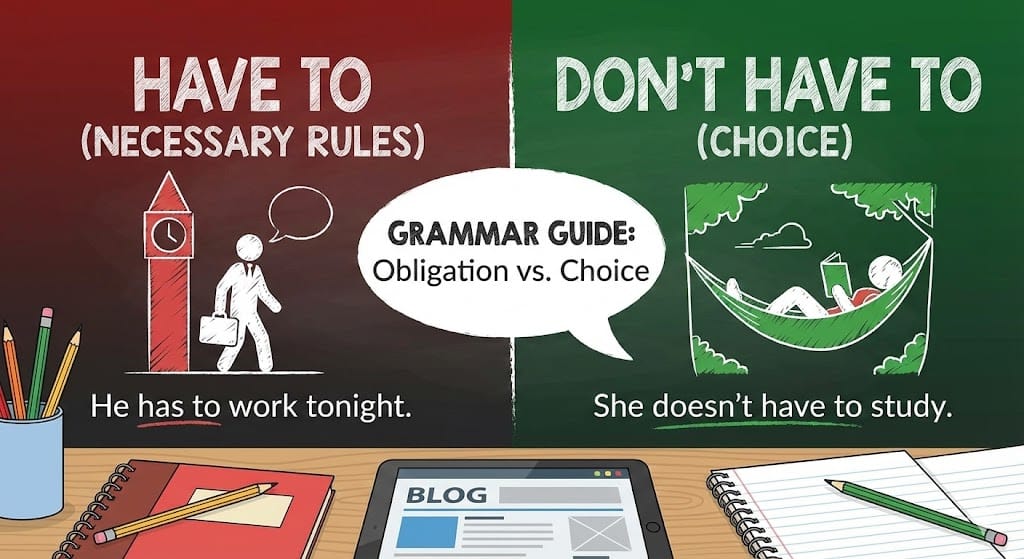
We use have to to talk about rules and necessary actions. However, the negative form (don't have to) has a very specific meaning.
1. Positive: Have to / Has to
We use this when something is necessary. You have no choice.
Structure:
I / You / We / They + have to + verb
He / She / It + has to + verb
Examples:
"I have to finish my homework tonight."
"She has to wear a uniform at work."
2. Negative: Don't have to / Doesn't have to
We use this when something is not necessary. It is your choice. You can do it if you want, but you are not forced to.
Structure:
I / You / We / They + don't have to + verb
He / She / It + doesn't have to + verb
Examples:
"It is Saturday. I don't have to get up early."
"We have a dishwasher. You don't have to wash the plates."
3. Warning: Compare with "Must"
This is the most common mistake for students.
A. Positive Meaning (Same)Have to and Must are very similar.
"I have to go." = "I must go."
Meaning: Both mean it is necessary.
B. Negative Meaning (Different!)Don't have to and Must not are completely different.
1. Don't have to
Meaning: It is not necessary. It is optional.
Example: "You don't have to bring food to the party."
(Context: You can bring food if you want, but it is okay if you don't.)
2. Must not
Meaning: It is prohibited. Do NOT do it.
Example: "You must not swim here."
(Context: It is dangerous or against the rules. Stop!)
Quick Tip:Don't have to = "You don't need to. You can choose."Must not = "Don't do it!"