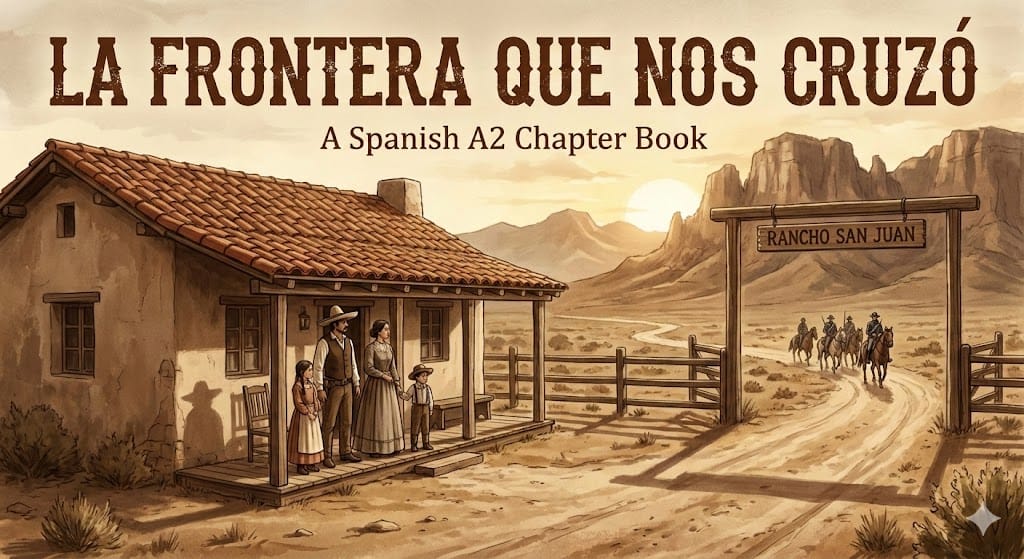
Explore the resilience of Spanish heritage in the US, following a family’s journey of adaptation, language survival, and cultural pride in the American Southwest.
{
"title": "La Frontera que nos Cruzó",
"language": "es",
"subtitle": "A Spanish A2 Chapter Book",
"chapters": [
{
"id": "chapter-1",
"title": "Chapitre 1: El Rancho San Juan",
"content": [
"En 1847, el sol brillaba fuerte sobre el Rancho San Juan. La familia García vivía aquí desde hacía muchas generaciones. Don Antonio, el padre, cuidaba el ganado con sus hijos. \"Los caballos necesitan agua\", dijo Antonio.",
"Su hijo menor, Mateo, corrió hacia el río. La vida era tranquila en el norte de México. Tenían vacas, ovejas y mucha tierra. La madre, Elena, cocinaba en la casa grande. Todo parecía perfecto y eterno. Nadie sabía que el mundo de los García estaba a punto de cambiar para siempre. Era un día normal, pero era el final de su vieja vida."
],
"translation": "In 1847, the sun shone brightly over the San Juan Ranch. The García family had lived here for many generations. Don Antonio, the father, looked after the cattle with his sons. \"The horses need water,\" said Antonio. His youngest son, Mateo, ran toward the river. Life was quiet in northern Mexico. They had cows, sheep, and a lot of land. The mother, Elena, cooked in the big house. Everything seemed perfect and eternal. No one knew that the García's world was about to change forever. It was a normal day, but it was the end of their old life.",
"quiz": [
{
"question": "1. True or False: The story begins in the year 1900.",
"options": [
{ "text": "True", "value": "wrong" },
{ "text": "False", "value": "correct" }
]
},
{
"question": "2. What animals does Don Antonio care for?",
"options": [
{ "text": "a) Elephants", "value": "wrong" },
{ "text": "b) Cattle and horses", "value": "correct" },
{ "text": "c) Only chickens", "value": "wrong" }
]
},
{
"question": "3. Where does the family live at the start of the story?",
"options": [
{ "text": "a) Northern Mexico", "value": "correct" },
{ "text": "b) New York", "value": "wrong" },
{ "text": "c) Spain", "value": "wrong" }
]
}
]
},
{
"id": "chapter-2",
"title": "Chapitre 2: Rumores de Guerra",
"content": [
"Un día, un mensajero llegó al rancho. Estaba cansado y sucio de tanto viajar. \"Hay problemas en el sur\", explicó el hombre con voz baja. \"Los soldados americanos están cerca\". Don Antonio escuchó con atención.",
"Él sabía que había un conflicto difícil entre México y los Estados Unidos. Elena estaba muy preocupada. \"¿Qué va a pasar con nosotros?\" preguntó ella. Antonio miró el horizonte lejano. \"No lo sé, pero debemos estar preparados\". El aire se sentía pesado esa tarde. Los rumores de guerra rompieron la paz del rancho. Esa noche, la familia durmió poco, pensando en el futuro incierto."
],
"translation": "One day, a messenger arrived at the ranch. He was tired and dirty from so much traveling. \"There are problems in the south,\" the man explained in a low voice. \"American soldiers are near.\" Don Antonio listened with attention. He knew there was a difficult conflict between Mexico and the United States. Elena was very worried. \"What is going to happen to us?\" she asked. Antonio looked at the distant horizon. \"I don't know, but we must be prepared.\" The air felt heavy that afternoon. Rumors of war broke the peace of the ranch. That night, the family slept little, thinking about the uncertain future.",
"quiz": [
{
"question": "1. Who arrived at the ranch?",
"options": [
{ "text": "a) A messenger", "value": "correct" },
{ "text": "b) A doctor", "value": "wrong" },
{ "text": "c) A teacher", "value": "wrong" }
]
},
{
"question": "2. True or False: Elena was happy about the news.",
"options": [
{ "text": "True", "value": "wrong" },
{ "text": "False", "value": "correct" }
]
},
{
"question": "3. What broke the peace of the ranch?",
"options": [
{ "text": "a) A storm", "value": "wrong" },
{ "text": "b) Rumors of war", "value": "correct" },
{ "text": "c) A party", "value": "wrong" }
]
}
]
},
{
"id": "chapter-3",
"title": "Chapitre 3: El Tratado de 1848",
"content": [
"Pasaron los meses y la guerra terminó en 1848. Pero las noticias no eran buenas para México. Se firmó un documento importante: el Tratado de Guadalupe Hidalgo. Un oficial del gobierno visitó el pueblo cercano.",
"\"Esta tierra ahora es parte de los Estados Unidos\", anunció él a la gente. La familia García estaba muy confundida. Ellos no se movieron de su casa, pero la frontera sí se movió. Cruzó sobre ellos. \"Ayer éramos mexicanos, hoy somos americanos\", dijo Antonio con tristeza. Sin viajar ni un kilómetro, ahora vivían en un país diferente. Era una situación muy extraña."
],
"translation": "Months passed and the war ended in 1848. But the news was not good for Mexico. An important document was signed: the Treaty of Guadalupe Hidalgo. A government official visited the nearby town. \"This land is now part of the United States,\" he announced to the people. The García family was very confused. They did not move from their house, but the border did move. It crossed over them. \"Yesterday we were Mexican, today we are American,\" said Antonio with sadness. Without traveling even one kilometer, they now lived in a different country. It was a very strange situation.",
"quiz": [
{
"question": "1. What year did the war end?",
"options": [
{ "text": "a) 1848", "value": "correct" },
{ "text": "b) 1850", "value": "wrong" },
{ "text": "c) 1900", "value": "wrong" }
]
},
{
"question": "2. True or False: The García family moved to a new house.",
"options": [
{ "text": "True", "value": "wrong" },
{ "text": "False", "value": "correct" }
]
},
{
"question": "3. What changed for the family?",
"options": [
{ "text": "a) Their country", "value": "correct" },
{ "text": "b) Their names", "value": "wrong" },
{ "text": "c) Their jobs", "value": "wrong" }
]
}
]
},
{
"id": "chapter-4",
"title": "Chapitre 4: Un Nuevo Idioma",
"content": [
"El cambio llegó muy rápido. En el pueblo, aparecieron letreros nuevos en las calles. Ya no decían \"Tienda\", ahora decían \"Store\". El alcalde ahora era un \"Mayor\". Mateo miraba las palabras y no entendía nada.",
"El inglés sonaba extraño a sus oídos. Era rápido y diferente al español. Un hombre habló con Don Antonio en inglés sobre negocios. Antonio no pudo responder y se sintió frustrado. \"¿Cómo vamos a vivir aquí si no entendemos la ley?\" pensó él. La barrera del idioma era un muro invisible. Aprender inglés era una necesidad urgente para sobrevivir en esta nueva realidad."
],
"translation": "The change arrived very fast. In the town, new signs appeared on the streets. They no longer said \"Tienda\" (store), now they said \"Store\". The mayor was now a \"Mayor\". Mateo looked at the words and understood nothing. English sounded strange to his ears. It was fast and different from Spanish. A man spoke with Don Antonio in English about business. Antonio could not answer and felt frustrated. \"How are we going to live here if we don't understand the law?\" he thought. The language barrier was an invisible wall. Learning English was an urgent necessity to survive in this new reality.",
"quiz": [
{
"question": "1. What appeared in the town?",
"options": [
{ "text": "a) New signs in English", "value": "correct" },
{ "text": "b) New horses", "value": "wrong" },
{ "text": "c) New houses", "value": "wrong" }
]
},
{
"question": "2. True or False: Mateo understood the English words easily.",
"options": [
{ "text": "True", "value": "wrong" },
{ "text": "False", "value": "correct" }
]
},
{
"question": "3. Why was Don Antonio frustrated?",
"options": [
{ "text": "a) He was hungry", "value": "wrong" },
{ "text": "b) He couldn't answer in English", "value": "correct" },
{ "text": "c) He lost his hat", "value": "wrong" }
]
}
]
},
{
"id": "chapter-5",
"title": "Chapitre 5: Los Documentos",
"content": [
"Unos abogados llegaron al Rancho San Juan. Querían ver los papeles oficiales de la tierra. \"¿Tienen el título de propiedad?\" preguntaron en un español difícil. Don Antonio sacó una caja vieja de madera.",
"Dentro había documentos antiguos con sellos del Rey de España y del gobierno mexicano. \"Estos son nuestros papeles\", dijo con orgullo. Los abogados miraron los documentos con duda. \"Necesitamos verificar esto\", dijeron ellos. El sistema legal americano era diferente y complicado. La familia tenía mucho miedo de perder su rancho. Esos papeles viejos y amarillos eran lo único que protegía su hogar y su historia."
],
"translation": "Some lawyers arrived at the San Juan Ranch. They wanted to see the official land papers. \"Do you have the property title?\" they asked in difficult Spanish. Don Antonio took out an old wooden box. Inside were ancient documents with seals from the King of Spain and the Mexican government. \"These are our papers,\" he said with pride. The lawyers looked at the documents with doubt. \"We need to verify this,\" they said. The American legal system was different and complicated. The family was very afraid of losing their ranch. Those old, yellow papers were the only thing protecting their home and their history.",
"quiz": [
{
"question": "1. What did the lawyers want to see?",
"options": [
{ "text": "a) The cows", "value": "wrong" },
{ "text": "b) The land papers", "value": "correct" },
{ "text": "c) The kitchen", "value": "wrong" }
]
},
{
"question": "2. True or False: The documents had seals from the King of Spain.",
"options": [
{ "text": "True", "value": "correct" },
{ "text": "False", "value": "wrong" }
]
},
{
"question": "3. How did the family feel?",
"options": [
{ "text": "a) Afraid of losing the ranch", "value": "correct" },
{ "text": "b) Happy to sell", "value": "wrong" },
{ "text": "c) Bored", "value": "wrong" }
]
}
]
},
{
"id": "chapter-6",
"title": "Chapitre 6: La Escuela del Pueblo",
"content": [
"Mateo comenzó a ir a la escuela del pueblo. Estaba nervioso. El maestro era estricto y solo hablaba inglés. \"En esta clase, no hablamos español\", dijo el maestro el primer día. Mateo quería hablar con sus amigos, pero tenía miedo.",
"Cuando dijo \"amigo\" por accidente, el maestro lo miró mal. Mateo se sintió triste y solo. Le dolía la cabeza de intentar entender todo el día. La escuela debía ser un lugar feliz, pero se sentía como una prisión para su voz. Sin embargo, Mateo era valiente y decidió que aprendería, sin olvidar nunca su propio idioma."
],
"translation": "Mateo started going to the town school. He was nervous. The teacher was strict and only spoke English. \"In this class, we do not speak Spanish,\" the teacher said on the first day. Mateo wanted to speak with his friends, but he was afraid. When he said \"amigo\" by accident, the teacher looked at him badly. Mateo felt sad and alone. His head hurt from trying to understand all day. School should be a happy place, but it felt like a prison for his voice. However, Mateo was brave and decided he would learn, without ever forgetting his own language.",
"quiz": [
{
"question": "1. What language was forbidden in class?",
"options": [
{ "text": "a) English", "value": "wrong" },
{ "text": "b) Spanish", "value": "correct" },
{ "text": "c) French", "value": "wrong" }
]
},
{
"question": "2. How did Mateo feel at school?",
"options": [
{ "text": "a) Happy and excited", "value": "wrong" },
{ "text": "b) Sad and alone", "value": "correct" },
{ "text": "c) Angry", "value": "wrong" }
]
},
{
"question": "3. True or False: The teacher was very relaxed.",
"options": [
{ "text": "True", "value": "wrong" },
{ "text": "False", "value": "correct" }
]
}
]
},
{
"id": "chapter-7",
"title": "Chapitre 7: Palabras Prestadas",
"content": [
"Un día, Mateo escuchó a unos vaqueros americanos trabajando cerca. Ellos hablaban inglés, pero usaban palabras familiares. Decían \"corral\", \"rodeo\" y \"mustang\". Mateo sonrió sorprendido. ¡Esas eran palabras en español!",
"\"Mustang\" venía de \"mesteño\". \"Ranch\" venía de \"rancho\". Mateo comprendió algo importante. Aunque los americanos gobernaban ahora, necesitaban el español para trabajar la tierra. La cultura de los vaqueros mexicanos era la base de todo. Mateo corrió a casa para contarle a su padre. \"Papá, ellos usan nuestras palabras\", dijo feliz. El español no iba a desaparecer; estaba transformando el inglés poco a poco."
],
"translation": "One day, Mateo heard some American cowboys working nearby. They spoke English, but used familiar words. They said \"corral,\" \"rodeo,\" and \"mustang.\" Mateo smiled, surprised. Those were words in Spanish! \"Mustang\" came from \"mesteño.\" \"Ranch\" came from \"rancho.\" Mateo understood something important. Even though the Americans governed now, they needed Spanish to work the land. The culture of the Mexican cowboys was the foundation of everything. Mateo ran home to tell his father. \"Dad, they use our words,\" he said happily. Spanish was not going to disappear; it was transforming English little by little.",
"quiz": [
{
"question": "1. What words did the cowboys use?",
"options": [
{ "text": "a) Sushi and kimono", "value": "wrong" },
{ "text": "b) Corral and rodeo", "value": "correct" },
{ "text": "c) Pizza and pasta", "value": "wrong" }
]
},
{
"question": "2. True or False: The American cowboys used no Spanish words.",
"options": [
{ "text": "True", "value": "wrong" },
{ "text": "False", "value": "correct" }
]
},
{
"question": "3. What did Mateo realize?",
"options": [
{ "text": "a) Spanish was transforming English", "value": "correct" },
{ "text": "b) English was easy", "value": "wrong" },
{ "text": "c) Cowboys were mean", "value": "wrong" }
]
}
]
},
{
"id": "chapter-8",
"title": "Chapitre 8: La Promesa de la Abuela",
"content": [
"La abuela de Mateo, Doña Sofía, era una mujer fuerte. Ella vio que los niños hablaban más inglés entre ellos. Una noche, durante la cena, habló seriamente. \"En esta casa, hablamos español\", declaró ella. Ella sirvió tortillas calientes y frijoles negros.",
"\"La comida sabe mejor en nuestro idioma\", dijo ella sonriendo. Doña Sofía les contó historias de sus antepasados. Hizo prometer a los niños que nunca olvidarían su lengua materna. \"El inglés es para la escuela y el comercio. El español es para el corazón y la familia\", les enseñó esa noche bajo la luz de las velas."
],
"translation": "Mateo's grandmother, Doña Sofía, was a strong woman. She saw that the children were speaking more English among themselves. One night, during dinner, she spoke seriously. \"In this house, we speak Spanish,\" she declared. She served hot tortillas and black beans. \"Food tastes better in our language,\" she said smiling. Doña Sofía told them stories of their ancestors. She made the children promise they would never forget their mother tongue. \"English is for school and business. Spanish is for the heart and family,\" she taught them that night under the candlelight.",
"quiz": [
{
"question": "1. Who insisted on speaking Spanish at home?",
"options": [
{ "text": "a) Mateo", "value": "wrong" },
{ "text": "b) Doña Sofía", "value": "correct" },
{ "text": "c) The teacher", "value": "wrong" }
]
},
{
"question": "2. What did she serve for dinner?",
"options": [
{ "text": "a) Burgers", "value": "wrong" },
{ "text": "b) Tortillas and beans", "value": "correct" },
{ "text": "c) Pizza", "value": "wrong" }
]
},
{
"question": "3. According to Sofía, what is Spanish for?",
"options": [
{ "text": "a) Business", "value": "wrong" },
{ "text": "b) The heart and family", "value": "correct" },
{ "text": "c) School", "value": "wrong" }
]
}
]
},
{
"id": "chapter-9",
"title": "Chapitre 9: Dos Banderas",
"content": [
"Llegó el 4 de julio, el Día de la Independencia de Estados Unidos. Había una gran fiesta en el pueblo. La familia García asistió para ver la celebración. Había muchas banderas rojas, blancas y azules. Pero también había música de guitarra y comida mexicana.",
"Mateo vio que sus dos mundos se mezclaban. Podía ser leal a su nueva nación y amar sus raíces mexicanas. Bailaron y comieron con sus vecinos, tanto nuevos como viejos. \"Somos americanos de herencia mexicana\", pensó Mateo. No tenía que elegir uno u otro. Podía celebrar las dos culturas al mismo tiempo."
],
"translation": "July 4th arrived, the Independence Day of the United States. There was a big party in town. The García family attended to see the celebration. There were many red, white, and blue flags. But there was also guitar music and Mexican food. Mateo saw that his two worlds were mixing. He could be loyal to his new nation and love his Mexican roots. They danced and ate with their neighbors, both new and old. \"We are Americans of Mexican heritage,\" Mateo thought. He didn't have to choose one or the other. He could celebrate both cultures at the same time.",
"quiz": [
{
"question": "1. What holiday was it?",
"options": [
{ "text": "a) Christmas", "value": "wrong" },
{ "text": "b) July 4th", "value": "correct" },
{ "text": "c) New Year", "value": "wrong" }
]
},
{
"question": "2. True or False: There was only American food at the party.",
"options": [
{ "text": "True", "value": "wrong" },
{ "text": "False", "value": "correct" }
]
},
{
"question": "3. What did Mateo realize about his culture?",
"options": [
{ "text": "a) He had to choose one", "value": "wrong" },
{ "text": "b) He could celebrate both", "value": "correct" },
{ "text": "c) He liked neither", "value": "wrong" }
]
}
]
},
{
"id": "chapter-10",
"title": "Chapitre 10: El Legado",
"content": [
"Pasaron muchos años. Mateo ya era un abuelo con pelo blanco. Estaba sentado en el porche del Rancho San Juan, que todavía pertenecía a la familia. Sus nietos jugaban en el jardín. Ellos hablaban inglés perfecto y español perfecto.",
"Cambiaban de idioma con mucha facilidad. Mateo sonrió feliz. La frontera había cruzado a su familia, pero ellos habían cruzado la barrera del tiempo. Habían sobrevivido y prosperado. El legado de los García no era solo la tierra, sino su capacidad de adaptarse. Eran el puente entre dos naciones, fuertes y orgullosos de su historia única en los Estados Unidos."
],
"translation": "Many years passed. Mateo was now a grandfather with white hair. He was sitting on the porch of the San Juan Ranch, which still belonged to the family. His grandchildren played in the garden. They spoke perfect English and perfect Spanish. They changed languages with great ease. Mateo smiled happily. The border had crossed his family, but they had crossed the barrier of time. They had survived and prospered. The legacy of the Garcías was not just the land, but their ability to adapt. They were the bridge between two nations, strong and proud of their unique history in the United States.",
"quiz": [
{
"question": "1. Who is Mateo in this chapter?",
"options": [
{ "text": "a) A young boy", "value": "wrong" },
{ "text": "b) A grandfather", "value": "correct" },
{ "text": "c) A soldier", "value": "wrong" }
]
},
{
"question": "2. How do the grandchildren speak?",
"options": [
{ "text": "a) Only English", "value": "wrong" },
{ "text": "b) Only Spanish", "value": "wrong" },
{ "text": "c) Both languages perfectly", "value": "correct" }
]
},
{
"question": "3. What is the family's legacy?",
"options": [
{ "text": "a) Only the land", "value": "wrong" },
{ "text": "b) Their ability to adapt", "value": "correct" },
{ "text": "c) Their horses", "value": "wrong" }
]
}
]
}
]
}