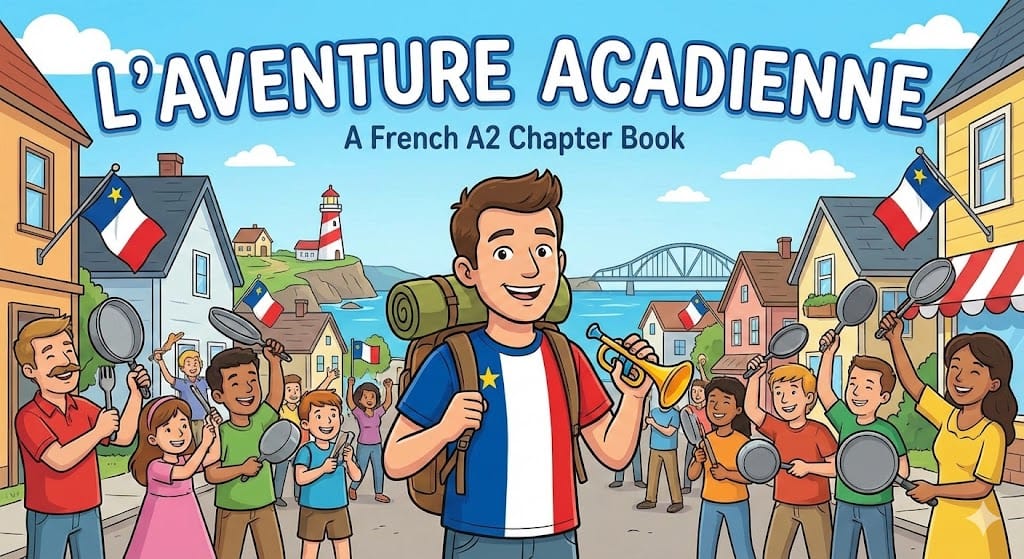
This French A2 chapter book follows Marc through New Brunswick as he experiences the local dialect (Chiac), the Tintamarre festival, and delicious traditional food.
{
"title": "L'Aventure Acadienne",
"language": "fr",
"subtitle": "A French A2 Chapter Book",
"chapters": [
{
"id": "chapter-1",
"title": "Chapitre 1: Bienvenue à Moncton",
"content": [
"Marc est arrivé à l'aéroport de Moncton en après-midi. C'était sa première visite au Nouveau-Brunswick. Il a pris un taxi pour aller au centre-ville. Le chauffeur de taxi était très sympathique. Il parlait un mélange unique de français et d'anglais.",
"Marc a appris que cela s'appelle le « Chiac ». La ville semblait calme mais accueillante. Marc a déposé sa valise à l'hôtel et a décidé de marcher un peu. Il a vu la rivière Petitcodiac, célèbre pour ses marées impressionnantes. Il était prêt pour son aventure."
],
"translation": "Marc arrived at the Moncton airport in the afternoon. It was his first visit to New Brunswick. He took a taxi to go downtown. The taxi driver was very friendly. He spoke a unique mix of French and English. Marc learned that this is called \"Chiac.\" The city seemed quiet but welcoming. Marc dropped his suitcase at the hotel and decided to walk a little. He saw the Petitcodiac River, famous for its impressive tides. He was ready for his adventure.",
"quiz": [
{
"question": "1. Où arrive Marc ?",
"options": [
{ "text": "a) À Paris", "value": "wrong" },
{ "text": "b) À Moncton", "value": "correct" },
{ "text": "c) À Montréal", "value": "wrong" }
]
},
{
"question": "2. Qu'est-ce que le « Chiac » ?",
"options": [
{ "text": "a) Un plat traditionnel", "value": "wrong" },
{ "text": "b) Une danse locale", "value": "wrong" },
{ "text": "c) Un mélange de français et d'anglais", "value": "correct" }
]
},
{
"question": "3. Vrai ou Faux : Marc a vu la rivière Petitcodiac.",
"options": [
{ "text": "a) Vrai", "value": "correct" },
{ "text": "b) Faux", "value": "wrong" }
]
}
]
},
{
"id": "chapter-2",
"title": "Chapitre 2: Le Goût du Fricot",
"content": [
"Pour le dîner, Marc voulait manger quelque chose de traditionnel. Il est entré dans un petit restaurant chaleureux. Le serveur lui a conseillé de goûter au « fricot au poulet ». C'est une soupe traditionnelle acadienne avec des pommes de terre et de la pâte.",
"Marc a aussi commandé une « poutine râpée », qui est très différente de la poutine québécoise. Quand le repas est arrivé, l'odeur était délicieuse. Le fricot était chaud et réconfortant. Marc a adoré la cuisine acadienne simple et savoureuse."
],
"translation": "For dinner, Marc wanted to eat something traditional. He entered a warm little restaurant. The waiter advised him to taste the \"chicken fricot.\" It is a traditional Acadian soup with potatoes and dough (dumplings). Marc also ordered a \"poutine râpée,\" which is very different from Quebec poutine. When the meal arrived, the smell was delicious. The fricot was hot and comforting. Marc loved the simple and tasty Acadian cuisine.",
"quiz": [
{
"question": "1. Qu'est-ce que le fricot ?",
"options": [
{ "text": "a) Un dessert", "value": "wrong" },
{ "text": "b) Une soupe au poulet", "value": "correct" },
{ "text": "c) Une boisson", "value": "wrong" }
]
},
{
"question": "2. Vrai ou Faux : La poutine râpée est identique à la poutine québécoise.",
"options": [
{ "text": "a) Vrai", "value": "wrong" },
{ "text": "b) Faux", "value": "correct" }
]
},
{
"question": "3. Comment était le repas ?",
"options": [
{ "text": "a) Froid", "value": "wrong" },
{ "text": "b) Mauvais", "value": "wrong" },
{ "text": "c) Délicieux", "value": "correct" }
]
}
]
},
{
"id": "chapter-3",
"title": "Chapitre 3: Le Village Historique",
"content": [
"Le lendemain, Marc a visité le Village Historique Acadien. C'est un musée en plein air. Il y avait de vieilles maisons en bois et des fermes. Les employés portaient des costumes du dix-neuvième siècle.",
"Marc a parlé avec une femme qui faisait du pain dans un four traditionnel. Elle lui a raconté l'histoire difficile de ses ancêtres. Marc a appris comment les Acadiens vivaient autrefois, sans électricité ni voitures. C'était comme un voyage dans le passé. Il a acheté un petit souvenir à la boutique."
],
"translation": "The next day, Marc visited the Acadian Historical Village. It is an open-air museum. There were old wooden houses and farms. The employees wore nineteenth-century costumes. Marc spoke with a woman who was making bread in a traditional oven. She told him the difficult history of her ancestors. Marc learned how the Acadians lived in the past, without electricity or cars. It was like a trip into the past. He bought a small souvenir at the shop.",
"quiz": [
{
"question": "1. Quel type de musée est-ce ?",
"options": [
{ "text": "a) Un musée d'art moderne", "value": "wrong" },
{ "text": "b) Un musée en plein air", "value": "correct" },
{ "text": "c) Un musée des sciences", "value": "wrong" }
]
},
{
"question": "2. Que faisaient les employés ?",
"options": [
{ "text": "a) Ils portaient des costumes anciens", "value": "correct" },
{ "text": "b) Ils utilisaient des ordinateurs", "value": "wrong" },
{ "text": "c) Ils conduisaint des voitures", "value": "wrong" }
]
},
{
"question": "3. Vrai ou Faux : Marc a parlé avec une femme qui faisait du pain.",
"options": [
{ "text": "a) Vrai", "value": "correct" },
{ "text": "b) Faux", "value": "wrong" }
]
}
]
},
{
"id": "chapter-4",
"title": "Chapitre 4: Les Dunes de Bouctouche",
"content": [
"Marc a conduit sa voiture de location vers le nord. Il est allé à la dune de Bouctouche. C'est une longue bande de sable qui protège la baie. Il y a une passerelle en bois pour marcher sans abîmer la nature.",
"L'air était salé et frais. Marc a marché pendant une heure, observant les oiseaux de mer. Il a vu un grand héron bleu dans l'eau. Le paysage était magnifique et très calme. C'était l'endroit parfait pour prendre des photos de la nature sauvage du Nouveau-Brunswick."
],
"translation": "Marc drove his rental car north. He went to the Bouctouche Dune. It is a long strip of sand that protects the bay. There is a wooden boardwalk for walking without damaging nature. The air was salty and fresh. Marc walked for an hour, observing the sea birds. He saw a great blue heron in the water. The landscape was magnificent and very calm. It was the perfect place to take photos of the wild nature of New Brunswick.",
"quiz": [
{
"question": "1. Où Marc est-il allé ?",
"options": [
{ "text": "a) À la montagne", "value": "wrong" },
{ "text": "b) À la dune de Bouctouche", "value": "correct" },
{ "text": "c) En forêt", "value": "wrong" }
]
},
{
"question": "2. Qu'est-ce qu'il a vu dans l'eau ?",
"options": [
{ "text": "a) Un requin", "value": "wrong" },
{ "text": "b) Un bateau", "value": "wrong" },
{ "text": "c) Un grand héron bleu", "value": "correct" }
]
},
{
"question": "3. Pourquoi y a-t-il une passerelle en bois ?",
"options": [
{ "text": "a) Pour protéger la nature", "value": "correct" },
{ "text": "b) Pour courir vite", "value": "wrong" },
{ "text": "c) Pour les voitures", "value": "wrong" }
]
}
]
},
{
"id": "chapter-5",
"title": "Chapitre 5: Le Drapeau Tricolore",
"content": [
"En voyageant, Marc a vu beaucoup de drapeaux devant les maisons. Le drapeau acadien ressemble au drapeau français. Il est bleu, blanc et rouge. Mais il y a une différence importante. Dans la partie bleue, il y a une étoile jaune.",
"Cette étoile s'appelle la « Stella Maris ». Elle guide les marins et protège le peuple acadien. Marc a trouvé que c'était un beau symbole d'espoir. Il a pris une photo d'un grand drapeau qui flottait au vent devant une église en bois."
],
"translation": "While traveling, Marc saw many flags in front of the houses. The Acadian flag looks like the French flag. It is blue, white, and red. But there is an important difference. In the blue part, there is a yellow star. This star is called the \"Stella Maris.\" It guides sailors and protects the Acadian people. Marc found it to be a beautiful symbol of hope. He took a picture of a large flag waving in the wind in front of a wooden church.",
"quiz": [
{
"question": "1. De quelle couleur est l'étoile sur le drapeau ?",
"options": [
{ "text": "a) Rouge", "value": "wrong" },
{ "text": "b) Blanche", "value": "wrong" },
{ "text": "c) Jaune", "value": "correct" }
]
},
{
"question": "2. Comment s'appelle l'étoile ?",
"options": [
{ "text": "a) L'Étoile du Nord", "value": "wrong" },
{ "text": "b) Stella Maris", "value": "correct" },
{ "text": "c) Le Soleil", "value": "wrong" }
]
},
{
"question": "3. Vrai ou Faux : Le drapeau est exactement le même que le drapeau de la France.",
"options": [
{ "text": "a) Vrai", "value": "wrong" },
{ "text": "b) Faux", "value": "correct" }
]
}
]
},
{
"id": "chapter-6",
"title": "Chapitre 6: Une Soirée Musicale",
"content": [
"Ce soir-là, Marc a été invité à une fête de cuisine, ou « kitchen party ». C'est une tradition locale très populaire. Des musiciens jouaient du violon avec beaucoup d'énergie. Une autre personne jouait des cuillères en métal sur sa jambe pour faire le rythme.",
"Tout le monde tapait du pied. La musique était joyeuse et rapide. Les gens chantaient de vieilles chansons acadiennes. Marc a essayé de jouer des cuillères, mais c'était difficile ! Il a ri et a passé une excellente soirée avec ses nouveaux amis."
],
"translation": "That evening, Marc was invited to a kitchen party. It is a very popular local tradition. Musicians played the fiddle (violin) with a lot of energy. Another person played metal spoons on their leg to make the rhythm. Everyone was tapping their feet. The music was joyful and fast. People sang old Acadian songs. Marc tried to play the spoons, but it was difficult! He laughed and had an excellent evening with his new friends.",
"quiz": [
{
"question": "1. Où était la fête ?",
"options": [
{ "text": "a) Dans une cuisine", "value": "correct" },
{ "text": "b) Dans un stade", "value": "wrong" },
{ "text": "c) Dans un parc", "value": "wrong" }
]
},
{
"question": "2. Quel instrument jouaient les musiciens ?",
"options": [
{ "text": "a) Du piano", "value": "wrong" },
{ "text": "b) Du violon", "value": "correct" },
{ "text": "c) De la trompette", "value": "wrong" }
]
},
{
"question": "3. Qu'est-ce que Marc a essayé de faire ?",
"options": [
{ "text": "a) Jouer du violon", "value": "wrong" },
{ "text": "b) Chanter", "value": "wrong" },
{ "text": "c) Jouer des cuillères", "value": "correct" }
]
}
]
},
{
"id": "chapter-7",
"title": "Chapitre 7: Le Roi du Homard",
"content": [
"Le lendemain, Marc est allé à Shediac. Cette ville est connue comme la « Capitale mondiale du homard ». À l'entrée de la ville, il y a une statue géante de homard. C'est le plus grand homard du monde ! Marc a pris une photo amusante avec la statue.",
"Ensuite, il est allé au port. Il a mangé un « guedille au homard » (lobster roll) pour le déjeuner. Le pain était grillé et le homard était très frais. C'était le meilleur repas de son voyage jusqu'à maintenant."
],
"translation": "The next day, Marc went to Shediac. This town is known as the \"Lobster Capital of the World.\" At the entrance of the town, there is a giant lobster statue. It is the world's largest lobster! Marc took a funny picture with the statue. Then, he went to the port. He ate a \"lobster roll\" for lunch. The bread was toasted and the lobster was very fresh. It was the best meal of his trip so far.",
"quiz": [
{
"question": "1. Quel est le titre de la ville de Shediac ?",
"options": [
{ "text": "a) Capitale de la crevette", "value": "wrong" },
{ "text": "b) Capitale du homard", "value": "correct" },
{ "text": "c) Capitale du poisson", "value": "wrong" }
]
},
{
"question": "2. Qu'est-ce qu'il y a à l'entrée de la ville ?",
"options": [
{ "text": "a) Un phare", "value": "wrong" },
{ "text": "b) Une statue géante", "value": "correct" },
{ "text": "c) Un grand bateau", "value": "wrong" }
]
},
{
"question": "3. Vrai ou Faux : Marc a mangé un hamburger.",
"options": [
{ "text": "a) Vrai", "value": "wrong" },
{ "text": "b) Faux", "value": "correct" }
]
}
]
},
{
"id": "chapter-8",
"title": "Chapitre 8: Préparer le Tintamarre",
"content": [
"C'était le 14 août, la veille de la Fête nationale de l'Acadie. Marc a vu que tout le monde se préparait pour le « Tintamarre ». Le but est de faire le plus de bruit possible. Marc a acheté un sifflet et une petite trompette en plastique.",
"Il a aussi acheté un t-shirt bleu, blanc et rouge. Les gens dans la rue étaient très excités. Ils peignaient leurs visages aux couleurs du drapeau. Marc sentait l'énergie monter dans la ville. Demain serait un grand jour."
],
"translation": "It was August 14th, the day before National Acadian Day. Marc saw that everyone was preparing for the \"Tintamarre.\" The goal is to make as much noise as possible. Marc bought a whistle and a small plastic trumpet. He also bought a blue, white, and red t-shirt. The people in the street were very excited. They were painting their faces in the flag's colors. Marc felt the energy rising in the city. Tomorrow would be a big day.",
"quiz": [
{
"question": "1. Quelle est la date dans ce chapitre ?",
"options": [
{ "text": "a) Le 15 août", "value": "wrong" },
{ "text": "b) Le 14 août", "value": "correct" },
{ "text": "c) Le 1er juillet", "value": "wrong" }
]
},
{
"question": "2. Quel est le but du Tintamarre ?",
"options": [
{ "text": "a) Dormir", "value": "wrong" },
{ "text": "b) Faire du bruit", "value": "correct" },
{ "text": "c) Manger en silence", "value": "wrong" }
]
},
{
"question": "3. Qu'a acheté Marc ?",
"options": [
{ "text": "a) Un sifflet et une trompette", "value": "correct" },
{ "text": "b) Une guitare", "value": "wrong" },
{ "text": "c) Un chapeau", "value": "wrong" }
]
}
]
},
{
"id": "chapter-9",
"title": "Chapitre 9: La Grande Fête (Le 15 août)",
"content": [
"Le 15 août est arrivé. À 17h55, le grand défilé a commencé. Des milliers de personnes marchaient dans la rue principale. Tout le monde criait, sifflait et tapait sur des casseroles. C'était le Tintamarre ! Le bruit était incroyable.",
"Marc marchait avec la foule, soufflant dans sa trompette. Les gens criaient : « On est là pour rester ! ». C'était une célébration de la survie et de la fierté acadienne. Marc se sentait ému de partager ce moment unique avec eux."
],
"translation": "August 15th arrived. At 5:55 PM, the big parade began. Thousands of people walked down the main street. Everyone was shouting, whistling, and banging on pots and pans. It was the Tintamarre! The noise was incredible. Marc walked with the crowd, blowing his trumpet. People shouted: \"We are here to stay!\" It was a celebration of survival and Acadian pride. Marc felt moved to share this unique moment with them.",
"quiz": [
{
"question": "1. À quelle heure commence le défilé ?",
"options": [
{ "text": "a) À midi", "value": "wrong" },
{ "text": "b) À 17h55", "value": "correct" },
{ "text": "c) À minuit", "value": "wrong" }
]
},
{
"question": "2. Que faisaient les gens ?",
"options": [
{ "text": "a) Ils lisaient des livres", "value": "wrong" },
{ "text": "b) Ils faisaient du bruit avec des casseroles", "value": "correct" },
{ "text": "c) Ils pleuraient de tristesse", "value": "wrong" }
]
},
{
"question": "3. Vrai ou Faux : C'était une célébration silencieuse.",
"options": [
{ "text": "a) Vrai", "value": "wrong" },
{ "text": "b) Faux", "value": "correct" }
]
}
]
},
{
"id": "chapter-10",
"title": "Chapitre 10: Au Revoir l'Acadie",
"content": [
"Le voyage de Marc touchait à sa fin. Il a fait sa valise avec tristesse. Il avait appris beaucoup de choses sur la culture acadienne. Il n'oublierait jamais le goût du fricot, le son du violon et l'énergie du Tintamarre.",
"Avant de partir, il a acheté une carte postale pour sa famille. Il a écrit : « L'Acadie est magnifique et les gens sont formidables ». En regardant par la fenêtre de l'avion, Marc a promis de revenir un jour au Nouveau-Brunswick."
],
"translation": "Marc's trip was coming to an end. He packed his suitcase with sadness. He had learned many things about Acadian culture. He would never forget the taste of fricot, the sound of the fiddle, and the energy of the Tintamarre. Before leaving, he bought a postcard for his family. He wrote: \"Acadia is beautiful and the people are wonderful.\" Looking out the plane window, Marc promised to return to New Brunswick one day.",
"quiz": [
{
"question": "1. Comment se sentait Marc en faisant sa valise ?",
"options": [
{ "text": "a) Triste", "value": "correct" },
{ "text": "b) En colère", "value": "wrong" },
{ "text": "c) Fatigué", "value": "wrong" }
]
},
{
"question": "2. Qu'a-t-il acheté avant de partir ?",
"options": [
{ "text": "a) Un drapeau", "value": "wrong" },
{ "text": "b) Une carte postale", "value": "correct" },
{ "text": "c) Un violon", "value": "wrong" }
]
},
{
"question": "3. Quelle promesse Marc a-t-il faite ?",
"options": [
{ "text": "a) De ne jamais revenir", "value": "wrong" },
{ "text": "b) De revenir un jour", "value": "correct" },
{ "text": "c) De déménager à Paris", "value": "wrong" }
]
}
]
}
]
}