Learn about the Eiffel Tower while practicing French.
{
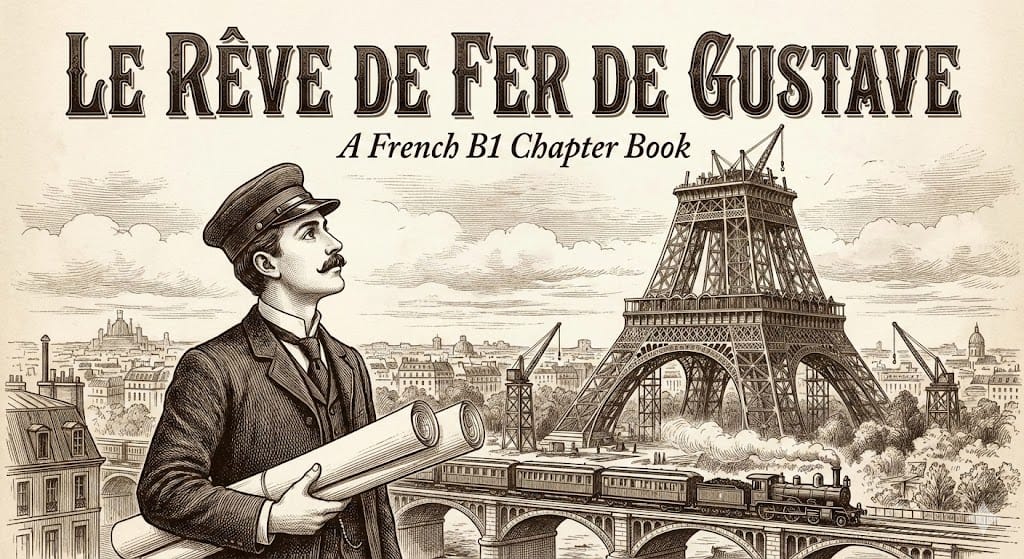
"title": "Le Rêve de Fer de Gustave",
"language": "fr",
"subtitle": "A French B1 Chapter Book",
"chapters": [
{
"id": "chapter-1",
"title": "Chapitre 1: Un Projet Audacieux",
"content": [
"Antoine entra dans le bureau de Monsieur Eiffel à Levallois-Perret. Sur la grande table en chêne, d'immenses plans bleus étaient étalés. « Voici le futur de Paris, » déclara l'ingénieur en chef avec fierté. C'était en janvier 1887, et l'Exposition Universelle approchait à grands pas.",
"Antoine regarda les dessins avec fascination. Une tour de fer de 300 mètres ? C'était impossible, disaient les journaux. Mais Antoine, jeune diplômé, voulait croire au progrès technique. Il savait que le métal remplacerait bientôt la pierre. Ce projet audacieux allait changer sa carrière et le visage de la France pour toujours."
],
"translation": "Antoine entered Mr. Eiffel's office in Levallois-Perret. On the large oak table, huge blue plans were spread out. \"Here is the future of Paris,\" declared the chief engineer with pride. It was January 1887, and the Universal Exhibition was approaching rapidly. Antoine looked at the drawings with fascination. A 300-meter iron tower? It was impossible, the newspapers said. But Antoine, a young graduate, wanted to believe in technical progress. He knew that metal would soon replace stone. This audacious project was going to change his career and the face of France forever.",
"quiz": [
{
"question": "1. Où se trouve Antoine au début de l'histoire ?",
"options": [
{ "text": "a) À la Tour Eiffel", "value": "wrong" },
{ "text": "b) Dans le bureau de M. Eiffel", "value": "correct" },
{ "text": "c) Dans un train", "value": "wrong" }
]
},
{
"question": "2. Quelle est la réaction des journaux face au projet ?",
"options": [
{ "text": "a) Ils sont enthousiastes", "value": "wrong" },
{ "text": "b) Ils disent que c'est impossible", "value": "correct" },
{ "text": "c) Ils l'ignorent complètement", "value": "wrong" }
]
},
{
"question": "3. Vrai ou Faux : Antoine pense que la pierre est le matériau du futur.",
"options": [
{ "text": "a) Vrai", "value": "wrong" },
{ "text": "b) Faux", "value": "correct" }
]
}
]
},
{
"id": "chapter-2",
"title": "Chapitre 2: Les Fondations",
"content": [
"Le chantier commença près de la Seine, sur le Champ-de-Mars. Le travail était difficile car le sol était boueux et instable. Antoine surveillait les ouvriers qui creusaient profondément dans la terre. Pour empêcher l'eau de la rivière d'entrer, ils utilisaient des caissons à air comprimé, une technique nouvelle et dangereuse.",
"« La tour doit avoir des racines solides, » cria le chef de chantier par-dessus le bruit des machines. Antoine avait froid et ses bottes étaient lourdes de boue, mais il ne se plaignait pas. Sans ces fondations massives en béton et en pierre, la tour ne pourrait jamais toucher le ciel."
],
"translation": "The construction site began near the Seine, on the Champ-de-Mars. The work was difficult because the ground was muddy and unstable. Antoine watched over the workers who were digging deep into the earth. To stop the river water from entering, they used compressed air caissons, a new and dangerous technique. \"The tower must have solid roots,\" shouted the foreman over the noise of the machines. Antoine was cold and his boots were heavy with mud, but he didn't complain. Without these massive concrete and stone foundations, the tower could never touch the sky.",
"quiz": [
{
"question": "1. Pourquoi le travail est-il difficile ?",
"options": [
{ "text": "a) Il fait trop chaud", "value": "wrong" },
{ "text": "b) Le sol est boueux et instable", "value": "correct" },
{ "text": "c) Il n'y a pas assez d'ouvriers", "value": "wrong" }
]
},
{
"question": "2. Quelle technique utilisent-ils pour l'eau ?",
"options": [
{ "text": "a) Des pompes électriques", "value": "wrong" },
{ "text": "b) Des caissons à air comprimé", "value": "correct" },
{ "text": "c) Des barrages en bois", "value": "wrong" }
]
},
{
"question": "3. Vrai ou Faux : La tour n'a pas besoin de fondations profondes.",
"options": [
{ "text": "a) Vrai", "value": "wrong" },
{ "text": "b) Faux", "value": "correct" }
]
}
]
},
{
"id": "chapter-3",
"title": "Chapitre 3: La Colère des Artistes",
"content": [
"Un matin, Antoine lut un article dans le journal Le Temps. C'était une lettre violente signée par des artistes célèbres comme Guy de Maupassant et Alexandre Dumas fils. Ils appelaient la tour une « odieuse colonne de tôle boulonnée ». Antoine était furieux. « Ils ne comprennent rien à la beauté de l'ingénierie ! » s'exclama-t-il.",
"Pour ces écrivains, Paris devait rester une ville de monuments en pierre classique, comme le Louvre. Pour Antoine et Eiffel, la beauté résidait dans la fonction et la mathématique. Cette lettre de protestation inquiétait l'équipe, mais Gustave Eiffel restait calme et confiant."
],
"translation": "One morning, Antoine read an article in the newspaper Le Temps. It was a violent letter signed by famous artists like Guy de Maupassant and Alexandre Dumas fils. They called the tower a \"hateful column of bolted sheet metal.\" Antoine was furious. \"They understand nothing about the beauty of engineering!\" he exclaimed. For these writers, Paris had to remain a city of classical stone monuments, like the Louvre. For Antoine and Eiffel, beauty resided in function and mathematics. This protest letter worried the team, but Gustave Eiffel remained calm and confident.",
"quiz": [
{
"question": "1. Qui a signé la lettre de protestation ?",
"options": [
{ "text": "a) Des politiciens", "value": "wrong" },
{ "text": "b) Des artistes et écrivains", "value": "correct" },
{ "text": "c) Les ouvriers", "value": "wrong" }
]
},
{
"question": "2. Comment les artistes décrivent-ils la tour ?",
"options": [
{ "text": "a) Une merveille moderne", "value": "wrong" },
{ "text": "b) Une odieuse colonne", "value": "correct" },
{ "text": "c) Un pont vers le ciel", "value": "wrong" }
]
},
{
"question": "3. Vrai ou Faux : Gustave Eiffel a arrêté la construction à cause de la lettre.",
"options": [
{ "text": "a) Vrai", "value": "wrong" },
{ "text": "b) Faux", "value": "correct" }
]
}
]
},
{
"id": "chapter-4",
"title": "Chapitre 4: Le \"Puddlage\"",
"content": [
"La tour n'était pas faite d'acier, mais de fer puddlé. Antoine expliqua le processus à un journaliste curieux. « Le fer est fondu et brassé pour enlever le carbone. Cela le rend plus résistant à la rouille, » dit-il en montrant une poutre. Chaque pièce était fabriquée à l'usine de Levallois-Perret avec une précision incroyable, au dixième de millimètre près.",
"Sur le chantier, c'était comme un gigantesque jeu de construction. Les ouvriers assemblaient les pièces avec des rivets chauds. L'odeur du métal brûlant remplissait l'air. C'était l'ère industrielle dans toute sa splendeur."
],
"translation": "The tower was not made of steel, but of puddled iron. Antoine explained the process to a curious journalist. \"The iron is melted and stirred to remove the carbon. This makes it more resistant to rust,\" he said, pointing to a beam. Each piece was manufactured at the Levallois-Perret factory with incredible precision, to the tenth of a millimeter. On the site, it was like a gigantic construction set. The workers assembled the pieces with hot rivets. The smell of burning metal filled the air. It was the industrial era in all its splendor.",
"quiz": [
{
"question": "1. En quel matériau est la tour ?",
"options": [
{ "text": "a) En acier", "value": "wrong" },
{ "text": "b) En fer puddlé", "value": "correct" },
{ "text": "c) En bronze", "value": "wrong" }
]
},
{
"question": "2. Où les pièces sont-elles fabriquées ?",
"options": [
{ "text": "a) Sur le Champ-de-Mars", "value": "wrong" },
{ "text": "b) À l'usine de Levallois-Perret", "value": "correct" },
{ "text": "c) En Allemagne", "value": "wrong" }
]
},
{
"question": "3. Vrai ou Faux : Les pièces sont assemblées avec de la colle.",
"options": [
{ "text": "a) Vrai", "value": "wrong" },
{ "text": "b) Faux", "value": "correct" }
]
}
]
},
{
"id": "chapter-5",
"title": "Chapitre 5: L'Ascension",
"content": [
"En 1888, la structure atteignit le deuxième étage. Antoine monta les escaliers provisoires pour inspecter les rivets. Arrivé à 115 mètres, il s'arrêta pour reprendre son souffle. La vue était spectaculaire. Paris s'étendait sous ses pieds comme une carte vivante.",
"Il pouvait voir les deux tours de Notre-Dame au loin et la butte Montmartre, où la basilique du Sacré-Cœur était aussi en construction. Le vent soufflait fort à cette altitude. Antoine réalisa soudainement la grandeur de leur exploit. Ils étaient en train de construire le plus haut bâtiment du monde."
],
"translation": "In 1888, the structure reached the second floor. Antoine climbed the temporary stairs to inspect the rivets. Arriving at 115 meters, he stopped to catch his breath. The view was spectacular. Paris stretched out beneath his feet like a living map. He could see the two towers of Notre-Dame in the distance and the Montmartre hill, where the Sacré-Cœur basilica was also under construction. The wind blew hard at this altitude. Antoine suddenly realized the magnitude of their achievement. They were building the tallest building in the world.",
"quiz": [
{
"question": "1. À quel étage Antoine est-il monté ?",
"options": [
{ "text": "a) Au premier étage", "value": "wrong" },
{ "text": "b) Au deuxième étage", "value": "correct" },
{ "text": "c) Au sommet", "value": "wrong" }
]
},
{
"question": "2. Que voit-il au loin ?",
"options": [
{ "text": "a) La mer", "value": "wrong" },
{ "text": "b) Notre-Dame et Montmartre", "value": "correct" },
{ "text": "c) Le château de Versailles", "value": "wrong" }
]
},
{
"question": "3. Vrai ou Faux : Le Sacré-Cœur était déjà fini.",
"options": [
{ "text": "a) Vrai", "value": "wrong" },
{ "text": "b) Faux", "value": "correct" }
]
}
]
},
{
"id": "chapter-6",
"title": "Chapitre 6: Danger dans le Ciel",
"content": [
"L'hiver arriva avec des vents glacials. Travailler à 200 mètres au-dessus du sol devenait effrayant. Certains ouvriers, les \"charpentiers du ciel\", hésitaient à monter sur les échafaudages étroits. Antoine devait vérifier les mesures de sécurité tous les matins. « Pas d'alcool sur le chantier et attachez-vous toujours ! » ordonnait-il sévèrement.",
"Heureusement, grâce à la discipline stricte de Gustave Eiffel, il n'y avait pas eu d'accidents mortels, ce qui était rare pour l'époque. Malgré la peur du vide, une solidarité forte existait entre les hommes. Ils savaient qu'ils partageaient un destin unique."
],
"translation": "Winter arrived with freezing winds. Working 200 meters above the ground became frightening. Some workers, the \"sky carpenters,\" hesitated to climb onto the narrow scaffolding. Antoine had to check the safety measures every morning. \"No alcohol on the site and always tie yourselves off!\" he ordered strictly. Fortunately, thanks to Gustave Eiffel's strict discipline, there had been no fatal accidents, which was rare for the time. Despite the fear of heights, a strong solidarity existed among the men. They knew they shared a unique destiny.",
"quiz": [
{
"question": "1. Pourquoi les ouvriers ont-ils peur ?",
"options": [
{ "text": "a) À cause des fantômes", "value": "wrong" },
{ "text": "b) À cause de la hauteur et du vent", "value": "correct" },
{ "text": "c) À cause du salaire", "value": "wrong" }
]
},
{
"question": "2. Quelle règle Antoine impose-t-il ?",
"options": [
{ "text": "a) Pas d'alcool et s'attacher", "value": "correct" },
{ "text": "b) Travailler la nuit", "value": "wrong" },
{ "text": "c) Ne pas parler", "value": "wrong" }
]
},
{
"question": "3. Vrai ou Faux : Il y avait beaucoup d'accidents mortels sur ce chantier.",
"options": [
{ "text": "a) Vrai", "value": "wrong" },
{ "text": "b) Faux", "value": "correct" }
]
}
]
},
{
"id": "chapter-7",
"title": "Chapitre 7: La Couleur Rouge",
"content": [
"Alors que la construction touchait à sa fin, il fallait peindre la tour pour la protéger de la rouille. Antoine supervisa l'arrivée des tonnes de peinture. À la surprise de beaucoup, la couleur choisie n'était pas le marron actuel, mais un « rouge Venise » éclatant. « Cette couleur vive symbolise notre victoire sur la matière, » pensa Antoine.",
"Les peintres ressemblaient à des acrobates, suspendus par des cordes, couvrant chaque centimètre de fer. La tour brillait sous le soleil pâle du printemps. Elle n'était pas seulement une structure technique; elle devenait une œuvre d'art."
],
"translation": "As construction neared its end, the tower had to be painted to protect it from rust. Antoine supervised the arrival of tons of paint. To the surprise of many, the chosen color was not the current brown, but a bright \"Venetian red.\" \"This vivid color symbolizes our victory over matter,\" thought Antoine. The painters looked like acrobats, suspended by ropes, covering every centimeter of iron. The tower shone under the pale spring sun. It was not just a technical structure; it was becoming a work of art.",
"quiz": [
{
"question": "1. Pourquoi faut-il peindre la tour ?",
"options": [
{ "text": "a) Pour la rendre jolie", "value": "wrong" },
{ "text": "b) Pour la protéger de la rouille", "value": "correct" },
{ "text": "c) Pour cacher les rivets", "value": "wrong" }
]
},
{
"question": "2. Quelle était la couleur originale de la tour ?",
"options": [
{ "text": "a) Marron", "value": "wrong" },
{ "text": "b) Rouge Venise", "value": "correct" },
{ "text": "c) Jaune", "value": "wrong" }
]
},
{
"question": "3. Vrai ou Faux : Les peintres travaillaient au sol.",
"options": [
{ "text": "a) Vrai", "value": "wrong" },
{ "text": "b) Faux", "value": "correct" }
]
}
]
},
{
"id": "chapter-8",
"title": "Chapitre 8: Le Drapeau Tricolore",
"content": [
"Le 31 mars 1889, la structure principale fut terminée. C'était un jour historique. Gustave Eiffel invita un petit groupe, dont Antoine, à monter les 1 710 marches jusqu'au sommet, car les ascenseurs ne fonctionnaient pas encore. Antoine avait les jambes lourdes, mais l'excitation le poussait.",
"Arrivés tout en haut, ils étaient essoufflés mais heureux. Eiffel déploya un immense drapeau tricolore : bleu, blanc, rouge. Le vent claquait dans le tissu. « Vive la France ! » crièrent-ils. Ils avaient fini à temps pour le centenaire de la Révolution française."
],
"translation": "On March 31, 1889, the main structure was finished. It was a historic day. Gustave Eiffel invited a small group, including Antoine, to climb the 1,710 steps to the top, because the elevators were not working yet. Antoine's legs were heavy, but excitement pushed him on. Arriving at the very top, they were out of breath but happy. Eiffel unfurled a huge tricolor flag: blue, white, red. The wind snapped in the fabric. \"Long live France!\" they shouted. They had finished in time for the centenary of the French Revolution.",
"quiz": [
{
"question": "1. Comment sont-ils montés au sommet ce jour-là ?",
"options": [
{ "text": "a) Par l'ascenseur", "value": "wrong" },
{ "text": "b) Par les escaliers", "value": "correct" },
{ "text": "c) En hélicoptère", "value": "wrong" }
]
},
{
"question": "2. Que fait Gustave Eiffel au sommet ?",
"options": [
{ "text": "a) Il mange un sandwich", "value": "wrong" },
{ "text": "b) Il déploie un drapeau français", "value": "correct" },
{ "text": "c) Il dort", "value": "wrong" }
]
},
{
"question": "3. Vrai ou Faux : C'était l'anniversaire de la Révolution française.",
"options": [
{ "text": "a) Vrai", "value": "correct" },
{ "text": "b) Faux", "value": "wrong" }
]
}
]
},
{
"id": "chapter-9",
"title": "Chapitre 9: L'Inauguration",
"content": [
"L'Exposition Universelle ouvrit ses portes en mai. La foule se pressait pour voir la \"Dame de Fer\". Antoine observait les visiteurs avec fierté. Les ascenseurs hydrauliques fonctionnaient enfin, transportant des milliers de personnes vers le ciel. Même Buffalo Bill, le célèbre cowboy américain qui présentait son spectacle à Paris, vint visiter la tour.",
"Antoine vit la peur se transformer en émerveillement sur le visage des gens. Les critiques des artistes furent oubliées. La tour était le succès incontesté de l'Exposition, dominant les pavillons du monde entier."
],
"translation": "The Universal Exhibition opened its doors in May. The crowd flocked to see the \"Iron Lady.\" Antoine observed the visitors with pride. The hydraulic elevators were finally working, transporting thousands of people to the sky. Even Buffalo Bill, the famous American cowboy who was presenting his show in Paris, came to visit the tower. Antoine saw fear turn into wonder on people's faces. The artists' criticisms were forgotten. The tower was the undisputed success of the Exhibition, dominating the pavilions of the whole world.",
"quiz": [
{
"question": "1. Comment s'appelle la tour dans ce chapitre ?",
"options": [
{ "text": "a) La Dame de Pierre", "value": "wrong" },
{ "text": "b) La Dame de Fer", "value": "correct" },
{ "text": "c) La Grande Girafe", "value": "wrong" }
]
},
{
"question": "2. Quelle célébrité américaine a visité la tour ?",
"options": [
{ "text": "a) Abraham Lincoln", "value": "wrong" },
{ "text": "b) Buffalo Bill", "value": "correct" },
{ "text": "c) Marilyn Monroe", "value": "wrong" }
]
},
{
"question": "3. Vrai ou Faux : Le public n'a pas aimé la tour.",
"options": [
{ "text": "a) Vrai", "value": "wrong" },
{ "text": "b) Faux", "value": "correct" }
]
}
]
},
{
"id": "chapter-10",
"title": "Chapitre 10: Un Symbole Éternel",
"content": [
"L'Exposition se termina, et une question se posa : fallait-il détruire la tour ? Le contrat de concession n'était que de vingt ans. Antoine, devenu un ingénieur expérimenté, savait qu'il fallait la sauver. « Elle peut servir à la science, à la radio, à la météorologie ! » argumentait-il.",
"Gustave Eiffel installa une antenne au sommet, ce qui la rendit indispensable pour les communications militaires. La tour fut sauvée. Antoine regarda son \"rêve de fer\" une dernière fois. Il savait qu'elle ne disparaîtrait jamais. Elle était devenue le cœur battant de Paris."
],
"translation": "The Exhibition ended, and a question arose: should the tower be destroyed? The concession contract was only for twenty years. Antoine, now an experienced engineer, knew it had to be saved. \"It can be used for science, radio, meteorology!\" he argued. Gustave Eiffel installed an antenna at the top, which made it indispensable for military communications. The tower was saved. Antoine looked at his \"iron dream\" one last time. He knew it would never disappear. It had become the beating heart of Paris.",
"quiz": [
{
"question": "1. Combien de temps devait durer la tour à l'origine ?",
"options": [
{ "text": "a) 20 ans", "value": "correct" },
{ "text": "b) 100 ans", "value": "wrong" },
{ "text": "c) Pour toujours", "value": "wrong" }
]
},
{
"question": "2. Qu'est-ce qui a sauvé la tour de la destruction ?",
"options": [
{ "text": "a) Sa beauté", "value": "wrong" },
{ "text": "b) Son utilité scientifique (radio)", "value": "correct" },
{ "text": "c) Une pétition des artistes", "value": "wrong" }
]
},
{
"question": "3. Vrai ou Faux : La tour est devenue inutile après l'exposition.",
"options": [
{ "text": "a) Vrai", "value": "wrong" },
{ "text": "b) Faux", "value": "correct" }
]
}
]
}
]
}