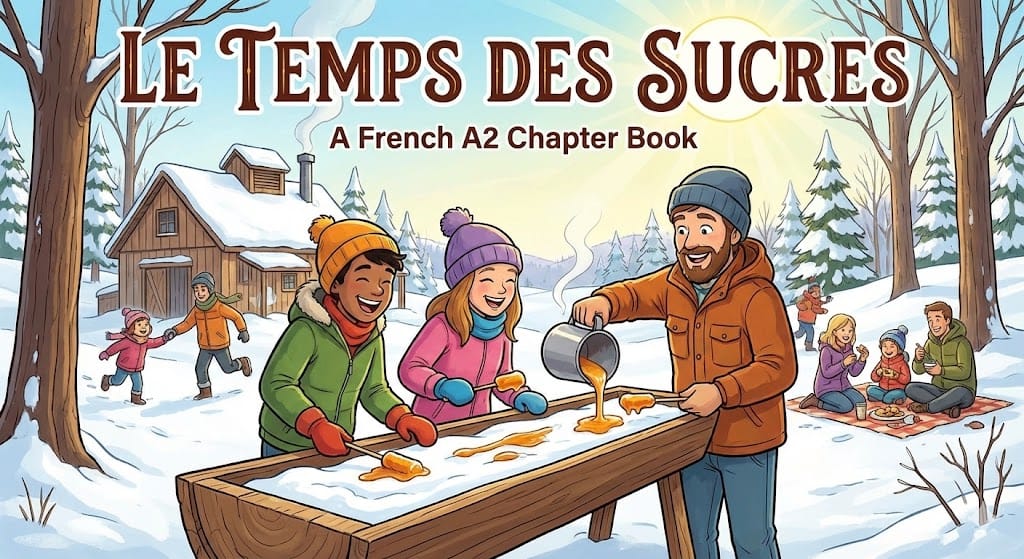
Follow Julie and friends as they explore a sugar shack, learn about maple syrup, and enjoy taffy on snow.
{
"title": "Le Temps des Sucres",
"language": "fr",
"subtitle": "A French A2 Chapter Book",
"chapters": [
{
"id": "chapter-1",
"title": "Chapitre 1: La Fin de l'Hiver",
"content": [
"C'était le mois de mars. Julie et ses amis, Marc et Sophie, ont pris la voiture pour aller à la campagne. L'hiver finissait doucement au Québec. Le soleil était brillant et la neige commençait à fondre sur le bord de la route.",
"C'est la saison idéale pour le « temps des sucres ». Les nuits sont encore froides, mais les jours sont chauds. Ce changement de température est essentiel pour que la sève des arbres commence à couler. Tout le monde était excité de passer la journée dehors."
],
"translation": "It was March. Julie and her friends, Marc and Sophie, took the car to go to the countryside. Winter was slowly ending in Quebec. The sun was bright and the snow was starting to melt on the side of the road. It is the ideal season for the \"sugar season.\" The nights are still cold, but the days are warm. This change in temperature is essential for the tree sap to start flowing. Everyone was excited to spend the day outside.",
"quiz": [
{
"question": "1. Quel mois est-il dans l'histoire ?",
"options": [
{ "text": "a) Décembre", "value": "wrong" },
{ "text": "b) Mars", "value": "correct" },
{ "text": "c) Juillet", "value": "wrong" }
]
},
{
"question": "2. Quel temps fait-il ?",
"options": [
{ "text": "a) Il pleut beaucoup", "value": "wrong" },
{ "text": "b) Le soleil brille et la neige fond", "value": "correct" },
{ "text": "c) Il fait une tempête de neige", "value": "wrong" }
]
},
{
"question": "3. Pourquoi la température est-elle importante ?",
"options": [
{ "text": "a) Pour bronzer", "value": "wrong" },
{ "text": "b) Pour que la sève coule", "value": "correct" },
{ "text": "c) Pour nager", "value": "wrong" }
]
}
]
},
{
"id": "chapter-2",
"title": "Chapitre 2: L'Arrivée à la Cabane",
"content": [
"Ils sont arrivés à la « Cabane à Sucre Tremblay ». La cabane était située au milieu d'une grande forêt. En sortant de la voiture, Marc a pris une grande inspiration. « Ça sent le bonheur ! » a-t-il dit.",
"Une fumée blanche sortait de la cheminée sur le toit. L'air sentait le bois brûlé et le sucre chaud. Il y avait beaucoup de familles et d'enfants qui jouaient dans la neige. L'ambiance était très festive et accueillante. Julie avait hâte de goûter aux produits de l'érable."
],
"translation": "They arrived at \"Tremblay Sugar Shack.\" The shack was located in the middle of a large forest. Getting out of the car, Marc took a deep breath. \"It smells like happiness!\" he said. White smoke was coming out of the chimney on the roof. The air smelled of burnt wood and hot sugar. There were many families and children playing in the snow. The atmosphere was very festive and welcoming. Julie couldn't wait to taste the maple products.",
"quiz": [
{
"question": "1. Où est située la cabane ?",
"options": [
{ "text": "a) En ville", "value": "wrong" },
{ "text": "b) Au milieu d'une forêt", "value": "correct" },
{ "text": "c) Sur la plage", "value": "wrong" }
]
},
{
"question": "2. Qu'est-ce qui sortait de la cheminée ?",
"options": [
{ "text": "a) De la fumée blanche", "value": "correct" },
{ "text": "b) Des oiseaux", "value": "wrong" },
{ "text": "c) De la neige", "value": "wrong" }
]
},
{
"question": "3. Que sentait l'air ?",
"options": [
{ "text": "a) L'essence", "value": "wrong" },
{ "text": "b) Le bois brûlé et le sucre", "value": "correct" },
{ "text": "c) Les fleurs", "value": "wrong" }
]
}
]
},
{
"id": "chapter-3",
"title": "Chapitre 3: La Forêt d'Érables",
"content": [
"Avant de manger, le groupe a décidé de marcher dans l'érablière. C'est le nom de la forêt où poussent les érables. Ils ont vu des milliers d'arbres. Sur chaque tronc, il y avait un petit tube en plastique ou un seau en métal accroché.",
"C'est ce qu'on appelle un chalumeau. Il sert à récolter l'eau d'érable goutte à goutte. Sophie a touché l'écorce rugueuse d'un vieil arbre. « C'est incroyable que la nature nous donne ce cadeau sucré », a-t-elle pensé."
],
"translation": "Before eating, the group decided to walk in the sugar bush (érablière). This is the name of the forest where maple trees grow. They saw thousands of trees. On each trunk, there was a small plastic tube or a metal bucket hanging. This is called a spout (chalumeau). It is used to collect maple water drop by drop. Sophie touched the rough bark of an old tree. \"It's incredible that nature gives us this sweet gift,\" she thought.",
"quiz": [
{
"question": "1. Comment s'appelle la forêt d'érables ?",
"options": [
{ "text": "a) La pinède", "value": "wrong" },
{ "text": "b) L'érablière", "value": "correct" },
{ "text": "c) La jungle", "value": "wrong" }
]
},
{
"question": "2. Qu'y a-t-il sur les troncs d'arbres ?",
"options": [
{ "text": "a) Des pommes", "value": "wrong" },
{ "text": "b) Des chalumeaux (tubes/seaux)", "value": "correct" },
{ "text": "c) Des lumières de Noël", "value": "wrong" }
]
},
{
"question": "3. Vrai ou Faux : L'eau coule rapidement comme une rivière.",
"options": [
{ "text": "a) Vrai", "value": "wrong" },
{ "text": "b) Faux", "value": "correct" }
]
}
]
},
{
"id": "chapter-4",
"title": "Chapitre 4: L'Eau ou le Sirop ?",
"content": [
"Un guide expliquait le processus aux touristes. Il a ouvert un seau et a montré le liquide à l'intérieur. « Regardez, c'est transparent comme de l'eau », a-t-il dit. Julie était surprise. Elle pensait que le sirop sortait directement de l'arbre.",
"Le guide a expliqué qu'il faut beaucoup de patience. Pour faire un seul litre de sirop d'érable, il faut bouillir quarante litres d'eau d'érable ! C'est un travail long et difficile qui demande beaucoup d'énergie."
],
"translation": "A guide was explaining the process to tourists. He opened a bucket and showed the liquid inside. \"Look, it is transparent like water,\" he said. Julie was surprised. She thought syrup came directly out of the tree. The guide explained that it takes a lot of patience. To make a single liter of maple syrup, you have to boil forty liters of maple water! It is long and hard work that requires a lot of energy.",
"quiz": [
{
"question": "1. De quelle couleur est le liquide qui sort de l'arbre ?",
"options": [
{ "text": "a) Marron", "value": "wrong" },
{ "text": "b) Transparent", "value": "correct" },
{ "text": "c) Jaune", "value": "wrong" }
]
},
{
"question": "2. Combien de litres d'eau faut-il pour un litre de sirop ?",
"options": [
{ "text": "a) 10 litres", "value": "wrong" },
{ "text": "b) 40 litres", "value": "correct" },
{ "text": "c) 100 litres", "value": "wrong" }
]
},
{
"question": "3. Vrai ou Faux : Le sirop sort directement de l'arbre.",
"options": [
{ "text": "a) Vrai", "value": "wrong" },
{ "text": "b) Faux", "value": "correct" }
]
}
]
},
{
"id": "chapter-5",
"title": "Chapitre 5: La Bouilloire (L'Évaporateur)",
"content": [
"Ils sont entrés dans la salle de bouillage. Il faisait très chaud et humide à l'intérieur. Au centre, il y avait une énorme machine en métal appelée « l'évaporateur ». Un homme ajoutait des bûches de bois dans le feu sous la machine.",
"L'eau d'érable bouillait fort et de gros nuages de vapeur montaient vers le plafond. C'est ici que l'eau se transforme en sirop doré. L'odeur était encore plus forte ici. Marc avait maintenant très faim."
],
"translation": "They entered the boiling room. It was very hot and humid inside. In the center, there was a huge metal machine called the \"evaporator.\" A man was adding wooden logs into the fire under the machine. The maple water was boiling hard and big clouds of steam were rising toward the ceiling. This is where the water transforms into golden syrup. The smell was even stronger here. Marc was very hungry now.",
"quiz": [
{
"question": "1. Comment s'appelle la machine pour bouillir l'eau ?",
"options": [
{ "text": "a) Le radiateur", "value": "wrong" },
{ "text": "b) L'évaporateur", "value": "correct" },
{ "text": "c) Le congélateur", "value": "wrong" }
]
},
{
"question": "2. Quelle source d'énergie utilisaient-ils ?",
"options": [
{ "text": "a) Du bois", "value": "correct" },
{ "text": "b) Du charbon", "value": "wrong" },
{ "text": "c) De l'énergie solaire", "value": "wrong" }
]
},
{
"question": "3. Comment était la température dans la salle ?",
"options": [
{ "text": "a) Froide", "value": "wrong" },
{ "text": "b) Chaude et humide", "value": "correct" },
{ "text": "c) Sèche", "value": "wrong" }
]
}
]
},
{
"id": "chapter-6",
"title": "Chapitre 6: Un Festin Traditionnel",
"content": [
"C'était enfin l'heure du repas. Ils se sont assis à de longues tables en bois avec d'autres gens. C'était un repas communautaire. Les serveurs ont apporté beaucoup de plats. Il y avait de la soupe aux pois, du jambon fumé, des fèves au lard et une omelette soufflée géante.",
"Il y avait aussi une bouteille de sirop d'érable sur la table. Sophie a mis du sirop partout, même sur ses œufs et son jambon. C'est la tradition !"
],
"translation": "It was finally meal time. They sat at long wooden tables with other people. It was a community meal. The servers brought many dishes. There was pea soup, smoked ham, baked beans, and a giant fluffy omelet. There was also a bottle of maple syrup on the table. Sophie put syrup everywhere, even on her eggs and ham. It's tradition!",
"quiz": [
{
"question": "1. Quel type de tables y avait-il ?",
"options": [
{ "text": "a) Des petites tables rondes", "value": "wrong" },
{ "text": "b) De longues tables en bois", "value": "correct" },
{ "text": "c) Des tables en plastique", "value": "wrong" }
]
},
{
"question": "2. Quel plat n'était PAS sur la table ?",
"options": [
{ "text": "a) De la pizza", "value": "correct" },
{ "text": "b) De la soupe aux pois", "value": "wrong" },
{ "text": "c) Une omelette", "value": "wrong" }
]
},
{
"question": "3. Où Sophie a-t-elle mis du sirop ?",
"options": [
{ "text": "a) Seulement dans son verre", "value": "wrong" },
{ "text": "b) Partout (sur les œufs et le jambon)", "value": "correct" },
{ "text": "c) Sur le plancher", "value": "wrong" }
]
}
]
},
{
"id": "chapter-7",
"title": "Chapitre 7: Les Oreilles de Crisse",
"content": [
"Marc a vu un bol rempli de morceaux bruns et croustillants. « Qu'est-ce que c'est ? » a-t-il demandé. Julie a ri. « Ce sont des oreilles de crisse », a-t-elle répondu. C'est un nom drôle pour du lard salé et frit.",
"C'est très gras et très croustillant. Marc en a goûté un morceau. C'était très salé. Les Québécois aiment manger ça avec le sirop d'érable. Le mélange de sucré et de salé est délicieux, mais il ne faut pas en manger trop !"
],
"translation": "Marc saw a bowl filled with brown, crispy pieces. \"What is this?\" he asked. Julie laughed. \"Those are oreilles de crisse (Christ's ears),\" she replied. It's a funny name for salted, fried pork jowls (pork rinds). It is very fatty and very crispy. Marc tasted a piece. It was very salty. Quebecers like to eat this with maple syrup. The mix of sweet and salty is delicious, but you shouldn't eat too much!",
"quiz": [
{
"question": "1. Comment s'appelle le plat de lard frit ?",
"options": [
{ "text": "a) Oreilles de lapin", "value": "wrong" },
{ "text": "b) Oreilles de crisse", "value": "correct" },
{ "text": "c) Nez de cochon", "value": "wrong" }
]
},
{
"question": "2. Quel est le goût de ce plat ?",
"options": [
{ "text": "a) Sucré", "value": "wrong" },
{ "text": "b) Salé et gras", "value": "correct" },
{ "text": "c) Acide", "value": "wrong" }
]
},
{
"question": "3. Vrai ou Faux : C'est un plat très léger et santé.",
"options": [
{ "text": "a) Vrai", "value": "wrong" },
{ "text": "b) Faux", "value": "correct" }
]
}
]
},
{
"id": "chapter-8",
"title": "Chapitre 8: Le Violoneux",
"content": [
"Après le repas copieux, la musique a commencé. Un homme jouait du violon avec beaucoup d'énergie. Il tapait du pied sur le plancher en bois pour garder le rythme. C'était de la musique folklorique traditionnelle. Une dame jouait de l'accordéon.",
"Le musicien a invité les gens à participer. Il a donné des cuillères en bois à Julie. Elle a essayé de les frapper ensemble en rythme sur sa cuisse. Tout le monde frappait dans les mains et chantait."
],
"translation": "After the hearty meal, the music started. A man was playing the fiddle (violin) with a lot of energy. He was tapping his foot on the wooden floor to keep the rhythm. It was traditional folk music. A lady was playing the accordion. The musician invited people to participate. He gave wooden spoons to Julie. She tried to hit them together in rhythm on her thigh. Everyone was clapping their hands and singing.",
"quiz": [
{
"question": "1. Quel instrument l'homme jouait-il ?",
"options": [
{ "text": "a) De la guitare", "value": "wrong" },
{ "text": "b) Du violon", "value": "correct" },
{ "text": "c) De la flûte", "value": "wrong" }
]
},
{
"question": "2. Que faisait-il avec son pied ?",
"options": [
{ "text": "a) Il dansait le tango", "value": "wrong" },
{ "text": "b) Il tapait pour garder le rythme", "value": "correct" },
{ "text": "c) Rien", "value": "wrong" }
]
},
{
"question": "3. Quel instrument Julie a-t-elle essayé ?",
"options": [
{ "text": "a) Les cuillères en bois", "value": "correct" },
{ "text": "b) Le piano", "value": "wrong" },
{ "text": "c) La batterie", "value": "wrong" }
]
}
]
},
{
"id": "chapter-9",
"title": "Chapitre 9: La Tire sur la Neige",
"content": [
"C'était le moment préféré de tout le monde : le dessert. Ils sont sortis à l'extérieur. Il y avait de longs bacs remplis de neige propre et compactée. Le guide est arrivé avec un pot de sirop très chaud et épais. Il a versé le sirop en lignes sur la neige froide.",
"Le choc thermique a transformé le sirop en bonbon mou. On appelle ça de la « tire d'érable ». Marc a pris un bâton de bois et a roulé la tire. C'était collant, froid et délicieux."
],
"translation": "It was everyone's favorite moment: dessert. They went outside. There were long troughs filled with clean, packed snow. The guide arrived with a pot of very hot, thick syrup. He poured the syrup in lines onto the cold snow. The thermal shock turned the syrup into soft candy. This is called \"maple taffy\" (tire d'érable). Marc took a wooden stick and rolled up the taffy. It was sticky, cold, and delicious.",
"quiz": [
{
"question": "1. Où verse-t-on le sirop chaud ?",
"options": [
{ "text": "a) Sur une assiette", "value": "wrong" },
{ "text": "b) Sur de la neige propre", "value": "correct" },
{ "text": "c) Dans un verre", "value": "wrong" }
]
},
{
"question": "2. Comment s'appelle ce bonbon ?",
"options": [
{ "text": "a) La tire d'érable", "value": "correct" },
{ "text": "b) Le sucre à la crème", "value": "wrong" },
{ "text": "c) Le glaçon", "value": "wrong" }
]
},
{
"question": "3. Avec quoi roule-t-on la tire ?",
"options": [
{ "text": "a) Une fourchette", "value": "wrong" },
{ "text": "b) Un bâton de bois", "value": "correct" },
{ "text": "c) Ses doigts", "value": "wrong" }
]
}
]
},
{
"id": "chapter-10",
"title": "Chapitre 10: Doux Souvenirs",
"content": [
"La journée à la cabane à sucre était terminée. Avant de partir, ils sont passés à la boutique de souvenirs. Julie a acheté une canne de sirop d'érable pour ses parents. Marc a choisi un pot de beurre d'érable crémeux. Ils étaient fatigués mais très heureux.",
"Ils avaient le ventre plein et le goût du sucre encore dans la bouche. En retournant à la maison, ils ont promis de revenir l'année prochaine. C'est une tradition qu'ils voulaient garder pour toujours."
],
"translation": "The day at the sugar shack was over. Before leaving, they stopped at the souvenir shop. Julie bought a can of maple syrup for her parents. Marc chose a jar of creamy maple butter. They were tired but very happy. They had full bellies and the taste of sugar still in their mouths. Driving back home, they promised to return next year. It is a tradition they wanted to keep forever.",
"quiz": [
{
"question": "1. Qu'est-ce que Julie a acheté ?",
"options": [
{ "text": "a) Une tuque", "value": "wrong" },
{ "text": "b) Une canne de sirop d'érable", "value": "correct" },
{ "text": "c) Une carte postale", "value": "wrong" }
]
},
{
"question": "2. Comment se sentaient-ils à la fin de la journée ?",
"options": [
{ "text": "a) Tristes et affamés", "value": "wrong" },
{ "text": "b) Fatigués mais heureux", "value": "correct" },
{ "text": "c) En colère", "value": "wrong" }
]
},
{
"question": "3. Quand veulent-ils revenir ?",
"options": [
{ "text": "a) Demain", "value": "wrong" },
{ "text": "b) L'année prochaine", "value": "correct" },
{ "text": "c) Jamais", "value": "wrong" }
]
}
]
}
]
}