Practice English while learning about America's Bill of Rights.
{
"title": "Letters from Paris",
"language": "en",
"subtitle": "An English A2 Chapter Book",
"chapters": [
{
"id": "chapter-1",
"title": "Chapter 1: The Long Summer",
"content": [
"It was the summer of 1787. James Madison was in Philadelphia. It was very hot. He sat in a room with many other men. They kept the windows closed to keep their secrets.",
"They were writing a new set of rules for the country. This document was called the Constitution. Madison was a small man, but he was very smart. He wrote many notes every day. Finally, in September, the work was finished. Madison was tired but proud. He hoped the new government would make America strong."
],
"translation": "มันเป็นฤดูร้อนของปี 1787 เจมส์ เมดิสัน อยู่ในฟิลาเดลเฟีย อากาศร้อนมาก เขานั่งอยู่ในห้องกับผู้ชายคนอื่นๆ อีกหลายคน พวกเขาปิดหน้าต่างไว้เพื่อรักษาความลับ พวกเขากำลังเขียนกฎชุดใหม่สำหรับประเทศ เอกสารนี้เรียกว่า \"รัฐธรรมนูญ\" เมดิสันเป็นชายตัวเล็ก แต่เขาฉลาดมาก เขาจดบันทึกมากมายทุกวัน ในที่สุดในเดือนกันยายน งานก็เสร็จสิ้น เมดิสันเหนื่อยแต่ภูมิใจ เขาหวังว่ารัฐบาลใหม่จะทำให้อเมริกาเข้มแข็ง",
"quiz": [
{
"question": "1. Where was James Madison?",
"options": [
{ "text": "a) New York", "value": "wrong" },
{ "text": "b) Philadelphia", "value": "correct" },
{ "text": "c) Paris", "value": "wrong" }
]
},
{
"question": "2. Why did they keep the windows closed?",
"options": [
{ "text": "a) It was cold", "value": "wrong" },
{ "text": "b) To keep secrets", "value": "correct" },
{ "text": "c) To stop the rain", "value": "wrong" }
]
},
{
"question": "3. True or False: Madison was a very tall man.",
"options": [
{ "text": "True", "value": "wrong" },
{ "text": "False", "value": "correct" }
]
}
]
},
{
"id": "chapter-2",
"title": "Chapter 2: A Ship Across the Ocean",
"content": [
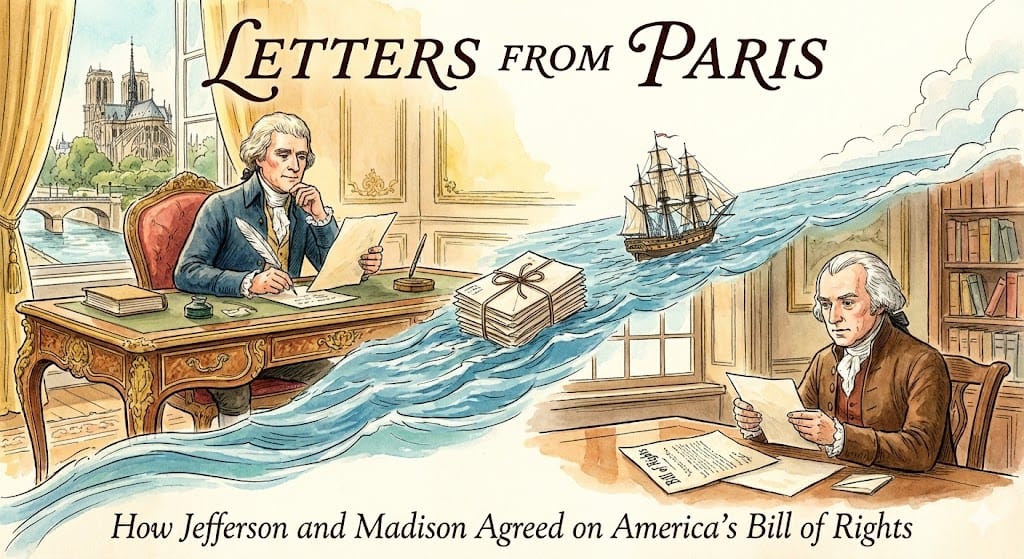
"Madison wanted his friend to see the new Constitution. His friend was Thomas Jefferson. But Jefferson was far away. He was across the Atlantic Ocean. He was in France. There were no telephones or emails in 1787.",
"Madison had to send a copy by ship. The ship traveled slowly across the water. It took many weeks to arrive. Madison waited nervously. He respected Jefferson’s opinion more than anyone else's. He wondered, \"Will Thomas like our work?\""
],
"translation": "เมดิสันต้องการให้เพื่อนของเขาได้เห็นรัฐธรรมนูญฉบับใหม่ เพื่อนของเขาคือ โทมัส เจฟเฟอร์สัน แต่เจฟเฟอร์สันอยู่ไกลมาก เขาอยู่อีกฝั่งของมหาสมุทรแอตแลนติก เขาอยู่ในประเทศฝรั่งเศส ในปี 1787 ไม่มีโทรศัพท์หรืออีเมล เมดิสันต้องส่งสำเนาไปทางเรือ เรือเดินทางข้ามน้ำอย่างช้าๆ มันใช้เวลาหลายสัปดาห์กว่าจะถึง เมดิสันรออย่างกระวนกระวายใจ เขาเคารพความคิดเห็นของเจฟเฟอร์สันมากกว่าใครๆ เขาสงสัยว่า \"โทมัสจะชอบงานของพวกเราไหมนะ?\"",
"quiz": [
{
"question": "1. Where was Thomas Jefferson?",
"options": [
{ "text": "a) France", "value": "correct" },
{ "text": "b) England", "value": "wrong" },
{ "text": "c) Spain", "value": "wrong" }
]
},
{
"question": "2. How did Madison send the Constitution?",
"options": [
{ "text": "a) By horse", "value": "wrong" },
{ "text": "b) By ship", "value": "correct" },
{ "text": "c) By train", "value": "wrong" }
]
},
{
"question": "3. True or False: The trip took only one day.",
"options": [
{ "text": "True", "value": "wrong" },
{ "text": "False", "value": "correct" }
]
}
]
},
{
"id": "chapter-3",
"title": "Chapter 3: Mr. Jefferson in Paris",
"content": [
"Thomas Jefferson was the American Ambassador in Paris. He loved the city. He liked the beautiful buildings and the books. He bought many books to send home to America. However, he missed his friends.",
"One day, a package arrived from America. It was from James Madison. Jefferson opened it quickly. He saw the new Constitution. He sat down at his desk to read it carefully. He held a pen in his hand, ready to make notes."
],
"translation": "โทมัส เจฟเฟอร์สัน เป็นทูตอเมริกันประจำกรุงปารีส เขาชอบเมืองนี้มาก เขาชอบตึกสวยๆ และหนังสือ เขาซื้อหนังสือมากมายเพื่อส่งกลับบ้านที่อเมริกา อย่างไรก็ตาม เขาคิดถึงเพื่อนๆ ของเขา วันหนึ่ง มีพัสดุส่งมาจากอเมริกา มันมาจาก เจมส์ เมดิสัน เจฟเฟอร์สันรีบเปิดมันออก เขาเห็นรัฐธรรมนูญฉบับใหม่ เขานั่งลงที่โต๊ะเพื่ออ่านมันอย่างละเอียด เขาถือปากกาในมือ เตรียมพร้อมที่จะจดบันทึก",
"quiz": [
{
"question": "1. What was Jefferson's job in Paris?",
"options": [
{ "text": "a) Teacher", "value": "wrong" },
{ "text": "b) Ambassador", "value": "correct" },
{ "text": "c) Soldier", "value": "wrong" }
]
},
{
"question": "2. What did Jefferson love to buy?",
"options": [
{ "text": "a) Food", "value": "wrong" },
{ "text": "b) Clothes", "value": "wrong" },
{ "text": "c) Books", "value": "correct" }
]
},
{
"question": "3. True or False: Jefferson received a package from Madison.",
"options": [
{ "text": "True", "value": "correct" },
{ "text": "False", "value": "wrong" }
]
}
]
},
{
"id": "chapter-4",
"title": "Chapter 4: Good News and Bad News",
"content": [
"Jefferson read the document. He liked many parts of it. He liked how the government was divided into three parts: the President, the Congress, and the Judges. This was a good idea. It meant no single person had all the power.",
"\"I like the organization,\" he thought. But then, he frowned. He looked for something important, but he could not find it. He read the pages again. He became worried. The document was good, but it was not perfect."
],
"translation": "เจฟเฟอร์สันอ่านเอกสารนั้น เขาชอบหลายส่วนของมัน เขาชอบวิธีที่รัฐบาลถูกแบ่งออกเป็นสามส่วน คือ ประธานาธิบดี รัฐสภา และผู้พิพากษา นี่เป็นความคิดที่ดี มันหมายความว่าไม่มีใครคนเดียวที่มีอำนาจทั้งหมด \"ฉันชอบการจัดระเบียบนี้\" เขาคิด แต่แล้วเขาก็ขมวดคิ้ว เขามองหาสิ่งสำคัญบางอย่าง แต่เขาหาไม่เจอ เขาอ่านหน้าเหล่านั้นอีกครั้ง เขาเริ่มกังวล เอกสารนี้ดี แต่ยังไม่สมบูรณ์แบบ",
"quiz": [
{
"question": "1. Did Jefferson like the three parts of government?",
"options": [
{ "text": "a) Yes", "value": "correct" },
{ "text": "b) No", "value": "wrong" },
{ "text": "c) He did not care", "value": "wrong" }
]
},
{
"question": "2. Why did he frown?",
"options": [
{ "text": "a) The paper was dirty", "value": "wrong" },
{ "text": "b) Something was missing", "value": "correct" },
{ "text": "c) He was hungry", "value": "wrong" }
]
},
{
"question": "3. True or False: He thought the document was perfect.",
"options": [
{ "text": "True", "value": "wrong" },
{ "text": "False", "value": "correct" }
]
}
]
},
{
"id": "chapter-5",
"title": "Chapter 5: What is Missing?",
"content": [
"Jefferson looked for a list of rights. He wanted to see a promise that the government would protect the people. He looked for freedom of speech. He looked for freedom of religion. He looked for the right to a fair trial. None of these were written down.",
"The Constitution listed what the government *could* do. But it did not say what the government *could not* do. \"This is a big mistake,\" Jefferson decided. Without a written list, the government might become too powerful."
],
"translation": "เจฟเฟอร์สันมองหารายการสิทธิ เขาต้องการเห็นคำสัญญาว่ารัฐบาลจะปกป้องประชาชน เขามองหาเสรีภาพในการพูด เขามองหาเสรีภาพในการนับถือศาสนา เขามองหาสิทธิในการได้รับการพิจารณาคดีอย่างยุติธรรม ไม่มีสิ่งเหล่านี้เขียนไว้เลย รัฐธรรมนูญระบุสิ่งที่รัฐบาล *ทำได้* แต่มันไม่ได้บอกสิ่งที่รัฐบาล *ห้ามทำ* \"นี่เป็นความผิดพลาดครั้งใหญ่\" เจฟเฟอร์สันตัดสินใจ หากไม่มีรายการที่เป็นลายลักษณ์อักษร รัฐบาลอาจมีอำนาจมากเกินไป",
"quiz": [
{
"question": "1. What was Jefferson looking for?",
"options": [
{ "text": "a) A list of rights", "value": "correct" },
{ "text": "b) A map", "value": "wrong" },
{ "text": "c) A signature", "value": "wrong" }
]
},
{
"question": "2. Did the Constitution list freedom of speech?",
"options": [
{ "text": "a) Yes", "value": "wrong" },
{ "text": "b) No", "value": "correct" },
{ "text": "c) Maybe", "value": "wrong" }
]
},
{
"question": "3. True or False: Jefferson thought this was a mistake.",
"options": [
{ "text": "True", "value": "correct" },
{ "text": "False", "value": "wrong" }
]
}
]
},
{
"id": "chapter-6",
"title": "Chapter 6: The Important Letter",
"content": [
"Jefferson took his pen. He dipped it in ink. He wrote a letter back to James Madison. He started with polite words, but then he was honest. \"I will tell you what I do not like,\" he wrote. \"First, the omission of a bill of rights.\"",
"Omission means leaving something out. He told Madison that every country needs a bill of rights. It protects the people against the government. He folded the letter and sent it back across the ocean."
],
"translation": "เจฟเฟอร์สันหยิบปากกาของเขา เขาจุ่มมันลงในหมึก เขาเขียนจดหมายตอบกลับไปหา เจมส์ เมดิสัน เขาเริ่มต้นด้วยคำพูดที่สุภาพ แต่จากนั้นเขาก็พูดอย่างตรงไปตรงมา \"ฉันจะบอกคุณถึงสิ่งที่ฉันไม่ชอบ\" เขาเขียน \"อย่างแรก คือการละเว้นบัญญัติสิทธิ\" Omission หมายถึงการละเลยบางสิ่งบางอย่างไป เขาบอกเมดิสันว่าทุกประเทศจำเป็นต้องมีบัญญัติสิทธิ มันช่วยปกป้องประชาชนจากรัฐบาล เขาพับจดหมายและส่งมันกลับข้ามมหาสมุทร",
"quiz": [
{
"question": "1. Who did Jefferson write to?",
"options": [
{ "text": "a) George Washington", "value": "wrong" },
{ "text": "b) James Madison", "value": "correct" },
{ "text": "c) The King of France", "value": "wrong" }
]
},
{
"question": "2. What does \"omission\" mean?",
"options": [
{ "text": "a) Adding something", "value": "wrong" },
{ "text": "b) Leaving something out", "value": "correct" },
{ "text": "c) Fixing something", "value": "wrong" }
]
},
{
"question": "3. True or False: Jefferson was dishonest in his letter.",
"options": [
{ "text": "True", "value": "wrong" },
{ "text": "False", "value": "correct" }
]
}
]
},
{
"id": "chapter-7",
"title": "Chapter 7: Madison’s Argument",
"content": [
"Weeks later, Madison received the letter. He read Jefferson’s complaint. Madison did not agree at first. He thought the Constitution was strong enough. He believed that listing rights was unnecessary. He called a bill of rights a \"parchment barrier.\"",
"Parchment is paper. He meant that bad governments would break the rules anyway, even if they were written on paper. He thought the structure of the government was the best protection. He wrote back to explain his idea."
],
"translation": "หลายสัปดาห์ต่อมา เมดิสันได้รับจดหมาย เขาอ่านข้อร้องเรียนของเจฟเฟอร์สัน ตอนแรกเมดิสันไม่เห็นด้วย เขาคิดว่ารัฐธรรมนูญแข็งแกร่งพอแล้ว เขาเชื่อว่าการระบุสิทธิไม่จำเป็น เขาเรียกบัญญัติสิทธิว่า \"กำแพงกระดาษ\" (Parchment barrier) Parchment คือกระดาษหนัง เขาหมายความว่ารัฐบาลที่ไม่ดีก็จะแหกกฎอยู่ดี แม้ว่ากฎเหล่านั้นจะถูกเขียนไว้บนกระดาษก็ตาม เขาคิดว่าโครงสร้างของรัฐบาลคือการป้องกันที่ดีที่สุด เขาเขียนตอบกลับไปเพื่ออธิบายความคิดของเขา",
"quiz": [
{
"question": "1. Did Madison agree immediately?",
"options": [
{ "text": "a) Yes", "value": "wrong" },
{ "text": "b) No", "value": "correct" },
{ "text": "c) He did not read it", "value": "wrong" }
]
},
{
"question": "2. What does \"parchment\" mean?",
"options": [
{ "text": "a) Stone", "value": "wrong" },
{ "text": "b) Paper", "value": "correct" },
{ "text": "c) Wood", "value": "wrong" }
]
},
{
"question": "3. True or False: Madison thought the structure was the best protection.",
"options": [
{ "text": "True", "value": "correct" },
{ "text": "False", "value": "wrong" }
]
}
]
},
{
"id": "chapter-8",
"title": "Chapter 8: Entitled to Freedom",
"content": [
"Jefferson did not give up. He wrote another letter. He used very strong words. He said, \"A bill of rights is what the people are entitled to against every government on earth.\" Entitled to means you deserve it.",
"He argued that even if the paper does not stop every bad action, it is still important. It teaches the people their rights. It gives them a standard to judge the government. \"We must not refuse it,\" Jefferson insisted."
],
"translation": "เจฟเฟอร์สันไม่ยอมแพ้ เขาเขียนจดหมายอีกฉบับ เขาใช้คำพูดที่หนักแน่นมาก เขากล่าวว่า \"บัญญัติสิทธิคือสิ่งที่ประชาชนพึงมีต่อรัฐบาลทุกแห่งบนโลก\" Entitled to หมายถึง คุณสมควรได้รับมัน เขาโต้แย้งว่าแม้กระดาษจะไม่สามารถหยุดการกระทำที่ไม่ดีได้ทุกอย่าง แต่มันก็ยังสำคัญ มันสอนให้ประชาชนรู้สิทธิของตน มันให้มาตรฐานแก่พวกเขาในการตัดสินรัฐบาล \"เราต้องไม่ปฏิเสธสิ่งนี้\" เจฟเฟอร์สันยืนกราน",
"quiz": [
{
"question": "1. What does \"entitled to\" mean?",
"options": [
{ "text": "a) You deserve it", "value": "correct" },
{ "text": "b) You hate it", "value": "wrong" },
{ "text": "c) You bought it", "value": "wrong" }
]
},
{
"question": "2. Why is the bill of rights important according to Jefferson?",
"options": [
{ "text": "a) It costs money", "value": "wrong" },
{ "text": "b) It teaches people their rights", "value": "correct" },
{ "text": "c) It makes the book heavy", "value": "wrong" }
]
},
{
"question": "3. True or False: Jefferson said we must refuse the bill of rights.",
"options": [
{ "text": "True", "value": "wrong" },
{ "text": "False", "value": "correct" }
]
}
]
},
{
"id": "chapter-9",
"title": "Chapter 9: Changing His Mind",
"content": [
"Madison read the second letter. He looked around his country. Many regular people were unhappy. They were afraid of the new, strong government. They agreed with Jefferson. Madison was a good politician. He realized he had to listen.",
"He began to change his mind. He saw that a bill of rights would make people feel safe. It would unite the country. He decided to support Jefferson’s idea. He promised to add the rights as soon as possible."
],
"translation": "เมดิสันอ่านจดหมายฉบับที่สอง เขามองไปรอบๆ ประเทศของเขา คนธรรมดาจำนวนมากไม่มีความสุข พวกเขากลัวรัฐบาลใหม่ที่เข้มแข็ง พวกเขาเห็นด้วยกับเจฟเฟอร์สัน เมดิสันเป็นนักการเมืองที่ดี เขาตระหนักว่าเขาต้องรับฟัง เขาเริ่มเปลี่ยนความคิด เขาเห็นว่าบัญญัติสิทธิจะทำให้ผู้คนรู้สึกปลอดภัย มันจะรวมประเทศให้เป็นหนึ่งเดียว เขาตัดสินใจที่จะสนับสนุนแนวคิดของเจฟเฟอร์สัน เขาเล็งว่าจะเพิ่มสิทธิเหล่านี้ให้เร็วที่สุด",
"quiz": [
{
"question": "1. Were regular people happy or afraid?",
"options": [
{ "text": "a) Happy", "value": "wrong" },
{ "text": "b) Afraid", "value": "correct" },
{ "text": "c) Sleeping", "value": "wrong" }
]
},
{
"question": "2. Why did Madison change his mind?",
"options": [
{ "text": "a) To make people feel safe", "value": "correct" },
{ "text": "b) Because he was bored", "value": "wrong" },
{ "text": "c) Because Jefferson paid him", "value": "wrong" }
]
},
{
"question": "3. True or False: Madison promised to add the rights.",
"options": [
{ "text": "True", "value": "correct" },
{ "text": "False", "value": "wrong" }
]
}
]
},
{
"id": "chapter-10",
"title": "Chapter 10: The First Ten",
"content": [
"In 1789, Madison stood up in Congress. He held a long list of changes. He selected the best ones. These became the first ten amendments to the Constitution. We call them the Bill of Rights.",
"They protect speech, religion, and the press. They protect people in their homes. Jefferson was happy in Paris. His friend had listened. Because of their letters, Americans have written laws that protect their freedom today."
],
"translation": "ในปี 1789 เมดิสันยืนขึ้นในรัฐสภา เขาถือรายการการเปลี่ยนแปลงยาวเหยียด เขาเลือกข้อที่ดีที่สุดมา สิ่งเหล่านี้กลายเป็นการแก้ไขรัฐธรรมนูญสิบข้อแรก เราเรียกมันว่า \"บัญญัติสิทธิ\" (Bill of Rights) มันปกป้องการพูด ศาสนา และสื่อมวลชน มันปกป้องผู้คนในบ้านของพวกเขา เจฟเฟอร์สันมีความสุขในปารีส เพื่อนของเขาได้รับฟังแล้ว เพราะจดหมายของพวกเขา ชาวอเมริกันจึงมีกฎหมายลายลักษณ์อักษรที่ปกป้องเสรีภาพของพวกเขาในทุกวันนี้",
"quiz": [
{
"question": "1. What do we call the first ten amendments?",
"options": [
{ "text": "a) The Big List", "value": "wrong" },
{ "text": "b) The Bill of Rights", "value": "correct" },
{ "text": "c) The Paris Rules", "value": "wrong" }
]
},
{
"question": "2. What happened in 1789?",
"options": [
{ "text": "a) Madison presented the list to Congress", "value": "correct" },
{ "text": "b) Jefferson moved to China", "value": "wrong" },
{ "text": "c) The war started", "value": "wrong" }
]
},
{
"question": "3. True or False: The Bill of Rights protects freedom of speech.",
"options": [
{ "text": "True", "value": "correct" },
{ "text": "False", "value": "wrong" }
]
}
]
}
]
}