
M6-1 LS Unit 7 Study Guide
Pathways Listening and Speaking 2
This guide covers essential vocabulary, confusing word pairs, reading skills, and linking words to help you prepare for your quiz.
1. Vocabulary List
Group A: General Terms
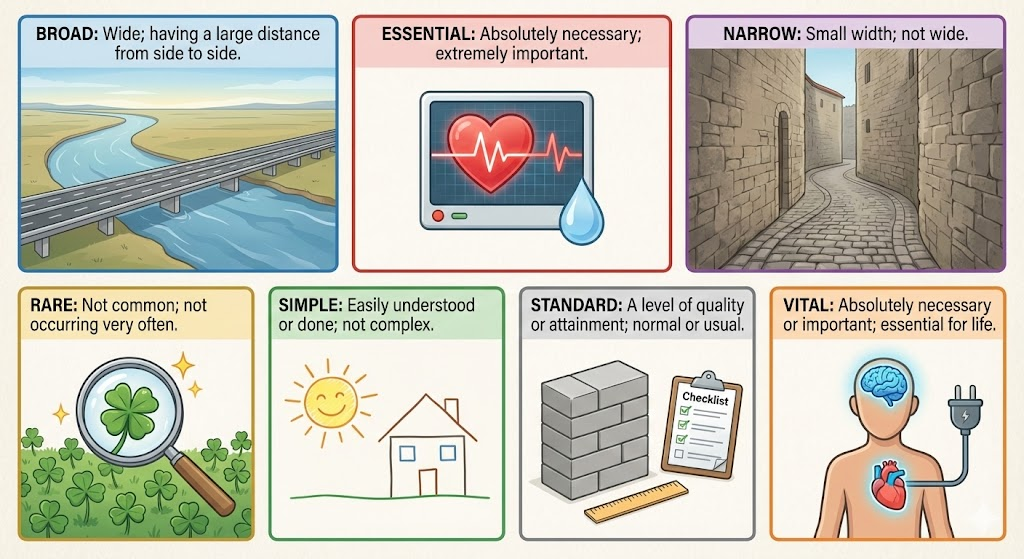
- Broad: Wide; having a large distance from side to side.
- Essential: Absolutely necessary; extremely important.
- Narrow: Small width; not wide.
- Rare: Not common; not occurring very often.
- Simple: Easily understood or done; not complex.
- Standard: A level of quality or attainment; normal or usual.
- Vital: Absolutely necessary or important; essential for life.
Group B: Actions & Verbs
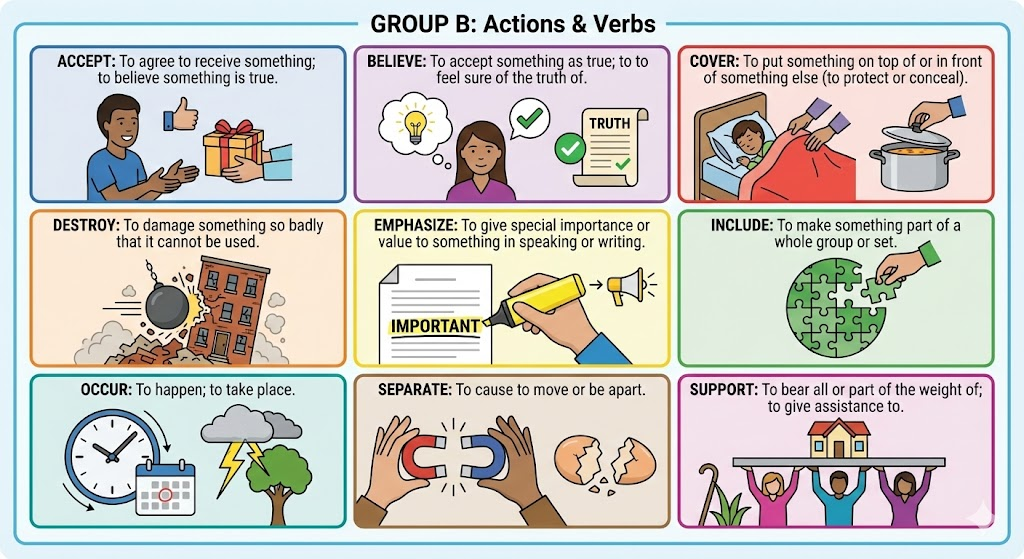
- Accept: To agree to receive something; to believe something is true.
- Believe: To accept something as true; to feel sure of the truth of.
- Cover: To put something on top of or in front of something else (to protect or conceal).
- Destroy: To damage something so badly that it cannot be used.
- Emphasize: To give special importance or value to something in speaking or writing.
- Include: To make something part of a whole group or set.
- Occur: To happen; to take place.
- Separate: To cause to move or be apart.
- Support: To bear all or part of the weight of; to give assistance to.
Group C: Nouns & Concepts
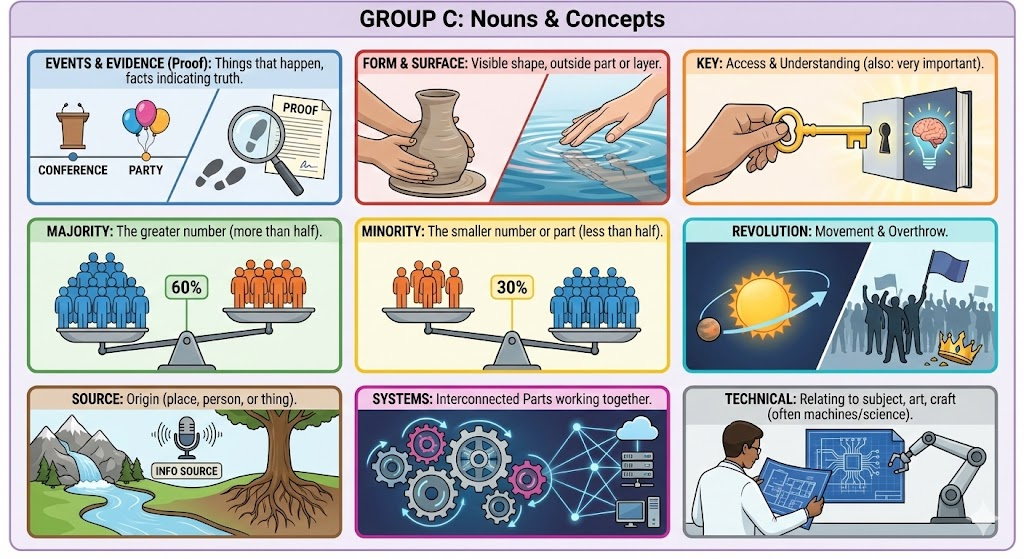
- Events: Things that happen, especially ones of importance.
- Evidence: Facts or information indicating whether a belief is true (proof).
- Form: The visible shape or configuration of something.
- Surface: The outside part or uppermost layer of something.
- Key: A thing that provides a means of gaining access to or understanding something (also: very important).
- Majority: The greater number (more than half).
- Minority: The smaller number or part (less than half).
- Revolution: Moving around an object; overthrowing a government.
- Source: A place, person, or thing from which something comes (origin).
- Systems: A set of things working together as parts of a mechanism or an interconnecting network.
- Technical: Relating to a particular subject, art, or craft, or its techniques (often involving machines or science).
2. Confusing Words
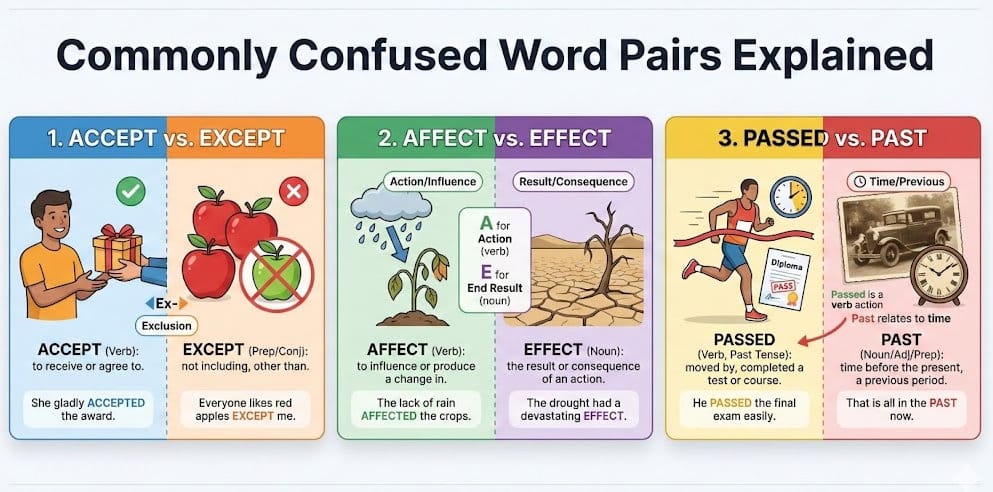
These words sound similar but have different meanings and spellings.
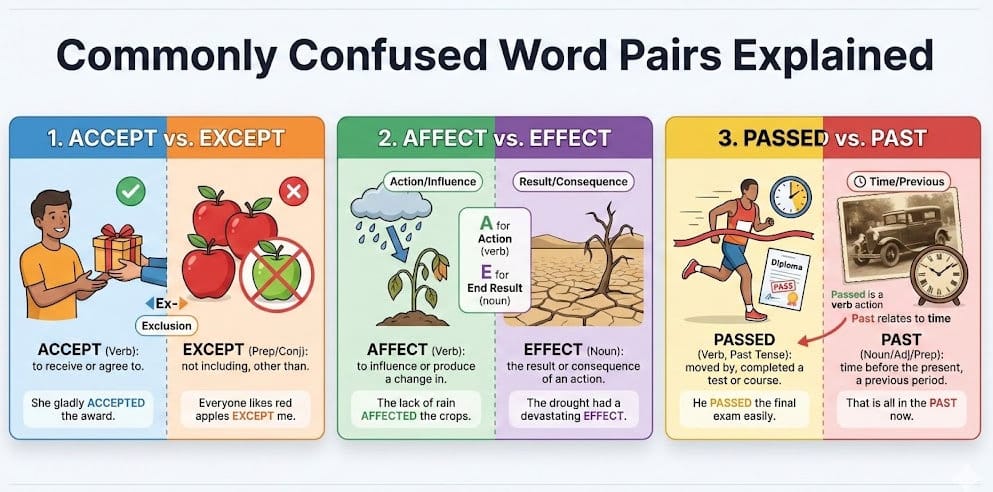
Accept vs. Except
- Accept (Verb): To receive or agree to.
- Example: "I accept your apology."
- Except (Preposition): Not including; other than.
- Example: "Everyone went to the party except John."
Affect vs. Effect
- Affect (Verb): To make a difference to; to influence.
- Example: "The cold weather will affect the crops."
- Effect (Noun): A result or consequence.
- Example: "The medicine had a positive effect on his health."
Passed vs. Past
- Passed (Verb): Past tense of "to pass" (moved by, succeeded).
- Example: "He passed the ball to his teammate."
- Example: "She passed her exam."
- Past (Noun/Adjective/Preposition): Gone by in time; no longer existing.
- Example: "In the past, people didn't have smartphones."
- Example: "He walked past the shop."
3. Linking Words
Linking words connect ideas and sentences.
Too
- Usage: Means "also" or "as well." It usually comes at the end of a sentence.
- Example: "I like swimming. I like running, too."
However
- Usage: Used to introduce a statement that contrasts with or seems to contradict something that has been said previously.
- Example: "I wanted to go to the park. However, it started to rain."
For instance
- Usage: Used to give an example (synonym for "for example").
- Example: "There are many healthy vegetables. For instance, broccoli and spinach are very good for you."
4. Reading Skill: Making Inferences
What is an inference?
Making an inference means "reading between the lines." The answer is not stated directly in the text, but you can guess it is true based on clues.
How to make inferences:
- Read the text carefully.
- Look for clues: (adjectives, tone, or specific details).
- Combine clues with what you already know.
- Example Text: "Tom walked into the house with a wet umbrella and muddy shoes."
- Inference: It is raining outside (even though the text didn't say "It is raining").
Take the quiz when you are ready.
M6-1 LS Quiz 7
Pathways Listening and Speak 2
 Jacob M