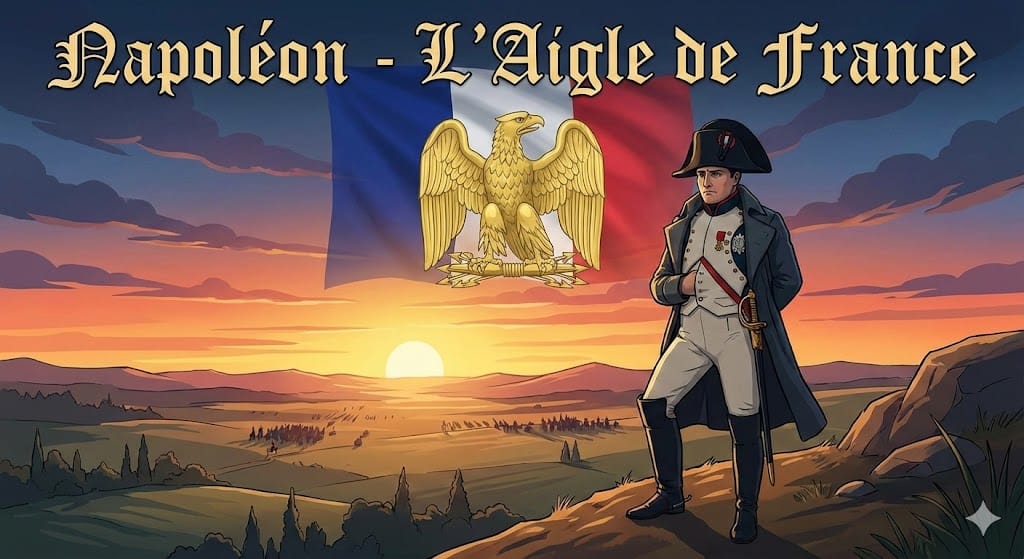
Immerse yourself in French history with this A2-level bilingual chapter book about Napoleon Bonaparte. Follow his legendary rise from Corsica to Emperor and his final exile, complete with comprehension quizzes.
{
"title": "Napoléon - L'Aigle de France",
"language": "fr",
"subtitle": "A French A2 Chapter Book",
"chapters": [
{
"id": "chapter-1",
"title": "Chapitre 1: Un Enfant de la Corse",
"content": [
"Napoléon Bonaparte est né le 15 août 1769 à Ajaccio, en Corse. Cette île de la Méditerranée était devenue française seulement un an avant sa naissance. Sa famille, les Bonaparte, était de petite noblesse mais ils n'étaient pas riches. La maison familiale était grande et bruyante avec beaucoup d'enfants.",
"Petit, Napoléon était un enfant turbulent et énergique. Il aimait jouer à la guerre avec ses amis dans les rues ensoleillées d'Ajaccio. À cette époque, il ne parlait pas français, mais un dialecte corse qui ressemblait à l'italien. Il aimait profondément son île sauvage et ses montagnes. C'était le début d'un destin incroyable."
],
"translation": "Napoleon Bonaparte was born on August 15, 1769, in Ajaccio, Corsica. This Mediterranean island had become French only one year before his birth. His family, the Bonapartes, were of minor nobility but they were not rich. The family home was large and noisy with many children. As a little one, Napoleon was a boisterous and energetic child. He loved playing war with his friends in the sunny streets of Ajaccio. At that time, he did not speak French, but a Corsican dialect that resembled Italian. He deeply loved his wild island and its mountains. It was the beginning of an incredible destiny.",
"quiz": [
{
"question": "1. Où est né Napoléon ?",
"options": [
{ "text": "a) À Paris", "value": "wrong" },
{ "text": "b) À Ajaccio", "value": "correct" },
{ "text": "c) À Rome", "value": "wrong" }
]
},
{
"question": "2. Vrai ou Faux : La famille de Napoléon était très riche.",
"options": [
{ "text": "Vrai", "value": "wrong" },
{ "text": "Faux", "value": "correct" }
]
},
{
"question": "3. Quelle langue parlait-il quand il était petit ?",
"options": [
{ "text": "a) Le français", "value": "wrong" },
{ "text": "b) L'anglais", "value": "wrong" },
{ "text": "c) Un dialecte corse", "value": "correct" }
]
}
]
},
{
"id": "chapter-2",
"title": "Chapitre 2: L'École Militaire à Brienne",
"content": [
"À l'âge de neuf ans, Napoléon quitta la Corse pour la France continentale. Il entra à l'école militaire de Brienne, en Champagne. L'hiver était très rude et il faisait froid, contrairement au climat doux de son île natale.",
"Napoléon se sentait seul. Ses camarades se moquaient de son accent corse et de sa petite taille. Il passait beaucoup de temps à lire des livres d'histoire, surtout sur Jules César et Alexandre le Grand. Il était excellent en mathématiques. Un jour d'hiver, il organisa une grande bataille de boules de neige, montrant déjà ses talents de chef et de stratège."
],
"translation": "At the age of nine, Napoleon left Corsica for mainland France. He entered the military school of Brienne, in Champagne. The winter was very harsh and it was cold, unlike the mild climate of his native island. Napoleon felt lonely. His classmates made fun of his Corsican accent and his short stature. He spent a lot of time reading history books, especially about Julius Caesar and Alexander the Great. He was excellent in mathematics. One winter day, he organized a great snowball fight, already showing his talents as a leader and strategist.",
"quiz": [
{
"question": "1. Pourquoi ses camarades se moquaient-ils de lui ?",
"options": [
{ "text": "a) À cause de ses vêtements", "value": "wrong" },
{ "text": "b) À cause de son accent", "value": "correct" },
{ "text": "c) Parce qu'il était riche", "value": "wrong" }
]
},
{
"question": "2. Quelle était sa matière scolaire préférée ?",
"options": [
{ "text": "a) Les mathématiques", "value": "correct" },
{ "text": "b) La musique", "value": "wrong" },
{ "text": "c) La biologie", "value": "wrong" }
]
},
{
"question": "3. Vrai ou Faux : Napoléon aimait le climat froid de Brienne.",
"options": [
{ "text": "Vrai", "value": "wrong" },
{ "text": "Faux", "value": "correct" }
]
}
]
},
{
"id": "chapter-3",
"title": "Chapitre 3: Le Jeune Général",
"content": [
"La Révolution française éclata en 1789. Tout changeait en France. Napoléon devint officier dans l'armée. En 1793, il participa au siège de Toulon contre les Anglais. Grâce à son intelligence et à son utilisation brillante des canons, les Français gagnèrent la bataille.",
"À seulement 24 ans, il fut nommé général. C'était très jeune pour un grade si important ! À Paris, il rencontra Joséphine de Beauharnais, une femme élégante et charmante. Il tomba très amoureux d'elle et ils se marièrent. Mais la guerre l'appelait. Il partit pour l'Italie où il gagna de nombreuses victoires rapides et impressionnantes."
],
"translation": "The French Revolution broke out in 1789. Everything was changing in France. Napoleon became an officer in the army. In 1793, he participated in the siege of Toulon against the English. Thanks to his intelligence and his brilliant use of cannons, the French won the battle. At only 24 years old, he was named general. That was very young for such an important rank! In Paris, he met Joséphine de Beauharnais, an elegant and charming woman. He fell very much in love with her and they married. But war was calling him. He left for Italy where he won many rapid and impressive victories.",
"quiz": [
{
"question": "1. Quel événement a commencé en 1789 ?",
"options": [
{ "text": "a) La Révolution française", "value": "correct" },
{ "text": "b) La Première Guerre mondiale", "value": "wrong" },
{ "text": "c) La construction de la Tour Eiffel", "value": "wrong" }
]
},
{
"question": "2. Comment s'appelait la femme de Napoléon ?",
"options": [
{ "text": "a) Marie-Antoinette", "value": "wrong" },
{ "text": "b) Joséphine", "value": "correct" },
{ "text": "c) Sophie", "value": "wrong" }
]
},
{
"question": "3. Vrai ou Faux : Napoléon est devenu général à 40 ans.",
"options": [
{ "text": "Vrai", "value": "wrong" },
{ "text": "Faux", "value": "correct" }
]
}
]
},
{
"id": "chapter-4",
"title": "Chapitre 4: L'Expédition en Égypte",
"content": [
"En 1798, le gouvernement envoya Napoléon en Égypte. Le but était de couper la route des Indes aux Anglais. Napoléon partit avec des soldats, mais aussi avec des savants, des artistes et des ingénieurs. Ils découvrirent les pyramides et le Sphinx.",
"Devant les grandes pyramides de Gizeh, Napoléon dit à ses soldats : « Soldats, du haut de ces pyramides, quarante siècles vous contemplent ! ». C'était une aventure exotique mais difficile à cause de la chaleur du désert. Durant cette expédition, un soldat français trouva la pierre de Rosette, qui permit plus tard de comprendre les hiéroglyphes égyptiens."
],
"translation": "In 1798, the government sent Napoleon to Egypt. The goal was to cut off the route to India from the English. Napoleon left with soldiers, but also with scholars, artists, and engineers. They discovered the pyramids and the Sphinx. In front of the great pyramids of Giza, Napoleon said to his soldiers: \"Soldiers, from the top of these pyramids, forty centuries look down upon you!\" It was an exotic adventure but difficult because of the desert heat. During this expedition, a French soldier found the Rosetta Stone, which later allowed the understanding of Egyptian hieroglyphs.",
"quiz": [
{
"question": "1. Qui a accompagné les soldats en Égypte ?",
"options": [
{ "text": "a) Des fermiers", "value": "wrong" },
{ "text": "b) Des savants et des artistes", "value": "correct" },
{ "text": "c) Des touristes", "value": "wrong" }
]
},
{
"question": "2. Quel monument important ont-ils vu ?",
"options": [
{ "text": "a) Le Colisée", "value": "wrong" },
{ "text": "b) Les Pyramides", "value": "correct" },
{ "text": "c) La Statue de la Liberté", "value": "wrong" }
]
},
{
"question": "3. Qu'est-ce qui a été découvert pendant l'expédition ?",
"options": [
{ "text": "a) La pierre de Rosette", "value": "correct" },
{ "text": "b) Une mine d'or", "value": "wrong" },
{ "text": "c) Un dinosaure", "value": "wrong" }
]
}
]
},
{
"id": "chapter-5",
"title": "Chapitre 5: Le Coup d'État",
"content": [
"Napoléon rentra en France en 1799. Le pays était dans le chaos et les Français étaient fatigués de l'instabilité politique. Napoléon, avec l'aide de son frère Lucien et de quelques alliés, prit le pouvoir par la force. C'est ce qu'on appelle le Coup d'État du 18 Brumaire.",
"Il créa un nouveau gouvernement : le Consulat. Napoléon devint le « Premier Consul ». Il travailla beaucoup pour réorganiser la France. Il créa la Banque de France et les lycées. Surtout, il rédigea le « Code Civil », un livre de lois qui organisait la vie des citoyens. La France retrouvait enfin un peu d'ordre."
],
"translation": "Napoleon returned to France in 1799. The country was in chaos and the French were tired of political instability. Napoleon, with the help of his brother Lucien and some allies, took power by force. This is called the Coup of 18 Brumaire. He created a new government: the Consulate. Napoleon became the \"First Consul.\" He worked a lot to reorganize France. He created the Bank of France and high schools (lycées). Above all, he wrote the \"Civil Code,\" a book of laws that organized the lives of citizens. France was finally finding a little order again.",
"quiz": [
{
"question": "1. Comment s'appelle la prise de pouvoir de Napoléon ?",
"options": [
{ "text": "a) La Révolution", "value": "wrong" },
{ "text": "b) Le Coup d'État", "value": "correct" },
{ "text": "c) L'Élection", "value": "wrong" }
]
},
{
"question": "2. Quel livre de lois Napoléon a-t-il créé ?",
"options": [
{ "text": "a) Le Code Civil", "value": "correct" },
{ "text": "b) La Constitution américaine", "value": "wrong" },
{ "text": "c) Le Roman National", "value": "wrong" }
]
},
{
"question": "3. Vrai ou Faux : Napoléon a créé les lycées.",
"options": [
{ "text": "Vrai", "value": "correct" },
{ "text": "Faux", "value": "wrong" }
]
}
]
},
{
"id": "chapter-6",
"title": "Chapitre 6: Le Sacre de l'Empereur",
"content": [
"Le 2 décembre 1804, un grand événement eut lieu à la cathédrale Notre-Dame de Paris. Napoléon décida de devenir « Empereur des Français ». Le Pape Pie VII vint de Rome pour la cérémonie, mais il y eut une surprise.",
"Au moment le plus important, Napoléon prit la couronne des mains du Pape. Il la posa lui-même sur sa propre tête, puis il couronna sa femme Joséphine. C'était un geste fort pour montrer qu'il ne devait son pouvoir à personne d'autre qu'à lui-même. Il choisit l'aigle comme symbole de son empire, rappelant la Rome antique. Napoléon Ier était né."
],
"translation": "On December 2, 1804, a great event took place at the Notre-Dame Cathedral in Paris. Napoleon decided to become \"Emperor of the French.\" Pope Pius VII came from Rome for the ceremony, but there was a surprise. At the most important moment, Napoleon took the crown from the Pope's hands. He placed it on his own head himself, then he crowned his wife Joséphine. It was a strong gesture to show that he owed his power to no one but himself. He chose the eagle as the symbol of his empire, recalling ancient Rome. Napoleon I was born.",
"quiz": [
{
"question": "1. Où a eu lieu le sacre ?",
"options": [
{ "text": "a) À la Tour Eiffel", "value": "wrong" },
{ "text": "b) À Notre-Dame de Paris", "value": "correct" },
{ "text": "c) À Versailles", "value": "wrong" }
]
},
{
"question": "2. Qui a posé la couronne sur la tête de Napoléon ?",
"options": [
{ "text": "a) Le Pape", "value": "wrong" },
{ "text": "b) Napoléon lui-même", "value": "correct" },
{ "text": "c) Joséphine", "value": "wrong" }
]
},
{
"question": "3. Quel animal est le symbole de l'Empire ?",
"options": [
{ "text": "a) Le lion", "value": "wrong" },
{ "text": "b) Le coq", "value": "wrong" },
{ "text": "c) L'aigle", "value": "correct" }
]
}
]
},
{
"id": "chapter-7",
"title": "Chapitre 7: La Grande Armée et Austerlitz",
"content": [
"L'année 1805 marqua la plus grande victoire militaire de Napoléon : la bataille d'Austerlitz. On l'appelle la « bataille des Trois Empereurs ». Malgré le froid et la neige, l'armée de Napoléon, appelée la « Grande Armée », était très disciplinée.",
"Napoléon utilisa une stratégie brillante. Il fit croire à ses ennemis qu'il était faible pour les piéger. Les soldats russes et autrichiens furent repoussés vers des lacs gelés. La victoire fut totale. Pour célébrer ses victoires, Napoléon ordonna la construction de l'Arc de Triomphe à Paris. À ce moment-là, il était le maître de l'Europe."
],
"translation": "The year 1805 marked Napoleon's greatest military victory: the Battle of Austerlitz. It is called the \"Battle of the Three Emperors.\" Despite the cold and snow, Napoleon's army, called the \"Grande Armée\" (Great Army), was very disciplined. Napoleon used a brilliant strategy. He made his enemies believe he was weak to trap them. The Russian and Austrian soldiers were pushed back toward frozen lakes. The victory was total. To celebrate his victories, Napoleon ordered the construction of the Arc de Triomphe in Paris. At that moment, he was the master of Europe.",
"quiz": [
{
"question": "1. Quelle est la plus grande victoire de Napoléon ?",
"options": [
{ "text": "a) Waterloo", "value": "wrong" },
{ "text": "b) Austerlitz", "value": "correct" },
{ "text": "c) Trafalgar", "value": "wrong" }
]
},
{
"question": "2. Quel monument Napoléon a-t-il fait construire à Paris ?",
"options": [
{ "text": "a) Le Louvre", "value": "wrong" },
{ "text": "b) L'Arc de Triomphe", "value": "correct" },
{ "text": "c) Le Sacré-Cœur", "value": "wrong" }
]
},
{
"question": "3. Vrai ou Faux : La Grande Armée a perdu la bataille d'Austerlitz.",
"options": [
{ "text": "Vrai", "value": "wrong" },
{ "text": "Faux", "value": "correct" }
]
}
]
},
{
"id": "chapter-8",
"title": "Chapitre 8: L'Hiver en Russie",
"content": [
"En 1812, Napoléon fit une erreur fatale. Il décida d'envahir la Russie avec une armée immense de 600 000 hommes. Les Russes reculèrent et brûlèrent leurs propres villes, y compris Moscou, pour ne rien laisser aux Français.",
"Quand l'hiver russe arriva, il faisait terriblement froid, jusqu'à -30 degrés. Les soldats français n'avaient pas de vêtements assez chauds et manquaient de nourriture. Napoléon ordonna la retraite. Le retour fut un cauchemar dans la neige. Beaucoup de soldats moururent de froid et de faim. C'était le début de la fin pour l'Empereur."
],
"translation": "In 1812, Napoleon made a fatal mistake. He decided to invade Russia with a huge army of 600,000 men. The Russians retreated and burned their own cities, including Moscow, to leave nothing for the French. When the Russian winter arrived, it was terribly cold, down to -30 degrees. The French soldiers did not have warm enough clothes and lacked food. Napoleon ordered the retreat. The return was a nightmare in the snow. Many soldiers died of cold and hunger. It was the beginning of the end for the Emperor.",
"quiz": [
{
"question": "1. Quel pays Napoléon a-t-il envahi en 1812 ?",
"options": [
{ "text": "a) L'Espagne", "value": "wrong" },
{ "text": "b) La Russie", "value": "correct" },
{ "text": "c) L'Angleterre", "value": "wrong" }
]
},
{
"question": "2. Quel était le plus grand ennemi des soldats français ?",
"options": [
{ "text": "a) Le froid (l'hiver)", "value": "correct" },
{ "text": "b) Les animaux sauvages", "value": "wrong" },
{ "text": "c) La pluie", "value": "wrong" }
]
},
{
"question": "3. Vrai ou Faux : Les Français ont trouvé beaucoup de nourriture à Moscou.",
"options": [
{ "text": "Vrai", "value": "wrong" },
{ "text": "Faux", "value": "correct" }
]
}
]
},
{
"id": "chapter-9",
"title": "Chapitre 9: La Défaite de Waterloo",
"content": [
"Après une première défaite et un exil sur l'île d'Elbe, Napoléon revint en France pour « les Cent-Jours ». Mais toute l'Europe était contre lui. Le 18 juin 1815, l'armée de Napoléon affronta les Anglais et les Prussiens en Belgique, près d'un village nommé Waterloo.",
"Le combat fut violent et dura toute la journée. Napoléon attendait des renforts qui n'arrivèrent jamais. Les Anglais, commandés par le duc de Wellington, résistèrent. Le soir, la Garde Impériale recula. C'était fini. Napoléon avait perdu sa dernière bataille. Il dut abdiquer (quitter le pouvoir) une seconde fois."
],
"translation": "After a first defeat and exile on the island of Elba, Napoleon returned to France for \"the Hundred Days.\" But all of Europe was against him. On June 18, 1815, Napoleon's army faced the English and Prussians in Belgium, near a village named Waterloo. The fight was violent and lasted all day. Napoleon waited for reinforcements that never arrived. The English, commanded by the Duke of Wellington, resisted. In the evening, the Imperial Guard retreated. It was over. Napoleon had lost his last battle. He had to abdicate (leave power) a second time.",
"quiz": [
{
"question": "1. Où se trouve Waterloo ?",
"options": [
{ "text": "a) En France", "value": "wrong" },
{ "text": "b) En Belgique", "value": "correct" },
{ "text": "c) En Allemagne", "value": "wrong" }
]
},
{
"question": "2. Qui commandait l'armée anglaise ?",
"options": [
{ "text": "a) Le duc de Wellington", "value": "correct" },
{ "text": "b) Le roi George", "value": "wrong" },
{ "text": "c) L'amiral Nelson", "value": "wrong" }
]
},
{
"question": "3. Vrai ou Faux : Napoléon a gagné la bataille de Waterloo.",
"options": [
{ "text": "Vrai", "value": "wrong" },
{ "text": "Faux", "value": "correct" }
]
}
]
},
{
"id": "chapter-10",
"title": "Chapitre 10: L'Exil à Sainte-Hélène",
"content": [
"Les Anglais envoyèrent Napoléon très loin, sur l'île de Sainte-Hélène. C'est un petit rocher perdu au milieu de l'océan Atlantique sud. Il ne pouvait plus s'échapper. Il vivait dans une maison humide, surveillé par des soldats anglais.",
"Napoléon était triste et malade, mais il voulait soigner sa légende. Il dicta ses mémoires pour raconter son histoire. Il mourut le 5 mai 1821. Des années plus tard, son corps fut ramené à Paris. Aujourd'hui, il repose sous le dôme doré des Invalides. Il reste l'une des figures les plus célèbres de l'histoire de France."
],
"translation": "The English sent Napoleon very far away, to the island of Saint Helena. It is a small rock lost in the middle of the South Atlantic Ocean. He could no longer escape. He lived in a damp house, watched by English soldiers. Napoleon was sad and sick, but he wanted to curate his legend. He dictated his memoirs to tell his story. He died on May 5, 1821. Years later, his body was brought back to Paris. Today, he rests under the golden dome of Les Invalides. He remains one of the most famous figures in French history.",
"quiz": [
{
"question": "1. Où Napoléon a-t-il passé ses dernières années ?",
"options": [
{ "text": "a) En Corse", "value": "wrong" },
{ "text": "b) À Paris", "value": "wrong" },
{ "text": "c) À Sainte-Hélène", "value": "correct" }
]
},
{
"question": "2. Qu'a-t-il fait pendant son exil ?",
"options": [
{ "text": "a) Il a construit un bateau", "value": "wrong" },
{ "text": "b) Il a dicté ses mémoires", "value": "correct" },
{ "text": "c) Il a appris l'anglais", "value": "wrong" }
]
},
{
"question": "3. Où est son tombeau aujourd'hui ?",
"options": [
{ "text": "a) Aux Invalides", "value": "correct" },
{ "text": "b) Au Panthéon", "value": "wrong" },
{ "text": "c) Au cimetière du Père-Lachaise", "value": "wrong" }
]
}
]
}
]
}