[
{
"title": "Past Simple vs Past Perfect",
"hint": {
"summary": "Time Order in the Past",
"content": "Use the **Past Simple** for the most recent event or a sequence of events. Use the **Past Perfect** (had + past participle) for an action that happened **before** another action in the past.\n\n* **Example:** When I arrived (2nd), the train **had left** (1st)."
},
"questions": [
{
"type": "multiple-choice",
"question": "When I got to the station, the train ___ already left.",
"options": ["had", "has", "have"],
"correctIndex": 0,
"explanation": "Use **Past Perfect** (had + V3) because the train left *before* you arrived."
},
{
"type": "multiple-choice",
"question": "She was hungry because she ___ eaten anything all day.",
"options": ["hadn't", "didn't", "hasn't"],
"correctIndex": 0,
"explanation": "The action of not eating happened *before* she felt hungry."
},
{
"type": "multiple-choice",
"question": "By the time we arrived, the movie ___.",
"options": ["had started", "started", "starts"],
"correctIndex": 0,
"explanation": "The movie started *before* we arrived."
},
{
"type": "multiple-choice",
"question": "I realized that I ___ my keys at home.",
"options": ["had left", "left", "was leaving"],
"correctIndex": 0,
"explanation": "Leaving the keys happened *before* the realization."
},
{
"type": "multiple-choice",
"question": "He ___ never been to France before that trip.",
"options": ["had", "was", "did"],
"correctIndex": 0,
"explanation": "We use **Past Perfect** to talk about experiences up to a point in the past."
},
{
"type": "multiple-choice",
"question": "After she ___ her homework, she watched TV.",
"options": ["had finished", "finish", "finishes"],
"correctIndex": 0,
"explanation": "She finished homework first, then watched TV."
},
{
"type": "multiple-choice",
"question": "The garden was dead because it ___ been dry all summer.",
"options": ["had", "was", "has"],
"correctIndex": 0,
"explanation": "The dryness happened *before* the garden died."
},
{
"type": "multiple-choice",
"question": "I didn't recognize him because he ___ changed so much.",
"options": ["had", "have", "was"],
"correctIndex": 0,
"explanation": "The change happened *before* the meeting."
},
{
"type": "multiple-choice",
"question": "She told me she ___ the email.",
"options": ["had sent", "sent", "send"],
"correctIndex": 0,
"explanation": "She sent the email *before* she told me about it."
},
{
"type": "multiple-choice",
"question": "We were late because we ___ the wrong bus.",
"options": ["had taken", "took", "were taking"],
"correctIndex": 0,
"explanation": "Taking the bus happened *before* being late."
},
{
"type": "fill-in-the-blank",
"instruction": "Fill in the blank with the correct form:",
"question": "The game ___ (start) before we got to the stadium.",
"answer": ["had started"],
"explanation": "The game started *before* the arrival."
},
{
"type": "fill-in-the-blank",
"instruction": "Fill in the blank with the correct form:",
"question": "I went to bed after I ___ (finish) my work.",
"answer": ["had finished"],
"explanation": "First I finished work, then I went to bed."
},
{
"type": "fill-in-the-blank",
"instruction": "Fill in the blank with the correct form:",
"question": "She ___ (live) in London before she moved to Paris.",
"answer": ["had lived", "'d lived"],
"explanation": "Living in London happened *before* moving to Paris."
},
{
"type": "fill-in-the-blank",
"instruction": "Fill in the blank with the correct form:",
"question": "The streets were wet because it ___ (rain) the night before.",
"answer": ["had rained"],
"explanation": "It rained *before* the streets were seen as wet."
},
{
"type": "fill-in-the-blank",
"instruction": "Fill in the blank with the correct form:",
"question": "I couldn't get in because I ___ (lose) my key.",
"answer": ["had lost", "'d lost"],
"explanation": "Losing the key happened *before* trying to get in."
},
{
"type": "fill-in-the-blank",
"instruction": "Fill in the blank with the correct form:",
"question": "They ___ (study) English before they visited the USA.",
"answer": ["had studied", "'d studied"],
"explanation": "Studying happened *before* the visit."
},
{
"type": "fill-in-the-blank",
"instruction": "Fill in the blank with the correct form:",
"question": "She was angry because he ___ (forget) her birthday.",
"answer": ["had forgotten", "'d forgotten"],
"explanation": "He forgot the birthday *before* she felt angry."
},
{
"type": "fill-in-the-blank",
"instruction": "Fill in the blank with the correct form:",
"question": "By 10 PM, the party ___ (end).",
"answer": ["had ended"],
"explanation": "The party ended *before* the time of 10 PM."
},
{
"type": "fill-in-the-blank",
"instruction": "Fill in the blank with the correct form:",
"question": "He ___ (see) the movie twice before we went together.",
"answer": ["had seen", "'d seen"],
"explanation": "He saw it *before* we went."
},
{
"type": "fill-in-the-blank",
"instruction": "Fill in the blank with the correct form:",
"question": "When I woke up, the sun ___ (rise).",
"answer": ["had risen"],
"explanation": "The sun rose *before* I woke up."
},
{
"type": "scramble",
"sentence": "I had eaten dinner before he arrived.",
"explanation": "The first action is 'had eaten'."
},
{
"type": "scramble",
"sentence": "She had done her homework so she was happy.",
"explanation": "Homework was done *before* she felt happy."
},
{
"type": "scramble",
"sentence": "The train had left when we got there.",
"explanation": "The train left first."
},
{
"type": "scramble",
"sentence": "He had never flown on a plane before.",
"explanation": "Subject + had + adverb + past participle."
},
{
"type": "scramble",
"sentence": "They had sold the house before they moved.",
"explanation": "Selling the house happened first."
},
{
"type": "scramble",
"sentence": "After I had washed the car it rained.",
"explanation": "First I washed the car, then it rained."
},
{
"type": "scramble",
"sentence": "She felt sick because she had eaten too much.",
"explanation": "Eating happened before feeling sick."
},
{
"type": "scramble",
"sentence": "He had read the book before watching the movie.",
"explanation": "Reading happened before watching."
},
{
"type": "scramble",
"sentence": "The teacher was angry because we had cheated.",
"explanation": "Cheating happened before the teacher was angry."
},
{
"type": "scramble",
"sentence": "I had already bought the tickets before you asked.",
"explanation": "Buying tickets happened first."
}
]
}
]
Past Simple vs. Past Perfect
Have you ever tried to tell a story in English, but got confused about the order of events? You know what happened in the past, but how do you say that something happened before the past?
This is one of the most common challenges for intermediate students: knowing when to use the Past Simple and when to switch to the Past Perfect.
The Difference in Short
Think of your story as a timeline.
Past Simple: This is for the main events of your story. It answers the question: "What happened next?"
Example: I woke up, ate breakfast, and went to work.
Past Perfect (had + V3): This is the "flashback" tense. It talks about things that happened before the Past Simple action.
Example: When I arrived at the office, I realized I had left my laptop at home.
The Rule:
Action 1 (First in time): Use Past Perfect.
Action 2 (Second in time): Use Past Simple.
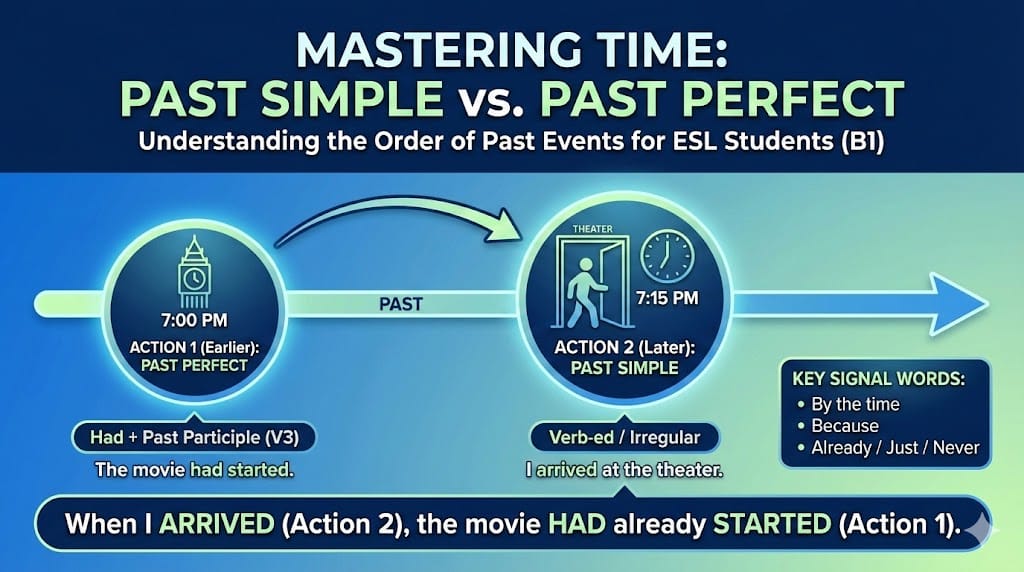
Let’s Look at an Example
Imagine you want to go to the movies.
7:00 PM: The movie starts.
7:15 PM: You arrive at the theater.
Because you were late, the movie started before you arrived.
"When I arrived at the theater, the movie had already started."
Action 1: The movie started (Past Perfect).
Action 2: You arrived (Past Simple).
Key Signal Words
There are certain words that act as clues. If you see these, you might need the Past Perfect!
1. By the time
We use this to show a deadline in the past.
Example:By the time the police arrived, the thief had escaped.
2. Because (Reason)
Often, the reason for a feeling happens before the feeling itself.
Example: She was hungry because she hadn't eaten all day.
3. Already / Just / Never
These are common with perfect tenses.
Example: I didn't want lunch because I hadalreadyeaten.
Common Mistakes to Avoid
Mistake: Using Past Perfect when you just mean "a long time ago."
Incorrect: I had visited Paris in 2010.
Correct: I visited Paris in 2010. (This is just a finished fact).
Mistake: Using Past Perfect for a sequence of events.
Incorrect: I arrived home and I had turned on the TV.
Correct: I arrived home and turned on the TV. (One thing happened right after the other).