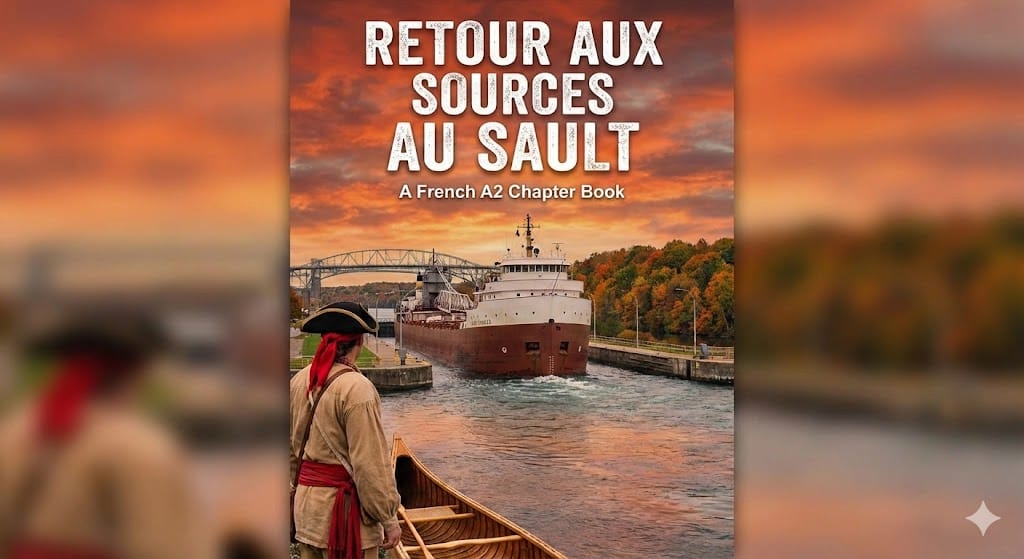
Discover the French heritage of Michigan's Upper Peninsula. This A2-level French reader explores the history of Sault Ste. Marie, the Soo Locks, and the Voyageurs.
{
"title": "Retour aux Sources au Sault",
"language": "fr",
"subtitle": "A French A2 Chapter Book",
"chapters": [
{
"id": "chapter-1",
"title": "Chapitre 1: L'Arrivée dans le Nord",
"content": [
"Marc conduisait sa voiture vers le nord du Michigan. Il voulait visiter la Péninsule Supérieure. Le voyage était long, mais les forêts étaient magnifiques. Enfin, il arriva à Sault Sainte Marie. C'était une ville frontière, séparée du Canada par la rivière Sainte-Marie.",
"L'air était frais, même en automne. Marc ouvrit sa fenêtre pour écouter le bruit de l'eau. Il était excité de découvrir l'histoire française de cette région isolée. C'était sa première fois ici, et il se sentait comme un explorateur moderne."
],
"translation": "Marc was driving his car toward northern Michigan. He wanted to visit the Upper Peninsula. The trip was long, but the forests were beautiful. Finally, he arrived in Sault Ste. Marie. It was a border town, separated from Canada by the Saint Marys River. The air was cool, even in autumn. Marc opened his window to listen to the sound of the water. He was excited to discover the French history of this isolated region. It was his first time here, and he felt like a modern explorer.",
"quiz": [
{
"question": "1. Où va Marc ?",
"options": [
{ "text": "a) À Détroit", "value": "wrong" },
{ "text": "b) À Sault Sainte Marie", "value": "correct" },
{ "text": "c) À Chicago", "value": "wrong" }
]
},
{
"question": "2. Quelle saison est-ce ?",
"options": [
{ "text": "a) L'été", "value": "wrong" },
{ "text": "b) L'hiver", "value": "wrong" },
{ "text": "c) L'automne", "value": "correct" }
]
},
{
"question": "3. Que ressent Marc ?",
"options": [
{ "text": "a) Il est fatigué", "value": "wrong" },
{ "text": "b) Il est excité", "value": "correct" },
{ "text": "c) Il a peur", "value": "wrong" }
]
}
]
},
{
"id": "chapter-2",
"title": "Chapitre 2: Les Écluses du Soo (Soo Locks)",
"content": [
"Le matin suivant, Marc alla voir les célèbres écluses du Soo. Il y avait une grande plateforme d'observation pour les touristes. Un immense cargo s'approchait lentement. Le navire était gigantesque, transportant du fer vers les usines du sud.",
"Marc regarda le niveau de l'eau monter dans l'écluse. C'était une merveille d'ingénierie. Sans ces écluses, les bateaux ne pourraient pas voyager entre le lac Supérieur et le lac Huron. C'était impressionnant de voir une telle machine en action."
],
"translation": "The next morning, Marc went to see the famous Soo Locks. There was a large observation platform for tourists. A huge freighter was approaching slowly. The ship was gigantic, carrying iron to the factories of the south. Marc watched the water level rise in the lock. It was a marvel of engineering. Without these locks, boats could not travel between Lake Superior and Lake Huron. It was impressive to see such a machine in action.",
"quiz": [
{
"question": "1. Qu'est-ce que Marc regarde ?",
"options": [
{ "text": "a) Un avion", "value": "wrong" },
{ "text": "b) Un immense cargo", "value": "correct" },
{ "text": "c) Une course de voitures", "value": "wrong" }
]
},
{
"question": "2. Que fait l'eau dans l'écluse ?",
"options": [
{ "text": "a) Elle monte", "value": "correct" },
{ "text": "b) Elle gèle", "value": "wrong" },
{ "text": "c) Elle change de couleur", "value": "wrong" }
]
},
{
"question": "3. Les écluses connectent quels lacs ?",
"options": [
{ "text": "a) Érié et Ontario", "value": "wrong" },
{ "text": "b) Supérieur et Huron", "value": "correct" },
{ "text": "c) Michigan et Supérieur", "value": "wrong" }
]
}
]
},
{
"id": "chapter-3",
"title": "Chapitre 3: Pourquoi \"Sault\" ?",
"content": [
"Marc visita le parc près de la rivière pour comprendre le nom de la ville. Il lut une plaque historique. Le mot \"Sault\" est un vieux mot français qui signifie \"saut\" ou \"rapides\".",
"Au 17ème siècle, les missionnaires français, comme le Père Marquette, sont arrivés ici. Ils ont vu que la rivière tombait de six mètres. Les canoës ne pouvaient pas passer. Il fallait porter les bateaux. C'est pour cela qu'ils ont nommé cet endroit le Sault de Sainte Marie."
],
"translation": "Marc visited the park near the river to understand the name of the city. He read a historical plaque. The word \"Sault\" is an old French word that means \"jump\" or \"rapids\". In the 17th century, French missionaries, like Father Marquette, arrived here. They saw that the river dropped six meters (21 feet). Canoes could not pass. They had to carry the boats. That is why they named this place the Sault of Saint Mary.",
"quiz": [
{
"question": "1. Que signifie le mot \"Sault\" ?",
"options": [
{ "text": "a) Une forêt", "value": "wrong" },
{ "text": "b) Un saut ou rapides", "value": "correct" },
{ "text": "c) Une montagne", "value": "wrong" }
]
},
{
"question": "2. Qui est arrivé au 17ème siècle ?",
"options": [
{ "text": "a) Des soldats anglais", "value": "wrong" },
{ "text": "b) Des missionnaires français", "value": "correct" },
{ "text": "c) Des touristes américains", "value": "wrong" }
]
},
{
"question": "3. Quel était le problème avec la rivière ?",
"options": [
{ "text": "a) Elle était trop profonde", "value": "wrong" },
{ "text": "b) Elle était sèche", "value": "wrong" },
{ "text": "c) Elle tombait de six mètres", "value": "correct" }
]
}
]
},
{
"id": "chapter-4",
"title": "Chapitre 4: La Vie des Voyageurs",
"content": [
"L'après-midi, Marc se rendit à un musée local sur la rue Water. Il apprit l'histoire des \"Voyageurs\". Ces hommes courageux transportaient des fourrures dans de grands canoës. Ils voyageaient de Montréal jusqu'au Sault.",
"Leur vie était très difficile et physique. Ils ramaient pendant des heures et chantaient des chansons françaises pour garder le rythme. Marc essaya de soulever un ballot de fourrure. C'était très lourd ! Il avait beaucoup de respect pour ces ancêtres francophones."
],
"translation": "In the afternoon, Marc went to a local museum on Water Street. He learned the history of the \"Voyageurs\". These brave men transported furs in large canoes. They traveled from Montreal to the Sault. Their life was very difficult and physical. They rowed for hours and sang French songs to keep the rhythm. Marc tried to lift a bundle of fur. It was very heavy! He had a lot of respect for these Francophone ancestors.",
"quiz": [
{
"question": "1. Que transportaient les Voyageurs ?",
"options": [
{ "text": "a) De l'or", "value": "wrong" },
{ "text": "b) Des fourrures", "value": "correct" },
{ "text": "c) Du poisson", "value": "wrong" }
]
},
{
"question": "2. Que faisaient-ils pour garder le rythme ?",
"options": [
{ "text": "a) Ils dormaient", "value": "wrong" },
{ "text": "b) Ils mangeaient", "value": "wrong" },
{ "text": "c) Ils chantaient", "value": "correct" }
]
},
{
"question": "3. Comment était le ballot de fourrure ?",
"options": [
{ "text": "a) Très lourd", "value": "correct" },
{ "text": "b) Très léger", "value": "wrong" },
{ "text": "c) Très doux", "value": "wrong" }
]
}
]
},
{
"id": "chapter-5",
"title": "Chapitre 5: Le Pont International",
"content": [
"Le lendemain, Marc regarda vers le nord. Il vit un grand pont en acier qui traversait la rivière. C'était le Pont International. Il relie Sault Sainte Marie, Michigan, à Sault Sainte Marie, Ontario.",
"C'est intéressant car ce sont deux villes avec le même nom, mais dans deux pays différents. Les voitures et les camions passaient sans cesse. Marc prit une photo du pont avec le drapeau américain et le drapeau canadien flottant côte à côte."
],
"translation": "The next day, Marc looked north. He saw a large steel bridge crossing the river. It was the International Bridge. It connects Sault Ste. Marie, Michigan, to Sault Ste. Marie, Ontario. It is interesting because they are two cities with the same name, but in two different countries. Cars and trucks passed constantly. Marc took a photo of the bridge with the American flag and the Canadian flag flying side by side.",
"quiz": [
{
"question": "1. En quoi est fait le pont ?",
"options": [
{ "text": "a) En bois", "value": "wrong" },
{ "text": "b) En acier", "value": "correct" },
{ "text": "c) En pierre", "value": "wrong" }
]
},
{
"question": "2. Qu'est-ce qui est unique au sujet des deux villes ?",
"options": [
{ "text": "a) Elles ont le même nom", "value": "correct" },
{ "text": "b) Elles sont vides", "value": "wrong" },
{ "text": "c) Elles n'ont pas de routes", "value": "wrong" }
]
},
{
"question": "3. Quels drapeaux Marc voit-il ?",
"options": [
{ "text": "a) Français et Anglais", "value": "wrong" },
{ "text": "b) Américain et Canadien", "value": "correct" },
{ "text": "c) Espagnol et Italien", "value": "wrong" }
]
}
]
},
{
"id": "chapter-6",
"title": "Chapitre 6: Le Poisson Blanc (Whitefish)",
"content": [
"Il était l'heure de manger. Marc avait très faim. Il entra dans un restaurant célèbre du centre-ville. Le serveur lui recommanda la spécialité locale : le poisson blanc du lac Supérieur. \"C'est pêché ce matin,\" dit le serveur.",
"Marc commanda le poisson avec des pommes de terre. Quand le plat arriva, l'odeur était délicieuse. Le poisson était tendre et frais. C'était le meilleur repas de son voyage. La cuisine locale était simple mais excellente."
],
"translation": "It was time to eat. Marc was very hungry. He entered a famous restaurant in the city center. The waiter recommended the local specialty: Lake Superior whitefish. \"It was caught this morning,\" said the waiter. Marc ordered the fish with potatoes. When the dish arrived, the smell was delicious. The fish was tender and fresh. It was the best meal of his trip. The local cuisine was simple but excellent.",
"quiz": [
{
"question": "1. Quelle est la spécialité locale ?",
"options": [
{ "text": "a) Le steak", "value": "wrong" },
{ "text": "b) Le poisson blanc", "value": "correct" },
{ "text": "c) Le poulet", "value": "wrong" }
]
},
{
"question": "2. Quand le poisson a-t-il été pêché ?",
"options": [
{ "text": "a) Le matin même", "value": "correct" },
{ "text": "b) La semaine dernière", "value": "wrong" },
{ "text": "c) L'année dernière", "value": "wrong" }
]
},
{
"question": "3. Comment Marc a-t-il trouvé le repas ?",
"options": [
{ "text": "a) Mauvais", "value": "wrong" },
{ "text": "b) Excellent", "value": "correct" },
{ "text": "c) Trop épicé", "value": "wrong" }
]
}
]
},
{
"id": "chapter-7",
"title": "Chapitre 7: Le Navire Musée (Valley Camp)",
"content": [
"Après le déjeuner, Marc visita le \"Valley Camp\". C'est un immense bateau à vapeur qui est maintenant un musée flottant. Marc monta à bord et descendit dans la cale. C'était immense à l'intérieur. Il vit les cabines de l'équipage et la salle des machines.",
"Le musée racontait aussi les histoires tragiques des naufrages sur les Grands Lacs. Il y avait même deux canots de sauvetage du célèbre navire \"Edmund Fitzgerald\". L'atmosphère était calme et respectueuse."
],
"translation": "After lunch, Marc visited the \"Valley Camp\". It is a huge steamship that is now a floating museum. Marc went aboard and went down into the hold. It was huge inside. He saw the crew's cabins and the engine room. The museum also told the tragic stories of shipwrecks on the Great Lakes. There were even two lifeboats from the famous ship \"Edmund Fitzgerald\". The atmosphere was quiet and respectful.",
"quiz": [
{
"question": "1. Qu'est-ce que le \"Valley Camp\" ?",
"options": [
{ "text": "a) Un hôtel", "value": "wrong" },
{ "text": "b) Un musée flottant", "value": "correct" },
{ "text": "c) Un restaurant", "value": "wrong" }
]
},
{
"question": "2. Où Marc est-il descendu ?",
"options": [
{ "text": "a) Dans la cale", "value": "correct" },
{ "text": "b) Sur le toit", "value": "wrong" },
{ "text": "c) Dans la rivière", "value": "wrong" }
]
},
{
"question": "3. De quel navire célèbre proviennent les canots de sauvetage ?",
"options": [
{ "text": "a) Le Titanic", "value": "wrong" },
{ "text": "b) L'Edmund Fitzgerald", "value": "correct" },
{ "text": "c) Le Santa Maria", "value": "wrong" }
]
}
]
},
{
"id": "chapter-8",
"title": "Chapitre 8: La Tour d'Histoire",
"content": [
"Pour voir toute la ville, Marc alla à la Tour d'Histoire. C'est une haute tour en béton. Il prit l'ascenseur rapide jusqu'au sommet. De là-haut, la vue était spectaculaire. Il pouvait voir les écluses, la rivière, le Canada et les forêts lointaines.",
"Le vent soufflait fort à cette altitude. Marc utilisa ses jumelles pour observer les détails de la ville. Il réalisa à quel point la nature dominait cette région industrielle."
],
"translation": "To see the whole city, Marc went to the Tower of History. It is a tall concrete tower. He took the fast elevator to the top. From up there, the view was spectacular. He could see the locks, the river, Canada, and the distant forests. The wind was blowing hard at this altitude. Marc used his binoculars to observe the details of the city. He realized how much nature dominated this industrial region.",
"quiz": [
{
"question": "1. Comment Marc est-il monté au sommet ?",
"options": [
{ "text": "a) Par les escaliers", "value": "wrong" },
{ "text": "b) Par l'ascenseur", "value": "correct" },
{ "text": "c) En hélicoptère", "value": "wrong" }
]
},
{
"question": "2. Que pouvait-il voir ?",
"options": [
{ "text": "a) Seulement le parking", "value": "wrong" },
{ "text": "b) Les écluses et le Canada", "value": "correct" },
{ "text": "c) La ville de Détroit", "value": "wrong" }
]
},
{
"question": "3. Comment était le vent ?",
"options": [
{ "text": "a) Il n'y avait pas de vent", "value": "wrong" },
{ "text": "b) Il soufflait fort", "value": "correct" },
{ "text": "c) Il était chaud", "value": "wrong" }
]
}
]
},
{
"id": "chapter-9",
"title": "Chapitre 9: Une Soirée Froide",
"content": [
"Le soleil commençait à se coucher. La température chuta rapidement. C'est typique du nord du Michigan. Marc chercha un endroit chaud. Il trouva un petit café confortable sur l'avenue Ashmun. Il commanda un chocolat chaud.",
"À l'intérieur, les gens parlaient et riaient. Marc entendit quelques mots de français à la table voisine. C'était peut-être des touristes canadiens. Il se sentait bien au chaud, à l'abri du froid extérieur."
],
"translation": "The sun was starting to set. The temperature dropped quickly. This is typical of northern Michigan. Marc looked for a warm place. He found a cozy little café on Ashmun Avenue. He ordered a hot chocolate. Inside, people were talking and laughing. Marc heard a few words of French at the next table. Perhaps they were Canadian tourists. He felt nice and warm, sheltered from the cold outside.",
"quiz": [
{
"question": "1. Qu'est-ce qui est typique du nord ?",
"options": [
{ "text": "a) La température chute vite", "value": "correct" },
{ "text": "b) Il fait toujours chaud", "value": "wrong" },
{ "text": "c) Il pleut toujours", "value": "wrong" }
]
},
{
"question": "2. Qu'est-ce que Marc a bu ?",
"options": [
{ "text": "a) Un café noir", "value": "wrong" },
{ "text": "b) Un chocolat chaud", "value": "correct" },
{ "text": "c) De l'eau glacée", "value": "wrong" }
]
},
{
"question": "3. Qu'a-t-il entendu à la table voisine ?",
"options": [
{ "text": "a) De la musique", "value": "wrong" },
{ "text": "b) Des mots de français", "value": "correct" },
{ "text": "c) Une dispute", "value": "wrong" }
]
}
]
},
{
"id": "chapter-10",
"title": "Chapitre 10: Un Au Revoir au Lac Supérieur",
"content": [
"Le matin de son départ, Marc retourna au bord de l'eau une dernière fois. Le lac Supérieur semblait infini, comme une mer intérieure. Il pensa à tout ce qu'il avait appris sur le Sault. L'histoire des explorateurs français et l'importance des écluses resteraient dans sa mémoire.",
"Il promit de revenir un jour, peut-être en hiver pour voir la neige. Il reprit la route vers le sud, heureux de son aventure."
],
"translation": "On the morning of his departure, Marc returned to the water's edge one last time. Lake Superior seemed infinite, like an inland sea. He thought about everything he had learned about the Sault. The history of the French explorers and the importance of the locks would stay in his memory. He promised to return one day, perhaps in winter to see the snow. He got back on the road heading south, happy with his adventure.",
"quiz": [
{
"question": "1. À quoi ressemblait le lac Supérieur ?",
"options": [
{ "text": "a) À une petite rivière", "value": "wrong" },
{ "text": "b) À une mer intérieure", "value": "correct" },
{ "text": "c) À une piscine", "value": "wrong" }
]
},
{
"question": "2. Quand Marc veut-il revenir ?",
"options": [
{ "text": "a) En hiver", "value": "correct" },
{ "text": "b) Demain", "value": "wrong" },
{ "text": "c) Jamais", "value": "wrong" }
]
},
{
"question": "3. Comment se sentait-il en partant ?",
"options": [
{ "text": "a) Triste", "value": "wrong" },
{ "text": "b) Heureux", "value": "correct" },
{ "text": "c) En colère", "value": "wrong" }
]
}
]
}
]
}