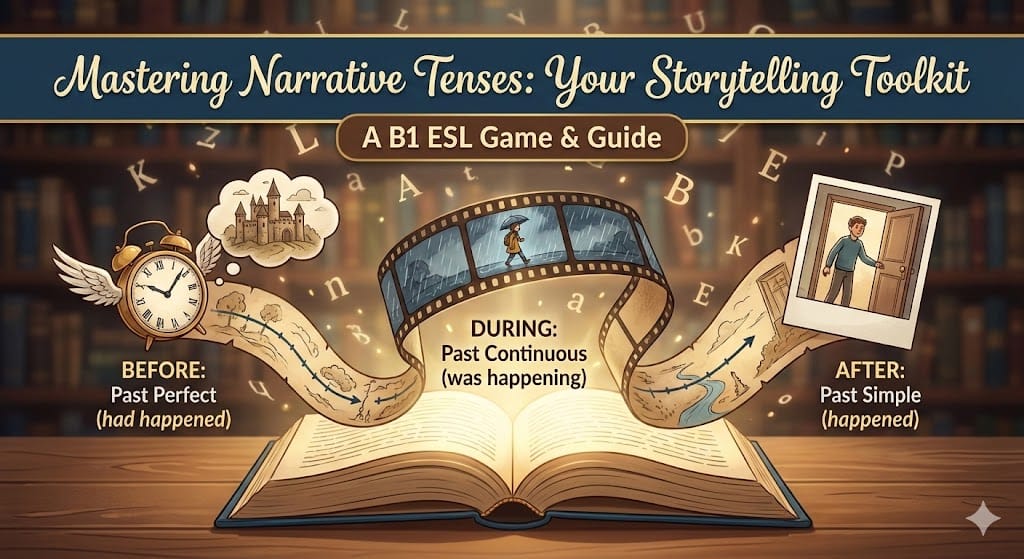
Practice distinguishing between completed past actions, ongoing background activities, and events that happened before a specific time in the past.
[
{
"title": "Narrative Tenses: Past Simple, Continuous & Perfect",
"hint": {
"summary": "Narrative Tenses Guide",
"content": "* **Past Simple**: Completed actions in the past (e.g., *I walked*).\n* **Past Continuous**: Actions in progress at a specific past moment (e.g., *I was walking*).\n* **Past Perfect**: Actions that happened before another past action (e.g., *I had walked*)."
},
"questions": [
{
"type": "multiple-choice",
"question": "When I arrived, they had already ___ dinner.",
"options": ["eaten", "eating", "ate"],
"correctIndex": 0,
"explanation": "Use **Past Perfect** because the action (eating) happened *before* the arrival."
},
{
"type": "multiple-choice",
"question": "It ___ when I woke up this morning so I drove to school.",
"options": ["rained", "was raining", "had rained"],
"correctIndex": 1,
"explanation": "Use **Past Continuous** for a background action in progress at a specific moment."
},
{
"type": "multiple-choice",
"question": "She ___ the door and walked inside.",
"options": ["opened", "was opening", "had opened"],
"correctIndex": 0,
"explanation": "Use **Past Simple** for consecutive completed actions in a story."
},
{
"type": "multiple-choice",
"question": "I ___ the movie before, so I knew the ending.",
"options": ["saw", "was seeing", "had seen"],
"correctIndex": 2,
"explanation": "Use **Past Perfect** because seeing the movie happened *before* the current past timeline."
},
{
"type": "multiple-choice",
"question": "While I ___ for the bus, I saw an accident.",
"options": ["waited", "was waiting", "had waited"],
"correctIndex": 1,
"explanation": "Use **Past Continuous** for an action interrupted by another event."
},
{
"type": "multiple-choice",
"question": "He ___ tired because he had worked all day.",
"options": ["was", "had been", "is"],
"correctIndex": 0,
"explanation": "Use **Past Simple** to describe a state in the past."
},
{
"type": "multiple-choice",
"question": "By the time the police arrived, the thief ___ away.",
"options": ["ran", "was running", "had run"],
"correctIndex": 2,
"explanation": "Use **Past Perfect** for an action completed before another past event (police arriving)."
},
{
"type": "multiple-choice",
"question": "What ___ at 8 PM last night?",
"options": ["did you", "were you doing", "had you done"],
"correctIndex": 1,
"explanation": "Use **Past Continuous** to ask about an activity in progress at a specific time."
},
{
"type": "multiple-choice",
"question": "They ___ to the beach last weekend.",
"options": ["went", "had gone", "were going"],
"correctIndex": 0,
"explanation": "Use **Past Simple** for a finished action at a definite time in the past."
},
{
"type": "multiple-choice",
"question": "She realized she ___ her phone at home.",
"options": ["left", "was leaving", "had left"],
"correctIndex": 2,
"explanation": "Use **Past Perfect** because leaving the phone happened before she realized it."
},
{
"type": "fill-in-the-blank",
"instruction": "Fill in the blank with the correct form:",
"question": "I ___ (study) when the lights went out.",
"answer": ["was studying"],
"explanation": "Use **Past Continuous** for an action in progress interrupted by another event."
},
{
"type": "fill-in-the-blank",
"instruction": "Fill in the blank with the correct form:",
"question": "He ___ (finish, already) his homework before he watched TV.",
"answer": ["had already finished"],
"explanation": "Use **Past Perfect** because finishing homework happened *before* watching TV."
},
{
"type": "fill-in-the-blank",
"instruction": "Fill in the blank with the correct form:",
"question": "We ___ (visit) Paris three years ago.",
"answer": ["visited"],
"explanation": "Use **Past Simple** for a fact or event completed at a specific time."
},
{
"type": "fill-in-the-blank",
"instruction": "Fill in the blank with the correct form:",
"question": "The sun ___ (shine) and the birds were singing.",
"answer": ["was shining"],
"explanation": "Use **Past Continuous** to set the scene or describe background atmosphere."
},
{
"type": "fill-in-the-blank",
"instruction": "Fill in the blank with the correct form:",
"question": "After they ___ (eat), they cleared the table.",
"answer": ["had eaten"],
"explanation": "Use **Past Perfect** to show one action finished before the next began."
},
{
"type": "fill-in-the-blank",
"instruction": "Fill in the blank with the correct form:",
"question": "She ___ (not / see) him for two years.",
"answer": ["had not seen", "hadn't seen"],
"explanation": "Use **Past Perfect** to describe the duration up to a past moment."
},
{
"type": "fill-in-the-blank",
"instruction": "Fill in the blank with the correct form:",
"question": "While Tom was cooking, Mary ___ (set) the table.",
"answer": ["was setting"],
"explanation": "Use **Past Continuous** for two parallel actions happening simultaneously."
},
{
"type": "fill-in-the-blank",
"instruction": "Fill in the blank with the correct form:",
"question": "I ___ (know) him since primary school.",
"answer": ["had known"],
"explanation": "Use **Past Perfect** with stative verbs for a duration up to a past point."
},
{
"type": "fill-in-the-blank",
"instruction": "Fill in the blank with the correct form:",
"question": "He ___ (drop) the vase and it broke.",
"answer": ["dropped"],
"explanation": "Use **Past Simple** for a sudden, completed action."
},
{
"type": "fill-in-the-blank",
"instruction": "Fill in the blank with the correct form:",
"question": "When we got to the station, the train ___ (leave) already.",
"answer": ["had left"],
"explanation": "Use **Past Perfect** because the train left *before* we arrived."
},
{
"type": "scramble",
"sentence": "He had never flown before that trip.",
"explanation": "Subject + had + adverb + past participle."
},
{
"type": "scramble",
"sentence": "I was reading while she was sleeping.",
"explanation": "Parallel actions in the past continuous connected by 'while'."
},
{
"type": "scramble",
"sentence": "Did you go out last night?",
"explanation": "Question form in Past Simple: Did + subject + verb."
},
{
"type": "scramble",
"sentence": "They were walking home when it started.",
"explanation": "Past Continuous interrupted by a Past Simple event."
},
{
"type": "scramble",
"sentence": "She had already left when I called.",
"explanation": "Past Perfect action happening before a Past Simple action."
},
{
"type": "scramble",
"sentence": "We didn't know he had arrived.",
"explanation": "Negative Past Simple followed by Past Perfect."
},
{
"type": "scramble",
"sentence": "What were you doing at noon?",
"explanation": "Wh- question in Past Continuous."
},
{
"type": "scramble",
"sentence": "The film had started by eight o'clock.",
"explanation": "Past Perfect used with a time expression ('by')."
},
{
"type": "scramble",
"sentence": "It happened while I was away.",
"explanation": "Simple Past event happening during a continuous state."
},
{
"type": "scramble",
"sentence": "He was tired because he had run.",
"explanation": "Past Simple state explained by a previous Past Perfect action."
}
]
}
]
The Narrative Tenses
How to Tell a Great Story in English
Have you ever tried to tell a funny story or an exciting memory in English, but felt like you were just listing facts? "I went here. Then I ate this. Then I slept."
To make your stories come alive, you need Narrative Tenses. They allow you to set the scene, talk about interruptions, and explain what happened before the main story began.
Here is your guide to the three main tenses used in storytelling: The Past Simple, Past Continuous, and Past Perfect.
1. The Past Simple: The Main Events
Formula: Subject + Verb (ed / V2)
(e.g., walked, went, saw)
Think of the Past Simple as the plot points of your movie. We use it for completed actions that happen one after another.
Example: "I woke up, put on my coat, and opened the door."
Key Idea: These events move the story forward.
2. The Past Continuous: Setting the Scene
Formula: Subject + was/were + Verb-ing
(e.g., was raining, were sleeping)
Think of this as the background scenery. We use it to describe what was happening around the main action, or an action that was in progress when it was interrupted.
Setting the scene: "The sun was shining and the birds were singing."
The Interruption: "I was walking down the street when I saw my friend."(I was walking = long background action. I saw = short interruption).
3. The Past Perfect
Formula: Subject + had + Past Participle (V3)
(e.g., had eaten, had left, had forgotten)
We use the Past Perfect when we are already talking about the past, but we need to talk about something that happened even earlier.
Example: "When I arrived at the cinema, the movie had already started."
Why use it? If you say "The movie started when I arrived," it means they happened at the same time. If you say "The movie had started," it emphasizes that you were late!
Putting It All Together
The magic happens when you mix them. Look at this example:
"It was raining heavily (Continuous - Background). I ran to the bus station (Simple - Action), but the bus had already left (Perfect - The Flashback/Result)."
Quick Tips for the Game
Look for "When" vs. "While": "While" is usually followed by Past Continuous (While I was cooking...).
Check the order: Did action A happen before action B? If yes, Action A is likely Past Perfect.
Spoken English: In informal spoken English the past simple can often be used instead of the past perfect. For the game, assume the speaker is using formal written English.
Don't overuse the Perfect: If the order is obvious ("I opened the bag and took out a book"), just use Past Simple.