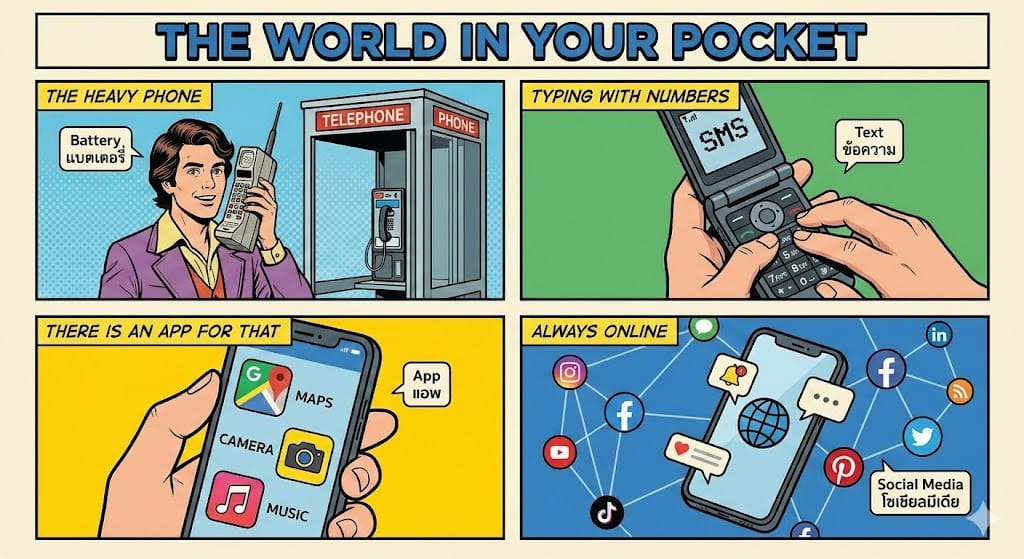
Explore the rapid evolution of technology in this bilingual English-Thai reader. Perfect for A2 learners, 'The World in Your Pocket' builds essential vocabulary through the history of smartphones, from brick phones to the mobile internet.
{
"title": "The World in Your Pocket",
"language": "en",
"subtitle": "An English A2 Chapter Book",
"chapters": [
{
"id": "chapter-1",
"title": "Chapter 1: The Heavy Phone",
"content": [
"In the 1980s, mobile phones were not small. They were very heavy and looked like bricks. You could not put them in your pocket. People usually used phone booths on the street to call friends. A mobile call was very expensive.",
"Businessmen carried these big phones in large bags. The battery only lasted for thirty minutes. It was a different world. Nobody texted because phones only had numbers. We used our voices to communicate. It was the beginning of a big change."
],
"translation": "ในทศวรรษที่ 1980 โทรศัพท์มือถือไม่ได้มีขนาดเล็ก พวกมันหนักมากและดูเหมือนก้อนอิฐ คุณไม่สามารถใส่พวกมันไว้ในกระเป๋าเสื้อหรือกางเกงได้ ผู้คนมักจะใช้ตู้โทรศัพท์ริมถนนเพื่อโทรหาเพื่อน การโทรผ่านมือถือมีราคาแพงมาก นักธุรกิจต้องพกโทรศัพท์เครื่องใหญ่เหล่านี้ในกระเป๋าใบโต แบตเตอรี่ใช้งานได้เพียงสามสิบนาทีเท่านั้น มันเป็นโลกที่แตกต่างไปจากปัจจุบัน ไม่มีใครส่งข้อความเพราะโทรศัพท์มีแค่ปุ่มตัวเลข เราใช้เสียงเพื่อสื่อสารกัน มันเป็นจุดเริ่มต้นของการเปลี่ยนแปลงครั้งใหญ่",
"quiz": [
{
"question": "1. True or False: In the 1980s, mobile phones fit easily in a pocket.",
"options": [
{ "text": "True", "value": "wrong" },
{ "text": "False", "value": "correct" }
]
},
{
"question": "2. How long did the battery usually last?",
"options": [
{ "text": "a) All day", "value": "wrong" },
{ "text": "b) Thirty minutes", "value": "correct" },
{ "text": "c) Five hours", "value": "wrong" }
]
},
{
"question": "3. True or False: Sending text messages was very popular in the 1980s.",
"options": [
{ "text": "True", "value": "wrong" },
{ "text": "False", "value": "correct" }
]
}
]
},
{
"id": "chapter-2",
"title": "Chapter 2: Typing with Numbers",
"content": [
"Later, phones became smaller. We could finally put them in our pockets. A new technology arrived called SMS. This stands for Short Message Service. Typing was difficult. We had to press the number buttons many times to find one letter.",
"To type \"C\", you pressed the number \"2\" three times. Messages were short and simple. We used abbreviations like \"LOL\" or \"CU\" because it was hard to type. People sent messages to say \"Where are you?\" It was slower than talking, but it was fun."
],
"translation": "ต่อมา โทรศัพท์เริ่มมีขนาดเล็กลง ในที่สุดเราก็สามารถใส่มันลงในกระเป๋าเสื้อหรือกางเกงได้ เทคโนโลยีใหม่ที่เรียกว่า SMS ก็มาถึง ซึ่งย่อมาจาก Short Message Service การพิมพ์นั้นยากลำบาก เราต้องกดปุ่มตัวเลขหลายครั้งเพื่อหาตัวอักษรหนึ่งตัว ในการพิมพ์ตัว \"C\" คุณต้องกดเลข \"2\" ถึงสามครั้ง ข้อความจึงสั้นและเรียบง่าย เราใช้คำย่ออย่าง \"LOL\" หรือ \"CU\" เพราะมันพิมพ์ยาก ผู้คนส่งข้อความเพื่อถามว่า \"คุณอยู่ที่ไหน?\" มันช้ากว่าการคุยกัน แต่ก็สนุกดี",
"quiz": [
{
"question": "1. What does SMS stand for?",
"options": [
{ "text": "a) Short Message Service", "value": "correct" },
{ "text": "b) Small Mobile System", "value": "wrong" },
{ "text": "c) Super Music Sound", "value": "wrong" }
]
},
{
"question": "2. True or False: Typing messages on old phones was very easy and fast.",
"options": [
{ "text": "True", "value": "wrong" },
{ "text": "False", "value": "correct" }
]
},
{
"question": "3. Why did people use abbreviations like \"LOL\"?",
"options": [
{ "text": "a) To look cool", "value": "wrong" },
{ "text": "b) Because typing was hard", "value": "correct" },
{ "text": "c) To save money", "value": "wrong" }
]
}
]
},
{
"id": "chapter-3",
"title": "Chapter 3: The Slow Web",
"content": [
"In the early 2000s, we tried to put the internet on phones. It was called WAP. The screens were small and black and white. It was very frustrating. You clicked a button and waited for a long time. Pictures did not load well.",
"Checking sports scores or the weather took minutes. People often gave up and used a computer instead. Data was very expensive. If you pressed the internet button by mistake, you lost money. We dreamed of a fast internet, but it was not ready yet."
],
"translation": "ในช่วงต้นทศวรรษ 2000 เราพยายามนำอินเทอร์เน็ตมาใส่ไว้ในโทรศัพท์ มันเรียกว่า WAP หน้าจอมีขนาดเล็กและเป็นขาวดำ มันน่าหงุดหงิดมาก คุณกดปุ่มแล้วต้องรอนานมาก รูปภาพก็โหลดไม่ค่อยได้ การเช็คผลกีฬาหรือสภาพอากาศใช้เวลาเป็นนาที ผู้คนมักจะยอมแพ้และไปใช้คอมพิวเตอร์แทน ข้อมูลอินเทอร์เน็ต (Data) ก็แพงมาก ถ้าคุณเผลอกดปุ่มอินเทอร์เน็ตโดยไม่ตั้งใจ คุณจะเสียเงิน เราฝันถึงอินเทอร์เน็ตที่รวดเร็ว แต่มันยังไม่พร้อม",
"quiz": [
{
"question": "1. True or False: Early mobile internet was fast and colorful.",
"options": [
{ "text": "True", "value": "wrong" },
{ "text": "False", "value": "correct" }
]
},
{
"question": "2. What happened if you pressed the internet button by mistake?",
"options": [
{ "text": "a) You played a game", "value": "wrong" },
{ "text": "b) You lost money", "value": "correct" },
{ "text": "c) Nothing happened", "value": "wrong" }
]
},
{
"question": "3. What did people often do because the mobile internet was slow?",
"options": [
{ "text": "a) Used a computer instead", "value": "correct" },
{ "text": "b) Bought a new phone", "value": "wrong" },
{ "text": "c) Wrote a letter", "value": "wrong" }
]
}
]
},
{
"id": "chapter-4",
"title": "Chapter 4: No More Buttons",
"content": [
"One day in 2007, everything changed. A famous company showed a new phone. It did not have a plastic keyboard. The front was just a glass screen. You used your fingers to touch icons. Many people were surprised.",
"They asked, \"How do we type without buttons?\" But the screen was smart. It changed to show a keyboard when you needed it. You could zoom into photos with two fingers. The phone looked like a piece of jewelry. The era of the touchscreen had begun."
],
"translation": "วันหนึ่งในปี 2007 ทุกอย่างก็เปลี่ยนไป บริษัทที่มีชื่อเสียงแห่งหนึ่งโชว์โทรศัพท์รุ่นใหม่ มันไม่มีคีย์บอร์ดพลาสติก ด้านหน้าเป็นเพียงหน้าจอกระจก คุณใช้นิ้วสัมผัสไอคอนต่างๆ หลายคนประหลาดใจ พวกเขาถามว่า \"เราจะพิมพ์อย่างไรถ้าไม่มีปุ่ม?\" แต่หน้าจอนั้นฉลาด มันเปลี่ยนเพื่อแสดงคีย์บอร์ดเมื่อคุณต้องการ คุณสามารถซูมดูรูปภาพด้วยสองนิ้ว โทรศัพท์ดูเหมือนเครื่องประดับชิ้นหนึ่ง ยุคของหน้าจอสัมผัสได้เริ่มต้นขึ้นแล้ว",
"quiz": [
{
"question": "1. What was missing from the new phone in 2007?",
"options": [
{ "text": "a) A screen", "value": "wrong" },
{ "text": "b) A plastic keyboard", "value": "correct" },
{ "text": "c) A battery", "value": "wrong" }
]
},
{
"question": "2. True or False: You used a pen to touch the screen.",
"options": [
{ "text": "True", "value": "wrong" },
{ "text": "False", "value": "correct" }
]
},
{
"question": "3. How did people feel when they first saw the phone?",
"options": [
{ "text": "a) Angry", "value": "wrong" },
{ "text": "b) Surprised", "value": "correct" },
{ "text": "c) Bored", "value": "wrong" }
]
}
]
},
{
"id": "chapter-5",
"title": "Chapter 5: There is an App for That",
"content": [
"Suddenly, our phones became more than just phones. Developers created small programs called \"apps.\" There was an app for everything. Do you need a flashlight? There is an app. Do you need a calculator? There is an app.",
"We stopped buying alarm clocks because our phones woke us up. Games became very popular. People played simple games while waiting for the bus. The phone became a toolbox. We carried a computer, a game console, and an assistant in our pockets every day."
],
"translation": "ทันใดนั้น โทรศัพท์ของเราก็กลายเป็นมากกว่าแค่โทรศัพท์ นักพัฒนาสร้างโปรแกรมเล็กๆ ที่เรียกว่า \"แอพ\" มีแอพสำหรับทุกสิ่ง คุณต้องการไฟฉายไหม? มีแอพให้ คุณต้องการเครื่องคิดเลขไหม? ก็มีแอพให้ เราเลิกซื้อนาฬิกาปลุกเพราะโทรศัพท์ปลุกเราตื่น เกมกลายเป็นที่นิยมมาก ผู้คนเล่นเกมง่ายๆ ระหว่างรอรถเมล์ โทรศัพท์กลายเป็นกล่องเครื่องมือ เราพกคอมพิวเตอร์ เครื่องเล่นเกม และผู้ช่วยไว้ในกระเป๋าของเราทุกวัน",
"quiz": [
{
"question": "1. What are the small programs on phones called?",
"options": [
{ "text": "a) Webs", "value": "wrong" },
{ "text": "b) Apps", "value": "correct" },
{ "text": "c) Calls", "value": "wrong" }
]
},
{
"question": "2. True or False: People continued to buy many alarm clocks.",
"options": [
{ "text": "True", "value": "wrong" },
{ "text": "False", "value": "correct" }
]
},
{
"question": "3. What did the phone become like?",
"options": [
{ "text": "a) A brick", "value": "wrong" },
{ "text": "b) A toolbox", "value": "correct" },
{ "text": "c) A shoe", "value": "wrong" }
]
}
]
},
{
"id": "chapter-6",
"title": "Chapter 6: Never Getting Lost",
"content": [
"Before smartphones, we used big paper maps in our cars. It was hard to fold them back up. Then, phones got GPS. Now, you can see a blue dot on a map. The dot shows exactly where you are.",
"You can search for a restaurant or a hotel. The phone speaks to you. It says, \"Turn left in one hundred meters.\" Getting lost became almost impossible. We explore new cities with confidence. We do not need to ask strangers for directions anymore."
],
"translation": "ก่อนที่จะมีสมาร์ทโฟน เราใช้แผนที่กระดาษแผ่นใหญ่ในรถ มันยากที่จะพับเก็บกลับเหมือนเดิม จากนั้นโทรศัพท์ก็มี GPS ตอนนี้คุณสามารถเห็นจุดสีน้ำเงินบนแผนที่ จุดนั้นแสดงตำแหน่งที่คุณอยู่ได้อย่างแม่นยำ คุณสามารถค้นหาร้านอาหารหรือโรงแรม โทรศัพท์พูดกับคุณได้ มันบอกว่า \"เลี้ยวซ้ายในอีกหนึ่งร้อยเมตร\" การหลงทางกลายเป็นเรื่องที่เป็นไปแทบไม่ได้ เราสำรวจเมืองใหม่ๆ ด้วยความมั่นใจ เราไม่จำเป็นต้องถามทางจากคนแปลกหน้าอีกต่อไป",
"quiz": [
{
"question": "1. What shows your location on the digital map?",
"options": [
{ "text": "a) A red star", "value": "wrong" },
{ "text": "b) A blue dot", "value": "correct" },
{ "text": "c) A yellow square", "value": "wrong" }
]
},
{
"question": "2. True or False: Paper maps were easy to fold.",
"options": [
{ "text": "True", "value": "wrong" },
{ "text": "False", "value": "correct" }
]
},
{
"question": "3. What does the phone do to help you drive?",
"options": [
{ "text": "a) It speaks directions", "value": "correct" },
{ "text": "b) It drives the car", "value": "wrong" },
{ "text": "c) It plays loud music", "value": "wrong" }
]
}
]
},
{
"id": "chapter-7",
"title": "Chapter 7: A Camera in Your Pocket",
"content": [
"Old phone cameras took blurry photos. But technology improved quickly. Soon, the phone camera was better than a normal camera. We stopped carrying digital cameras on vacation. We took pictures of our food, our pets, and our friends.",
"A new word became popular: \"selfie.\" This is a photo you take of yourself. People took selfies at famous monuments. We captured every moment of our lives instantly. Photography was no longer just for professionals. It was for everyone, everywhere."
],
"translation": "กล้องโทรศัพท์รุ่นเก่าถ่ายภาพได้เบลอ แต่เทคโนโลยีพัฒนาขึ้นอย่างรวดเร็ว ในไม่ช้า กล้องโทรศัพท์ก็ดีกว่ากล้องปกติ เราเลิกพกกล้องดิจิทัลไปเที่ยว เราถ่ายรูปอาหาร สัตว์เลี้ยง และเพื่อนๆ ของเรา คำศัพท์ใหม่กลายเป็นที่นิยมคือ \"เซลฟี่\" นี่คือรูปที่คุณถ่ายตัวเอง ผู้คนถ่ายเซลฟี่ตามสถานที่ท่องเที่ยวชื่อดัง เราบันทึกทุกช่วงเวลาของชีวิตได้ในทันที การถ่ายภาพไม่ได้มีไว้สำหรับมืออาชีพเท่านั้นอีกต่อไป มันเป็นเรื่องของทุกคน ในทุกๆ ที่",
"quiz": [
{
"question": "1. True or False: Old phone cameras took very clear photos.",
"options": [
{ "text": "True", "value": "wrong" },
{ "text": "False", "value": "correct" }
]
},
{
"question": "2. What is a \"selfie\"?",
"options": [
{ "text": "a) A photo of food", "value": "wrong" },
{ "text": "b) A photo of yourself", "value": "correct" },
{ "text": "c) A photo of a landscape", "value": "wrong" }
]
},
{
"question": "3. Who can take photos now?",
"options": [
{ "text": "a) Only professionals", "value": "wrong" },
{ "text": "b) Everyone", "value": "correct" },
{ "text": "c) Only rich people", "value": "wrong" }
]
}
]
},
{
"id": "chapter-8",
"title": "Chapter 8: Music without CDs",
"content": [
"We used to carry stacks of CDs or small MP3 players. The smartphone changed this too. With fast internet, we do not need to download songs. We \"stream\" music. This means the music comes from the internet while we listen.",
"We have millions of songs in our pocket. We can listen to pop, rock, or jazz at any time. We make playlists for running or studying. The music industry changed completely. We do not own the music, but we can hear it all the time."
],
"translation": "เราเคยพกตั้งแผ่นซีดีหรือเครื่องเล่น MP3 เครื่องเล็กๆ สมาร์ทโฟนเปลี่ยนเรื่องนี้เช่นกัน ด้วยอินเทอร์เน็ตที่รวดเร็ว เราไม่จำเป็นต้องดาวน์โหลดเพลง เรา \"สตรีม\" เพลง ซึ่งหมายความว่าเพลงมาจากอินเทอร์เน็ตในขณะที่เราฟัง เรามีเพลงนับล้านในกระเป๋า เราสามารถฟังเพลงป็อป ร็อค หรือแจ๊สได้ตลอดเวลา เราสร้างเพลย์ลิสต์สำหรับวิ่งหรืออ่านหนังสือ อุตสาหกรรมดนตรีเปลี่ยนไปอย่างสิ้นเชิง เราไม่ได้เป็นเจ้าของเพลง แต่เราสามารถฟังมันได้ตลอดเวลา",
"quiz": [
{
"question": "1. What does \"streaming\" mean?",
"options": [
{ "text": "a) Listening via the internet without downloading", "value": "correct" },
{ "text": "b) Buying a CD", "value": "wrong" },
{ "text": "c) Singing loudly", "value": "wrong" }
]
},
{
"question": "2. True or False: We need to carry CDs to listen to music now.",
"options": [
{ "text": "True", "value": "wrong" },
{ "text": "False", "value": "correct" }
]
},
{
"question": "3. What can you create for running or studying?",
"options": [
{ "text": "a) An album", "value": "wrong" },
{ "text": "b) A playlist", "value": "correct" },
{ "text": "c) A concert", "value": "wrong" }
]
}
]
},
{
"id": "chapter-9",
"title": "Chapter 9: The World of Social Media",
"content": [
"The internet made us social. With smartphones, we check social media many times a day. We see what our friends are doing in other countries. We \"like\" their photos and write comments. News travels very fast.",
"If something happens in the world, we know it in seconds. We share funny videos and interesting articles. However, some people say we look at our screens too much. We sometimes forget to talk to the people sitting next to us at dinner."
],
"translation": "อินเทอร์เน็ตทำให้เราเข้าสังคม ผ่านสมาร์ทโฟน เราเช็คโซเชียลมีเดียวันละหลายครั้ง เราเห็นว่าเพื่อนๆ ของเราทำอะไรอยู่ในต่างประเทศ เรากด \"ไลค์\" รูปภาพของพวกเขาและเขียนคอมเมนต์ ข่าวสารเดินทางไปเร็วมาก หากมีอะไรเกิดขึ้นในโลก เรารู้เรื่องได้ในไม่กี่วินาที เราแชร์วิดีโอตลกๆ และบทความที่น่าสนใจ อย่างไรก็ตาม บางคนบอกว่าเราจ้องหน้าจอมากเกินไป บางครั้งเราลืมที่จะคุยกับคนที่นั่งข้างๆ เราในมื้อเย็น",
"quiz": [
{
"question": "1. How fast does news travel on social media?",
"options": [
{ "text": "a) In seconds", "value": "correct" },
{ "text": "b) In days", "value": "wrong" },
{ "text": "c) In weeks", "value": "wrong" }
]
},
{
"question": "2. What do we do on friends' photos?",
"options": [
{ "text": "a) Delete them", "value": "wrong" },
{ "text": "b) Like and comment", "value": "correct" },
{ "text": "c) Print them", "value": "wrong" }
]
},
{
"question": "3. True or False: Everyone thinks looking at screens all day is good.",
"options": [
{ "text": "True", "value": "wrong" },
{ "text": "False", "value": "correct" }
]
}
]
},
{
"id": "chapter-10",
"title": "Chapter 10: Always Online",
"content": [
"Today, the smartphone is essential. We use it to pay for coffee, call a taxi, and work. When the battery is low, we feel anxious. We look for a charger immediately. The internet is in the air all around us.",
"The world is truly in our pocket. We have instant access to all human knowledge. It is a powerful tool. We must remember to look up at the sky sometimes, but we cannot imagine life without it."
],
"translation": "ทุกวันนี้ สมาร์ทโฟนเป็นสิ่งจำเป็น เราใช้มันจ่ายค่ากาแฟ เรียกแท็กซี่ และทำงาน เมื่อแบตเตอรี่ต่ำ เราจะรู้สึกกังวล เรามองหาที่ชาร์จทันที อินเทอร์เน็ตลอยอยู่ในอากาศรอบตัวเรา โลกทั้งใบอยู่ในกระเป๋าเราจริงๆ เราสามารถเข้าถึงความรู้ทั้งหมดของมนุษยชาติได้ทันที มันเป็นเครื่องมือที่ทรงพลัง เราต้องจำไว้ว่าให้เงยหน้ามองท้องฟ้าบ้าง แต่เราก็นึกภาพชีวิตที่ไม่มีมันไม่ออกเลย",
"quiz": [
{
"question": "1. How do people feel when their battery is low?",
"options": [
{ "text": "a) Happy", "value": "wrong" },
{ "text": "b) Anxious", "value": "correct" },
{ "text": "c) Sleepy", "value": "wrong" }
]
},
{
"question": "2. True or False: The smartphone is used for paying for things like coffee.",
"options": [
{ "text": "True", "value": "correct" },
{ "text": "False", "value": "wrong" }
]
},
{
"question": "3. What should we remember to do sometimes?",
"options": [
{ "text": "a) Look up at the sky", "value": "correct" },
{ "text": "b) Buy more phones", "value": "wrong" },
{ "text": "c) Stop learning", "value": "wrong" }
]
}
]
}
]
}