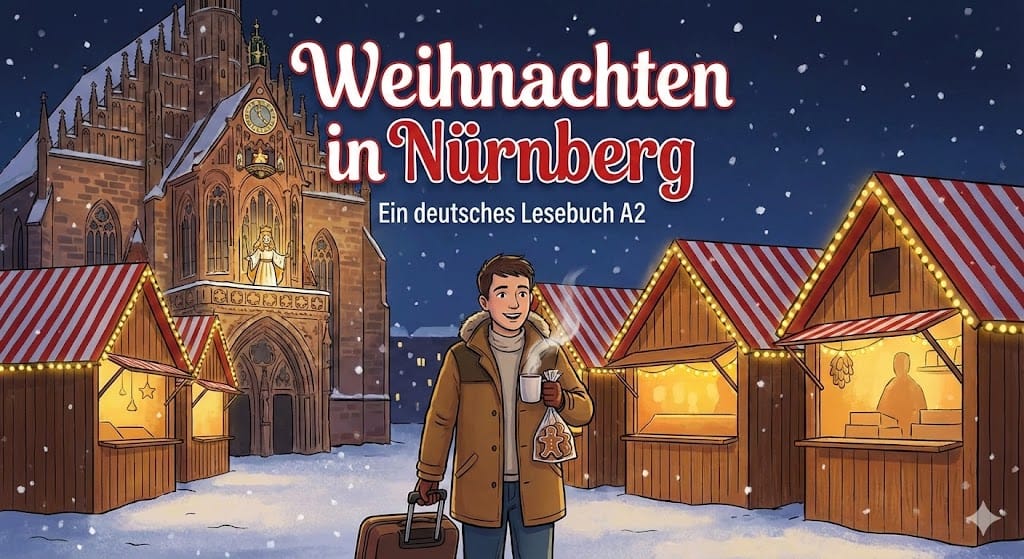
This A2-level chapter book explores Christmas markets, local delicacies, and traditions, helping you master German reading comprehension in a festive context.
{
"title": "Weihnachten in Nürnberg",
"language": "de",
"subtitle": "A German A2 Chapter Book",
"chapters": [
{
"id": "chapter-1",
"title": "Kapitel 1: Ankunft im Schnee",
"content": [
"Markus stieg am Nürnberger Hauptbahnhof aus dem Zug. Die Luft war eiskalt und es begann leicht zu schneien. Er zog seinen dicken Mantel enger, aber er lächelte. Endlich war er in Bayern. Er wollte den berühmten Christkindlesmarkt besuchen.",
"Markus ging durch den unterirdischen Gang zur Altstadt. Als er nach oben kam, sah er die großen, alten Stadtmauern. Der Königstorturm stand majestätisch vor ihm. Die Dächer der Stadt waren schon weiß gepudert. Überall hingen Lichterketten. Markus atmete tief ein. Die Stadt roch schon ein wenig nach Winter und Abenteuer. Sein Hotel lag direkt im Zentrum, nur wenige Minuten zu Fuß entfernt."
],
"translation": "Markus stepped off the train at Nuremberg Central Station. The air was ice-cold and it was starting to snow lightly. He pulled his thick coat tighter, but he smiled. Finally, he was in Bavaria. He wanted to visit the famous Christkindlesmarkt. Markus walked through the underground passage to the Old Town. When he came up, he saw the large, old city walls. The Königstor Tower stood majestically before him. The roofs of the city were already powdered white. Chains of lights hung everywhere. Markus breathed in deeply. The city already smelled a little of winter and adventure. His hotel was located right in the center, only a few minutes away on foot.",
"quiz": [
{
"question": "1. Where does Markus arrive?",
"options": [
{ "text": "a) Munich Airport", "value": "wrong" },
{ "text": "b) Nuremberg Central Station", "value": "correct" },
{ "text": "c) Berlin Bus Terminal", "value": "wrong" }
]
},
{
"question": "2. True or False: It is raining when Markus arrives.",
"options": [
{ "text": "a) True", "value": "wrong" },
{ "text": "b) False", "value": "correct" }
]
},
{
"question": "3. What does Markus see first near the Old Town?",
"options": [
{ "text": "a) The city walls and a tower", "value": "correct" },
{ "text": "b) A modern shopping mall", "value": "wrong" },
{ "text": "c) A river boat", "value": "wrong" }
]
}
]
},
{
"id": "chapter-2",
"title": "Kapitel 2: Der Hauptmarkt",
"content": [
"Nachdem Markus seinen Koffer im Hotel gelassen hatte, ging er zum Hauptmarkt. Es war dunkel, aber der Platz war hell erleuchtet. Hunderte von kleinen Buden mit rot-weißen Stoffdächern standen dort. Das war das „Städtlein aus Holz und Tuch“.",
"Viele Menschen spazierten durch die Gassen zwischen den Buden. Markus hörte Weihnachtsmusik und das Lachen von Kindern. Im Hintergrund sah er die Frauenkirche. Jeden Tag um zwölf Uhr mittags laufen dort die kleinen Figuren an der Uhr, das \"Männleinlaufen\". Aber jetzt war es Abend. Die goldene Farbe der Lichter reflektierte in den Fenstern der Kirche. Es war eine magische Atmosphäre."
],
"translation": "After Markus had left his suitcase at the hotel, he went to the main market square. It was dark, but the square was brightly illuminated. Hundreds of small stalls with red and white fabric roofs stood there. That was the \"little city of wood and cloth.\" Many people strolled through the alleys between the stalls. Markus heard Christmas music and children's laughter. In the background, he saw the Church of Our Lady (Frauenkirche). Every day at twelve noon, the little figures on the clock run there, the \"Männleinlaufen.\" But now it was evening. The golden color of the lights reflected in the church windows. It was a magical atmosphere.",
"quiz": [
{
"question": "1. What color are the roofs of the stalls?",
"options": [
{ "text": "a) Blue and yellow", "value": "wrong" },
{ "text": "b) Red and white", "value": "correct" },
{ "text": "c) Green and gold", "value": "wrong" }
]
},
{
"question": "2. True or False: The market was very dark and scary.",
"options": [
{ "text": "a) True", "value": "wrong" },
{ "text": "b) False", "value": "correct" }
]
},
{
"question": "3. What church stands in the background?",
"options": [
{ "text": "a) St. Lorenz", "value": "wrong" },
{ "text": "b) The Cathedral of Berlin", "value": "wrong" },
{ "text": "c) The Frauenkirche", "value": "correct" }
]
}
]
},
{
"id": "chapter-3",
"title": "Kapitel 3: Das Christkind",
"content": [
"Plötzlich wurden die Leute auf dem Markt ruhig. Alle schauten zum Balkon der Frauenkirche. Markus schaute auch nach oben. Dort stand eine junge Frau in einem goldenen Kleid. Sie hatte lange, blonde Locken und eine große Krone. Das war das Nürnberger Christkind.",
"In Deutschland bringt oft das Christkind die Geschenke, nicht der Weihnachtsmann. Das Mädchen sprach einen feierlichen Prolog. Ihre Stimme war klar und freundlich. Sie lud alle Menschen ein, den Markt zu besuchen. Markus verstand nicht jedes Wort, aber er fühlte die Wärme in ihren Worten. Die Kinder um ihn herum hatten große, glänzende Augen."
],
"translation": "Suddenly, the people at the market became quiet. Everyone looked at the balcony of the Frauenkirche. Markus looked up too. There stood a young woman in a golden dress. She had long, blonde curls and a large crown. That was the Nuremberg Christkind. In Germany, the Christkind often brings the gifts, not Santa Claus. The girl spoke a solemn prologue. Her voice was clear and friendly. She invited all people to visit the market. Markus didn't understand every word, but he felt the warmth in her words. The children around him had big, shining eyes.",
"quiz": [
{
"question": "1. Who appeared on the balcony?",
"options": [
{ "text": "a) Santa Claus", "value": "wrong" },
{ "text": "b) The Mayor", "value": "wrong" },
{ "text": "c) The Christkind", "value": "correct" }
]
},
{
"question": "2. True or False: The Christkind wears a red suit.",
"options": [
{ "text": "a) True", "value": "wrong" },
{ "text": "b) False", "value": "correct" }
]
},
{
"question": "3. What happens to the crowd when the Christkind appears?",
"options": [
{ "text": "a) They become quiet", "value": "correct" },
{ "text": "b) They start dancing", "value": "wrong" },
{ "text": "c) They go home", "value": "wrong" }
]
}
]
},
{
"id": "chapter-4",
"title": "Kapitel 4: Lebkuchen und Gewürze",
"content": [
"Markus bekam Hunger. Ein süßer Duft lag in der Luft. Er folgte seiner Nase zu einer Bäckerei-Bude. Dort lagen große, runde Kekse. „Das sind Original Nürnberger Elisenlebkuchen,“ erklärte die Verkäuferin.",
"Diese Lebkuchen haben fast kein Mehl, aber viele Nüsse, Honig und Gewürze. Markus kaufte eine Dose für seine Familie. Er probierte auch ein frisches Stück. Es schmeckte nach Zimt, Nelken und Mandeln. Der Geschmack war weich und warm. Nürnberg war früher ein Zentrum für den Gewürzhandel, deshalb ist der Lebkuchen hier so besonders. Markus kaufte gleich noch eine zweite Packung."
],
"translation": "Markus got hungry. A sweet scent was in the air. He followed his nose to a bakery stall. Large, round cookies lay there. \"These are original Nuremberg Elisenlebkuchen,\" the saleswoman explained. These gingerbreads have almost no flour, but many nuts, honey, and spices. Markus bought a tin for his family. He also tried a fresh piece. It tasted of cinnamon, cloves, and almonds. The taste was soft and warm. Nuremberg used to be a hub for the spice trade, which is why the gingerbread is so special here. Markus immediately bought a second pack.",
"quiz": [
{
"question": "1. What distinguishes Elisenlebkuchen?",
"options": [
{ "text": "a) They have lots of flour", "value": "wrong" },
{ "text": "b) They have many nuts and little flour", "value": "correct" },
{ "text": "c) They are very salty", "value": "wrong" }
]
},
{
"question": "2. True or False: Markus thinks the gingerbread tastes bad.",
"options": [
{ "text": "a) True", "value": "wrong" },
{ "text": "b) False", "value": "correct" }
]
},
{
"question": "3. Why are spices important to Nuremberg's history?",
"options": [
{ "text": "a) It was a spice trade hub", "value": "correct" },
{ "text": "b) They grow in the city parks", "value": "wrong" },
{ "text": "c) The King loved spicy food", "value": "wrong" }
]
}
]
},
{
"id": "chapter-5",
"title": "Kapitel 5: Die Zwetschgenmännle",
"content": [
"Weiter hinten auf dem Markt sah Markus lustige kleine Figuren. Sie waren nur so groß wie eine Hand. Die Figuren hatten Körper aus getrockneten Pflaumen (Zwetschgen) und Feigen. Sie hießen „Zwetschgenmännle“.",
"Die kleinen Puppen trugen Kleidung aus Stoff. Es gab Figuren als Schornsteinfeger, als Lehrer oder als Musiker. Ein altes Sprichwort sagt: „Hast du einen Zwetschgenmosh' im Haus, geht dir das Geld und Glück nicht aus.“ Markus fand sie sehr charmant. Er suchte lange, bis er einen kleinen Zwetschgenmann mit einer Gitarre fand. Das war das perfekte Souvenir für seinen Bruder, der Musik liebte."
],
"translation": "Further back in the market, Markus saw funny little figures. They were only as big as a hand. The figures had bodies made of dried plums (Zwetschgen) and figs. They were called \"Prune Men\" (Zwetschgenmännle). The little dolls wore clothes made of fabric. There were figures as chimney sweeps, teachers, or musicians. An old saying goes: \"If you have a Prune Man in the house, money and luck won't run out.\" Markus found them very charming. He searched for a long time until he found a little Prune Man with a guitar. That was the perfect souvenir for his brother, who loved music.",
"quiz": [
{
"question": "1. What are Zwetschgenmännle made of?",
"options": [
{ "text": "a) Plastic and metal", "value": "wrong" },
{ "text": "b) Dried plums and figs", "value": "correct" },
{ "text": "c) Chocolate and marzipan", "value": "wrong" }
]
},
{
"question": "2. True or False: The figures are very large.",
"options": [
{ "text": "a) True", "value": "wrong" },
{ "text": "b) False", "value": "correct" }
]
},
{
"question": "3. Why did Markus choose the guitar figure?",
"options": [
{ "text": "a) For his brother who loves music", "value": "correct" },
{ "text": "b) He plays guitar himself", "value": "wrong" },
{ "text": "c) It was the cheapest one", "value": "wrong" }
]
}
]
},
{
"id": "chapter-6",
"title": "Kapitel 6: Drei im Weggla",
"content": [
"Nach den Süßigkeiten brauchte Markus etwas Herzhaftes. In Nürnberg gibt es eine sehr berühmte Spezialität: die Nürnberger Rostbratwurst. Diese Würste sind sehr klein und dünn, nicht wie die großen deutschen Bratwürste.",
"Markus ging zu einem Grillstand. Er bestellte „Drei im Weggla“. Das bedeutet drei kleine Würstchen in einem Brötchen. Der Verkäufer fragte: „Mit Senf?“ Markus nickte. Die Würste waren knusprig und heiß. Er stand an einem Stehtisch und aß sein Abendessen. Um ihn herum aßen Touristen und Einheimische zusammen. Das Essen war einfach, aber unglaublich lecker."
],
"translation": "After the sweets, Markus needed something savory. In Nuremberg, there is a very famous specialty: the Nuremberg roast sausage. These sausages are very small and thin, not like the big German bratwursts. Markus went to a grill stand. He ordered \"Drei im Weggla.\" That means three little sausages in a bun. The vendor asked: \"With mustard?\" Markus nodded. The sausages were crispy and hot. He stood at a standing table and ate his dinner. Around him, tourists and locals ate together. The food was simple, but incredibly delicious.",
"quiz": [
{
"question": "1. What is special about Nuremberg sausages?",
"options": [
{ "text": "a) They are very small and thin", "value": "correct" },
{ "text": "b) They are blue", "value": "wrong" },
{ "text": "c) They are made of fish", "value": "wrong" }
]
},
{
"question": "2. What does \"Drei im Weggla\" mean?",
"options": [
{ "text": "a) Three beers please", "value": "wrong" },
{ "text": "b) Three sausages in a bun", "value": "correct" },
{ "text": "c) Three friends walking", "value": "wrong" }
]
},
{
"question": "3. True or False: Markus ate his sausages with ketchup.",
"options": [
{ "text": "a) True", "value": "wrong" },
{ "text": "b) False", "value": "correct" }
]
}
]
},
{
"id": "chapter-7",
"title": "Kapitel 7: Das Spielzeugmuseum",
"content": [
"Am nächsten Nachmittag wurde es Markus zu kalt draußen. Er beschloss, das Spielzeugmuseum zu besuchen. Nürnberg ist seit dem Mittelalter die „Stadt des Spielzeugs“.",
"Im Museum war es warm und gemütlich. Markus sah altes Spielzeug aus Holz und Blech. Es gab wunderschöne Puppenhäuser aus dem 18. Jahrhundert. Er sah auch Modelleisenbahnen, die durch kleine Landschaften fuhren. Es erinnerte Markus an seine eigene Kindheit. Er lernte, dass viele berühmte Spielzeugfirmen aus dieser Region kommen. Es war eine Reise in die Vergangenheit. Er kaufte eine Postkarte mit einem alten Teddybären darauf."
],
"translation": "The next afternoon, it got too cold outside for Markus. He decided to visit the Toy Museum. Nuremberg has been the \"City of Toys\" since the Middle Ages. Inside the museum, it was warm and cozy. Markus saw old toys made of wood and tin. There were beautiful dollhouses from the 18th century. He also saw model trains driving through small landscapes. It reminded Markus of his own childhood. He learned that many famous toy companies come from this region. It was a journey into the past. He bought a postcard with an old teddy bear on it.",
"quiz": [
{
"question": "1. Why did Markus go to the museum?",
"options": [
{ "text": "a) He was hungry", "value": "wrong" },
{ "text": "b) It was too cold outside", "value": "correct" },
{ "text": "c) He needed to use the restroom", "value": "wrong" }
]
},
{
"question": "2. True or False: Nuremberg is known as the City of Toys.",
"options": [
{ "text": "a) True", "value": "correct" },
{ "text": "b) False", "value": "wrong" }
]
},
{
"question": "3. What did he buy at the museum?",
"options": [
{ "text": "a) A model train", "value": "wrong" },
{ "text": "b) A wooden doll", "value": "wrong" },
{ "text": "c) A postcard", "value": "correct" }
]
}
]
},
{
"id": "chapter-8",
"title": "Kapitel 8: Der Schöne Brunnen",
"content": [
"Zurück auf dem Hauptmarkt ging Markus zum „Schönen Brunnen“. Das ist ein hoher, goldener Brunnen, der wie eine Kirchturmspitze aussieht. Er ist sehr beeindruckend.",
"Ein Reiseführer erklärte einer Gruppe: „Hier gibt es einen goldenen Ring. Wer ihn dreht, hat Glück.“ Markus wartete, bis die Gruppe weg war. Er suchte den nahtlosen goldenen Ring am Gitter. Er fasste den Ring an und drehte ihn. Manche sagen, man muss ihn dreimal drehen. Markus schloss die Augen und wünschte sich etwas. Er hoffte, dass er bald wieder nach Deutschland reisen konnte."
],
"translation": "Back at the main market, Markus went to the \"Beautiful Fountain.\" This is a tall, golden fountain that looks like a church spire. It is very impressive. A tour guide explained to a group: \"There is a golden ring here. Whoever turns it has good luck.\" Markus waited until the group was gone. He looked for the seamless golden ring on the grille. He grabbed the ring and turned it. Some say you have to turn it three times. Markus closed his eyes and made a wish. He hoped that he could travel to Germany again soon.",
"quiz": [
{
"question": "1. What does the Beautiful Fountain look like?",
"options": [
{ "text": "a) A statue of a lion", "value": "wrong" },
{ "text": "b) A church spire", "value": "correct" },
{ "text": "c) A modern glass box", "value": "wrong" }
]
},
{
"question": "2. What happens if you turn the golden ring?",
"options": [
{ "text": "a) It rains", "value": "wrong" },
{ "text": "b) You get good luck", "value": "correct" },
{ "text": "c) The fountain stops water", "value": "wrong" }
]
},
{
"question": "3. True or False: Markus made a wish when he turned the ring.",
"options": [
{ "text": "a) True", "value": "correct" },
{ "text": "b) False", "value": "wrong" }
]
}
]
},
{
"id": "chapter-9",
"title": "Kapitel 9: Heiligabend steht vor der Tür",
"content": [
"Es war der 23. Dezember. Morgen war Heiligabend. In Deutschland feiern die Familien am Abend des 24. Dezember. Sie essen zusammen, singen Lieder und öffnen Geschenke unter dem Weihnachtsbaum.",
"Die Stimmung in der Stadt war aufgeregt. Die Leute kauften die letzten Geschenke. Markus kaufte noch eine Weihnachtskugel aus Glas. Sie war handbemalt und zeigte die Nürnberger Burg. Er setzte sich in ein Café und trank einen Glühwein, um sich aufzuwärmen. Er beobachtete die glücklichen Gesichter der Menschen. Er fühlte sich nicht mehr wie ein Tourist, sondern wie ein Teil der Stadt."
],
"translation": "It was December 23rd. Tomorrow was Christmas Eve. In Germany, families celebrate on the evening of December 24th. They eat together, sing songs, and open gifts under the Christmas tree. The mood in the city was excited. People were buying the last gifts. Markus bought one more Christmas ornament made of glass. It was hand-painted and showed the Nuremberg Castle. He sat down in a café and drank a mulled wine to warm up. He watched the happy faces of the people. He no longer felt like a tourist, but like a part of the city.",
"quiz": [
{
"question": "1. When do Germans celebrate with gifts?",
"options": [
{ "text": "a) Morning of December 25th", "value": "wrong" },
{ "text": "b) Evening of December 24th", "value": "correct" },
{ "text": "c) New Year's Eve", "value": "wrong" }
]
},
{
"question": "2. What did Markus drink to warm up?",
"options": [
{ "text": "a) Cold beer", "value": "wrong" },
{ "text": "b) Mineral water", "value": "wrong" },
{ "text": "c) Glühwein (mulled wine)", "value": "correct" }
]
},
{
"question": "3. True or False: Markus felt lonely and sad.",
"options": [
{ "text": "a) True", "value": "wrong" },
{ "text": "b) False", "value": "correct" }
]
}
]
},
{
"id": "chapter-10",
"title": "Kapitel 10: Abschied mit Herz",
"content": [
"Der Tag der Abreise war da. Markus packte seinen Koffer. Er war schwerer als vorher, wegen der Lebkuchen und Geschenke. Er checkte aus dem Hotel aus und ging ein letztes Mal über den Markt.",
"Der Morgen war ruhig. Die Buden waren noch geschlossen. „Auf Wiedersehen, Nürnberg,“ flüsterte er. Er hatte viel gelernt. Er kannte jetzt den Geschmack von Lebkuchen und die Tradition des Christkinds. Er fühlte die bayerische „Gemütlichkeit“. Markus stieg in den Zug. Als der Zug losfuhr, wusste er: Das war nicht sein letzter Besuch in dieser wunderschönen Stadt."
],
"translation": "The day of departure arrived. Markus packed his suitcase. It was heavier than before, because of the gingerbread and gifts. He checked out of the hotel and walked across the market one last time. The morning was quiet. The stalls were still closed. \"Goodbye, Nuremberg,\" he whispered. He had learned a lot. He now knew the taste of gingerbread and the tradition of the Christkind. He felt the Bavarian \"Gemütlichkeit\" (coziness). Markus boarded the train. As the train pulled away, he knew: This was not his last visit to this beautiful city.",
"quiz": [
{
"question": "1. Why was Markus's suitcase heavier?",
"options": [
{ "text": "a) He packed rocks", "value": "wrong" },
{ "text": "b) Because of gingerbread and gifts", "value": "correct" },
{ "text": "c) It was wet", "value": "wrong" }
]
},
{
"question": "2. What is \"Gemütlichkeit\"?",
"options": [
{ "text": "a) A feeling of coziness and comfort", "value": "correct" },
{ "text": "b) A type of fast car", "value": "wrong" },
{ "text": "c) A scary monster", "value": "wrong" }
]
},
{
"question": "3. True or False: Markus plans to never return.",
"options": [
{ "text": "a) True", "value": "wrong" },
{ "text": "b) False", "value": "correct" }
]
}
]
}
]
}