Pronouns are small words, but they do a lot of heavy lifting in English. They replace nouns (people, places, or things) so we don't have to repeat the same words over and over again.
1. Subject Pronouns: The Star of the Sentence
Every sentence needs a subject—the person or thing performing the action. When you want to replace the name of the "doer," you use a subject pronoun.
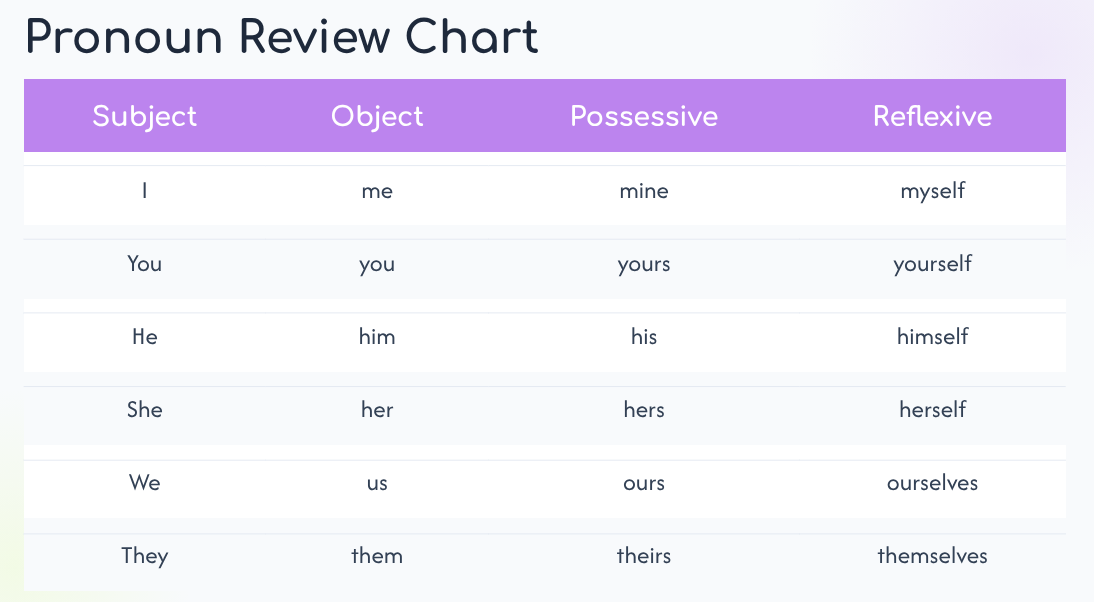
Common Subject Pronouns:I, You, He, She, It, We, They
Instead of saying: "Maria is studying. Maria has a test," we use a subject pronoun to sound more natural:
"Maria is studying. She has a test."
"We are going to the park."
"They play football every weekend."
2. Object Pronouns: The Action Receiver
If the subject is throwing a ball, the object is catching it. Object pronouns receive the action in a sentence. They usually come after the verb or after a preposition (like to, for, with).
Common Object Pronouns:Me, You, Him, Her, It, Us, Them
Notice how the pronoun changes when a person goes from being the doer to the receiver:
"Please give the book to me." (Not: Please give the book to I.)
When you want to talk about who owns something, you use possessives. There are two ways to do this, and it depends on where the word sits in the sentence.
Possessive Adjectives always sit right before the noun they own (My, Your, His, Her, Its, Our, Their).
Possessive Pronouns stand alone and replace the noun entirely (Mine, Yours, His, Hers, Ours, Theirs).
Possessive Adjective: "This is your pen." (Comes before "pen")
Possessive Pronoun: "This pen is yours." (Stands alone)
"That car is not mine."
4. Reflexive Pronouns: Looking in the Mirror
Reflexive pronouns are used when the subject and the object of the sentence are exactly the same person. It is like looking in a mirror! We also use them to emphasize that someone did something completely on their own.
Common Reflexive Pronouns:Myself, Yourself, Himself, Herself, Itself, Ourselves, Yourselves, Themselves
"He made dinner all by himself." (He did it alone.)
"Be careful, you might cut yourself!" (The person doing the cutting and receiving the cut is the same.)
[
{
"title": "M.1 Pronoun Practice: Subject, Object, Possessive, and Reflexive",
"questions": [
{
"category": "Subject Pronoun",
"question": "My brother loves reading. ___ goes to the library every day.",
"options": ["He", "She", "It", "They"],
"answer": "He",
"explanation": "'He' is the correct subject pronoun used to replace 'my brother'."
},
{
"category": "Subject Pronoun",
"question": "Sarah and I are going to the park. ___ want to play football.",
"options": ["They", "We", "Us", "I"],
"answer": "We",
"explanation": "'We' replaces 'Sarah and I' as the subject of the sentence."
},
{
"category": "Subject Pronoun",
"question": "The dog is very tired. ___ is sleeping under the tree.",
"options": ["He", "She", "It", "They"],
"answer": "It",
"explanation": "'It' is used for animals when their specific gender is not mentioned."
},
{
"category": "Subject Pronoun",
"question": "Lisa and Tom are running fast. ___ are in a race.",
"options": ["We", "You", "They", "It"],
"answer": "They",
"explanation": "'They' replaces plural subjects like 'Lisa and Tom'."
},
{
"category": "Subject Pronoun",
"question": "Excuse me, are ___ the new English teacher?",
"options": ["you", "they", "we", "he"],
"answer": "you",
"explanation": "'You' is the subject pronoun used when talking directly to someone."
},
{
"category": "Object Pronoun",
"question": "I can't find my keys. Can you help ___ look for them?",
"options": ["my", "I", "me", "mine"],
"answer": "me",
"explanation": "'Me' is the object pronoun because you are receiving the help."
},
{
"category": "Object Pronoun",
"question": "That is John's jacket. Please give it to ___.",
"options": ["him", "his", "he", "himself"],
"answer": "him",
"explanation": "'Him' is the object pronoun replacing 'John'."
},
{
"category": "Object Pronoun",
"question": "We are going to the cinema. Do you want to come with ___?",
"options": ["we", "us", "our", "ours"],
"answer": "us",
"explanation": "'Us' is the object pronoun used instead of 'we'."
},
{
"category": "Object Pronoun",
"question": "My sister is crying. I will go talk to ___.",
"options": ["she", "hers", "her", "herself"],
"answer": "her",
"explanation": "'Her' is the object pronoun used for female subjects like 'my sister'."
},
{
"category": "Object Pronoun",
"question": "The apples look delicious. I want to eat ___.",
"options": ["they", "their", "them", "it"],
"answer": "them",
"explanation": "'Them' is the plural object pronoun replacing 'apples'."
},
{
"category": "Possessive Pronoun",
"question": "This is not my pen. I think it is ___.",
"options": ["your", "yours", "you", "yourself"],
"answer": "yours",
"explanation": "'Yours' is a possessive pronoun meaning 'your pen'."
},
{
"category": "Possessive Pronoun",
"question": "We bought a new car. The car is ___.",
"options": ["our", "ours", "us", "we"],
"answer": "ours",
"explanation": "'Ours' shows that the car belongs to 'us'."
},
{
"category": "Possessive Adjective",
"question": "I left ___ backpack at home today.",
"options": ["me", "mine", "my", "I"],
"answer": "my",
"explanation": "'My' is a possessive adjective used before the noun 'backpack'."
},
{
"category": "Possessive Adjective",
"question": "They have a big house. ___ house is very beautiful.",
"options": ["Their", "Theirs", "They", "Them"],
"answer": "Their",
"explanation": "'Their' is used before the noun 'house' to show it belongs to them."
},
{
"category": "Possessive Adjective",
"question": "The cat is eating ___ food.",
"options": ["it", "its", "itself", "it's"],
"answer": "its",
"explanation": "'Its' is the possessive adjective for animals or things, written without an apostrophe."
},
{
"category": "Reflexive Pronoun",
"question": "She cut ___ while cooking dinner.",
"options": ["her", "hers", "herself", "she"],
"answer": "herself",
"explanation": "'Herself' is a reflexive pronoun that matches the subject 'She'."
},
{
"category": "Reflexive Pronoun",
"question": "Did you make this cake all by ___?",
"options": ["you", "your", "yours", "yourself"],
"answer": "yourself",
"explanation": "When asking directly, 'yourself' means doing the action without any help."
},
{
"category": "Reflexive Pronoun",
"question": "They cleaned the whole classroom by ___.",
"options": ["them", "their", "themselves", "theirs"],
"answer": "themselves",
"explanation": "'Themselves' is the reflexive pronoun for 'They'."
},
{
"category": "Reflexive Pronoun",
"question": "I learned how to play the piano by ___.",
"options": ["me", "my", "myself", "mine"],
"answer": "myself",
"explanation": "'Myself' shows you did the action alone, matching the subject 'I'."
},
{
"category": "Reflexive Pronoun",
"question": "He painted the entire wall by ___.",
"options": ["his", "him", "himself", "he"],
"answer": "himself",
"explanation": "'Himself' matches the subject 'He' to show he did it entirely alone."
},
{
"category": "Possessive Pronoun",
"question": "That book belongs to Maria. It is ___.",
"options": ["her", "hers", "she", "herself"],
"answer": "hers",
"explanation": "'Hers' replaces 'her book' to show possession."
},
{
"category": "Object Pronoun",
"question": "The teacher asked a question, but I didn't hear ___.",
"options": ["him", "his", "he", "himself"],
"answer": "him",
"explanation": "'Him' is the object pronoun replacing 'the teacher'."
},
{
"category": "Reflexive Pronoun",
"question": "We built the treehouse all by ___.",
"options": ["us", "our", "ourselves", "ours"],
"answer": "ourselves",
"explanation": "'Ourselves' matches 'we' when doing something independently."
},
{
"category": "Possessive Adjective",
"question": "The students must bring ___ own pencils to the test.",
"options": ["they", "them", "their", "theirs"],
"answer": "their",
"explanation": "'Their' is a possessive adjective placed before the noun phrase 'own pencils'."
},
{
"category": "Subject Pronoun",
"question": "___ is raining very heavily outside.",
"options": ["It", "He", "They", "She"],
"answer": "It",
"explanation": "'It' is the standard subject pronoun used for the weather."
}
]
}
]