[
{
"title": "Modal Verbs: Uses of CAN",
"hint": {
"summary": "Possibility vs. Permission vs. Ability",
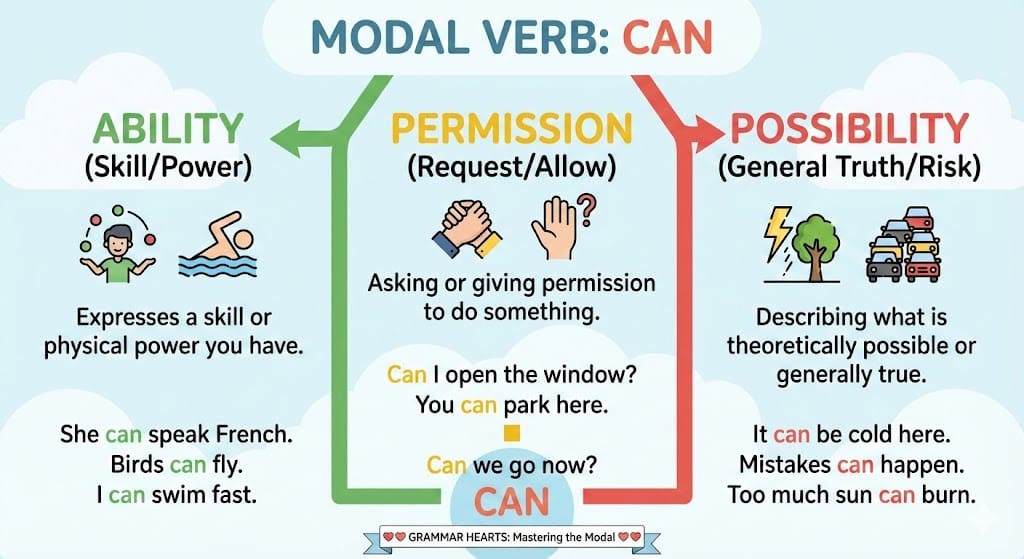
"content": "The word **CAN** has three main uses:\n\n* **Possibility**: Something is generally possible or true (e.g., *It can be cold here.*)\n* **Ability**: A skill or physical power (e.g., *Birds can fly.*)\n* **Permission**: Asking or allowing someone to do something (e.g., *Can I go?*)"
},
"questions": [
{
"type": "multiple-choice",
"question": "Choose the correct usage: 'It can be very dangerous to drive at night.'",
"options": ["Possibility", "Permission", "Ability"],
"correctIndex": 0,
"explanation": "This describes a general **possibility** or truth, not a specific skill or permission."
},
{
"type": "multiple-choice",
"question": "Choose the correct usage: 'Can I open the window, please?'",
"options": ["Possibility", "Ability", "Permission"],
"correctIndex": 2,
"explanation": "The speaker is asking for **permission** to do something."
},
{
"type": "multiple-choice",
"question": "Choose the correct usage: 'She can speak three languages fluently.'",
"options": ["Permission", "Ability", "Possibility"],
"correctIndex": 1,
"explanation": "This describes a skill or **ability** that she possesses."
},
{
"type": "multiple-choice",
"question": "Which sentence shows **Possibility**?",
"options": ["I can swim fast.", "This puzzle can be tricky.", "You can go home now."],
"correctIndex": 1,
"explanation": "'This puzzle can be tricky' describes a quality the puzzle generally has (**Possibility**)."
},
{
"type": "multiple-choice",
"question": "Which sentence shows **Permission**?",
"options": ["Can I use your pen?", "Cats can see in the dark.", "It can rain a lot in April."],
"correctIndex": 0,
"explanation": "Asking to use a pen is a request for **permission**."
},
{
"type": "multiple-choice",
"question": "Select the correct form: 'Traffic ___ bad in the city center.'",
"options": ["can to be", "can be", "cans be"],
"correctIndex": 1,
"explanation": "After **can**, use the base verb (infinitive without 'to'). Use 'can be' for possibility."
},
{
"type": "multiple-choice",
"question": "Select the correct meaning: 'Anyone can make a mistake.'",
"options": ["It is generally possible for people to make mistakes.", "People have permission to make mistakes.", "People are skilled at making mistakes."],
"correctIndex": 0,
"explanation": "This refers to the general **possibility** that mistakes happen to everyone."
},
{
"type": "multiple-choice",
"question": "Which sentence is grammatically correct?",
"options": ["He can sings well.", "He can to sing well.", "He can sing well."],
"correctIndex": 2,
"explanation": "Never add 's' or 'to' after **can**. Use the base form."
},
{
"type": "multiple-choice",
"question": "Choose the correct usage: 'Can you see the ocean from here?'",
"options": ["Permission", "Ability / Possibility", "Obligation"],
"correctIndex": 1,
"explanation": "This asks about the physical **ability** or **possibility** of seeing the ocean."
},
{
"type": "multiple-choice",
"question": "Choose the correct usage: 'You can park your car here.'",
"options": ["Permission", "Ability", "Possibility"],
"correctIndex": 0,
"explanation": "This is giving someone **permission** to park."
},
{
"type": "fill-in-the-blank",
"instruction": "Complete the sentence with one word:",
"question": "Learning a new language ___ be difficult.",
"answer": ["can"],
"explanation": "Use **can** to express general **possibility**."
},
{
"type": "fill-in-the-blank",
"instruction": "Type the modal verb:",
"question": "___ I have a glass of water, please?",
"answer": ["Can", "can"],
"explanation": "Use **Can** to ask for **permission** or make a request."
},
{
"type": "fill-in-the-blank",
"instruction": "Complete the sentence:",
"question": "Temperatures in the desert ___ drop quickly at night.",
"answer": ["can"],
"explanation": "Use **can** for things that are theoretically **possible**."
},
{
"type": "fill-in-the-blank",
"instruction": "Fill in the verb:",
"question": "This game can ___ fun for the whole family. (is/are verb)",
"answer": ["be"],
"explanation": "After 'can', we use the base verb. In this case, 'be' (e.g., *can be*)."
},
{
"type": "fill-in-the-blank",
"instruction": "Complete the sentence:",
"question": "Penguins ___ swim, but they can't fly.",
"answer": ["can", "Can"],
"explanation": "Use **can** to describe an **ability**."
},
{
"type": "fill-in-the-blank",
"instruction": "Complete the warning:",
"question": "Smoking ___ cause serious health problems.",
"answer": ["can"],
"explanation": "Use **can** to express a strong **possibility** or risk."
},
{
"type": "fill-in-the-blank",
"instruction": "Fill in the blank:",
"question": "You ___ take photos in this museum. (It is not permitted)",
"answer": ["can't", "cannot"],
"explanation": "We use **can't or cannot** (with not) to deny **permission**."
},
{
"type": "fill-in-the-blank",
"instruction": "Complete the sentence:",
"question": "It can ___ a long time to get there by bus. (to take)",
"answer": ["take"],
"explanation": "We use the base verb with no S after can."
},
{
"type": "fill-in-the-blank",
"instruction": "Complete the sentence:",
"question": "___ you help me lift this box?",
"answer": ["Can", "can"],
"explanation": "Use **Can** to ask about **ability** or make a request."
},
{
"type": "fill-in-the-blank",
"instruction": "Complete the sentence:",
"question": "Eating out in London ___ be very expensive.",
"answer": ["can"],
"explanation": "Use **can** for general **possibility**."
},
{
"type": "scramble",
"sentence": "It can be cold in winter.",
"explanation": "Subject + can + base verb. This expresses **possibility**."
},
{
"type": "scramble",
"sentence": "Can I open the door?",
"explanation": "Can + Subject + Verb? This is asking for **permission**."
},
{
"type": "scramble",
"sentence": "He can run very fast.",
"explanation": "Subject + can + verb. This expresses **ability**."
},
{
"type": "scramble",
"sentence": "Fast food can be unhealthy.",
"explanation": "Subject + can + base verb. This expresses a general **possibility**."
},
{
"type": "scramble",
"sentence": "You can leave early today.",
"explanation": "Subject + can + verb. This gives **permission**."
},
{
"type": "scramble",
"sentence": "Fireworks can be very loud.",
"explanation": "Subject + can + base verb (be). This expresses **possibility**."
},
{
"type": "scramble",
"sentence": "Can you speak Japanese?",
"explanation": "Can + Subject + Verb? This asks about **ability**."
},
{
"type": "scramble",
"sentence": "Too much sun can burn you.",
"explanation": "Subject + can + verb. This expresses a negative **possibility**."
},
{
"type": "scramble",
"sentence": "Anyone can learn to cook.",
"explanation": "Subject + can + verb. This expresses general **possibility** or potential."
},
{
"type": "scramble",
"sentence": "Can I sit here?",
"explanation": "Can + Subject + Verb? This asks for **permission**."
}
]
}
]
3 Ways to Use "Can"
The verb Can is one of the most useful words in English. It is a modal verb, which means it never changes form (no "s" at the end!) and is always followed by a verb in the base form.
Here are the three most common ways we use it.
1. Ability (Physical skills or knowledge)
We use can to say that we know how to do something, or we are physically able to do it.
Positive (+): I can speak English. / Birds can fly.
Negative (-): She can't cook very well. / Fish can't walk.
Question (?):Can you swim? / Can they play the piano?
2. Permission (Is it allowed?)
We use can to ask if we are allowed to do something, or to tell someone what the rules are.
Positive (+): Students can use dictionaries during the exam. (It is allowed).
Negative (-): You can't park here. (It is against the rules).
Question (?):Can I go to the bathroom, please? / Can we sit here?
3. Possibility (General truths)
We use can to talk about things that are generally possible. This means it happens sometimes, but not always. It expresses a theoretical possibility.
Positive (+): It can be very cold in London in the winter. (It is possible).
Negative (-): It can't be true! (I don't believe it is possible).
Question (?):Can fireworks be dangerous? (Yes, they can be).
Note: For specific predictions about the future (like the weather tomorrow), we usually use might or will, not can.
Correct: It might rain tomorrow. Incorrect: It can rain tomorrow.